



by Nadine Whitney
Of the three women-directed films playing at the festival, two are debuts: Stephanie Zari’s Zebra Girl and Elise Finnerty’s The Ones You Didn’t Burn. The third film Follow Her, although not the first by director Sylvia Caminer is her first foray into fiction.
What the films all have in common is their unique use of limited budgets to create atmospheric, disturbing, and sometimes droll works.
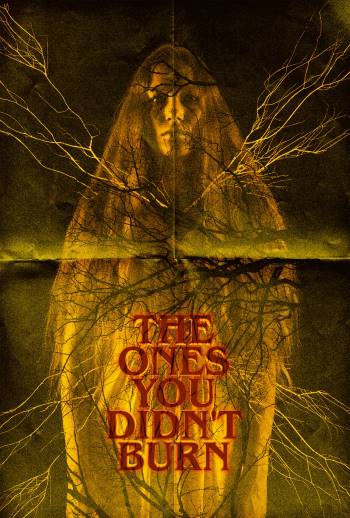 Festival standout is writer/director Elise Finnerty’s tale of witchy revenge, The Ones You Didn’t Burn.
The film opens with unemployed ex-addict Nathan (Nathan Wallace) receiving news that his estranged father has committed suicide after leaving him increasingly paranoid messages about the original owners of his upstate New York farm and how “They never forget” how the farm came into the ownership of his family.
Nathan and his sister Mirra (Jenna Sander) reunite on the property to go through their father’s belongings and settle on selling the farm. The siblings have a difficult relationship due to Nathan’s history of substance abuse and the lingering trauma of living with their father who had many demons of his own. Mirra has a successful career in the city while Nathan floats aimlessly doing his best to maintain sobriety. Neither want the farm.
The siblings are introduced to two women who have been working on the farm, Alice (Elise Finney) and her sister Scarlett (Estelle Girard Parks). It doesn’t take long for the audience to be clued into the fact that the sisters have something more going on than worrying about potential unemployment when the farm sells.
It’s not long before Nathan is seduced back into his addictive behaviour by local douchebag Greg (Samuel Dunning), a misogynistic half-wit whose influence over Nathan proves that Nathan himself has little in the manner of redeeming features. A different kind of seduction is going on with Mirra. Alice and Scarlett uncover the harmony of living on the farm, a form of sacred bond between nature and woman. Mirra realises her life in the city has been one of loneliness and decides that living on the farm with the two sisters is a more fulfilling path for her.
The title of The Ones You Didn’t Burn implies it is a narrative about witches. The farm was once owned by a group of women from Massachusetts but was stolen by Nathan’s forebears through proclaiming the women witches and dispatching them via hangings, drownings, and burnings. Finnerty’s lens is distinctly feminist, but the idea of dispossession of marginalised people through the violent actions of white men also resonates.
As Nathan’s mental health deteriorates through increased drug and alcohol abuse, he becomes violently paranoid trying to piece together his father’s demise. He also has haunted dreams (sometimes waking) that taunt him with the same fate of his father. A succubus from the sea becomes a recurring nightmare. As Nathan’s grip on reality loosens, so too does his veneer of civility. He turns to gendered violence with an all-too-common cry of “Look what you made me do.”
Elise Finnerty’s folk horror tale is taut and effective. It’s a slow burn that never drags and is gloriously shot. Finnerty’s performance as the elusive Alice is a highlight. Although the audience is never fully given a resolution as to whether Alice and Scarlett are ageless witches, Finnerty’s thesis is that it doesn’t really matter. Nathan is one in a long line of men who choose violence and destruction when confronted with women who demand self-actualisation. Nathan says he “feels a lot of guilt,” but when it comes to the crunch, his guilt is secondary to maintaining patriarchal control.
 Trauma and mental health are at the centre of Stephanie Zari’s horror/crime thriller Zebra Girl. Adapted from a play by Derek Ahonen with a screenplay by Ahonen, Zari, and the film’s star Sarah Roy, Zebra Girl wastes nothing getting straight to the gore but takes its time in telling why the events happen.
Pastel wearing wife, Catherine (Sarah Roy) has murdered her well-to-do academic husband Dan (Tom Cullen) by lodging a knife into the side of his head while he was at his computer late at night. She calls her childhood friend and ex-lover Anita (Jade Anouka) to assist with the clean up, which will entail the dismemberment and burning of the body. Catherine and Dan had been married for five years and in that time Catherine made no effort to reach out to Anita, which is a point of soreness. After an initial freak out about the fact that she’s dealing with a corpse, Anita goes along with Catherine’s plan to dispose of the body (specifically using a pastel pink hacksaw). Why did Catherine kill her husband? He had an online porn addiction, which undermined her trust in his “good guy” nature.
A porn addiction may not seem like much of a motivation for murder, but as the film goes on, we become aware that Catherine has little reason to trust people in general. Zari weaves a series of flashbacks, so we get to know Catherine and what has led her to destroy her seemingly perfect life in an idyllic country mansion.
What begins as a darkly comic piece soon peels back layers to show the true horror of Catherine’s life. A victim of child sexual abuse by her father, fifteen-year-old Catherine murdered him in the same manner that she did her husband and ended up in a psychiatric institution for over a decade. At some point, her mind cracked and her coping methods included writing a superhero story called ‘Zebra Girl’ where the heroine was able to devour her enemies.
On release from the hospital, where she was given massive doses of Risperdal to control her psychotic tendencies, she meets the extremely charming Dan and divulges her history to him on their first date. Despite her past, Dan is taken with Catherine, and they marry and move out to the country. Catherine finds out Dan’s dirty little secret is a penchant for porn and insists that he gets help to overcome it, which he does. They want a family and when Catherine falls pregnant, she has to decide whether to continue taking her anti-psychotics and risk foetal damage or transfer to a less harmful drug to aid her mental health.
Unfortunately, Zari’s film is tonally discordant. While there are admirable set pieces, especially involving the interrogation of young Catherine (played brilliantly by Isabelle Connolly). The hazy flashbacks to Catherine’s youth are well executed, and the production design is gorgeous. Too much of the film telegraphs what will ultimately happen. The twist ending is no twist at all for anyone paying vague attention to the narrative.
Ultimately, Zebra Girl does have some pertinent themes but is hampered by a messy narrative that begs more questions than it answers. Despite its failings, the film manages to be generally engaging if eventually dubious.
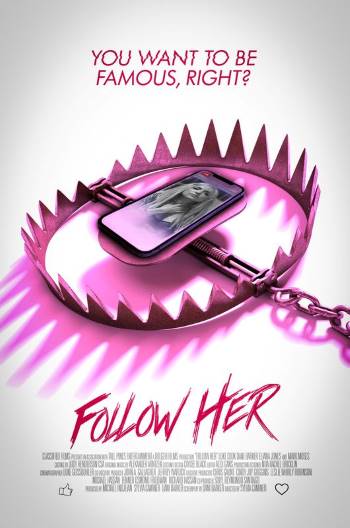 Social media horror/thrillers seem to be a dime a dozen and for good reason – for many people, it’s how they interact with the wider world. Some are incisive and fun such as Tragedy Girls and Bodies Bodies Bodies, others are dodgy exploitation like Dashcam and arguably Spree. Some manage to hit the sweet spot between satire, social discourse, and providing decent scares; Sylvia Caminer’s Follow Her does that and a little bit more.
Written by Dani Baker who also stars, Follow Her is delightfully meta and self-aware. The film follows the exploits of Jess Peters, a spoiled 27-year-old struggling actress. To make ends meet while she awaits her big break, she takes on jobs she finds in the classifieds meeting up with men who have particular fetishes.
However, that’s not her only reason for meeting up with the men – Jess AKA J_PEEPS runs a channel called “Classified Crazies” on a social media platform called Live Hive where she uploads videos of her encounters with the men who she has filmed without their consent or knowledge. Hoping for clicks that will monetise her channel, she’s cavalier about whose privacy she invades.
When one of her meetings with a guy, Bryan (Justin L. Wilson), whose fetish is tickling accidentally, shows an unobscured shot of his face, she is faced with the dilemma of taking the video down which has gone viral or keeping it up and hopefully cracking the top 10 of Live Hive. Jess opts for the latter.
Her disapproving lawyer father has informed her that he will be selling the well-appointed NYC apartment that she’s been living in and that he believes it’s about time she gets a real job. Jess argues with him that she can’t possibly afford to live in NYC and follow her dream without free accommodation. The audience sees Jess for what she is, a shallow grifter who may indeed have some talent (she’s great at playing the roles necessary for her channel) but is more concerned with finding shortcuts to success.
For her next “Classified Crazies” episode, she agrees to meet with a man who is writing an erotic thriller in the vein of Hitchcock. He has specified that he’s only interested in working with girls (hence the “Classified Crazies” angle). The meeting is set for upstate New York and she asks her friend and fellow Live Hiver, Kai (Eliana Jones) to accompany her because she “might get killed, or something.” On the day in question, Kai flakes on her but as there is the promise of $100 for just turning up to the meeting with an extra $1500 promised for the job itself, she decides it’s an opportunity she can’t pass up.
Jess adopts the persona Lucy Byers for the meeting. She is surprised when the man who placed the ad turns out to be a handsome and flirtatious Australian (Luke Cook), ironically named Tom Brady. Despite being in the middle of nowhere with spotty cell coverage, Jess agrees to go back to Tom’s house and start work on the screenplay immediately. She does take a little coaxing, including the promise of more cash, but her attraction to Tom overrides her better judgement.
On the long walk to Tom’s abode, he and ‘Lucy’ start to bond over their shared love of film. The chemistry between them is palpable and although Jess is playing a role, she seems to be more honest with him than she has been with anyone for a long time. The flirty interplay continues when they reach Tom’s house which is a converted barn. The two dance around each other as Jess starts to notice small aspects of the place that seem dubious. What is even more dubious is that the screenplay that Tom wants her to read is called “Classified Killer” and is three pages detailing their day so far with a main character called Jess. Tom tells her they need to role play the script to work out the ending. Will Jess be the victim or final girl?
Shit starts to get real as Tom alternates between terrorising and seducing Jess. She thinks she has a safety net of sorts as she is filming the events, but it appears the pair both know something the other does not. The cat and mouse game between the two is thrilling and knowing, deliberately leaning into genre tropes to ramp up the tension. Soon, both Jess and Tom (who has dropped his Australian accent) are no longer playing, as Tom literally and figuratively strips Jess of her identity (as well as her clothing, hair extensions, and false eyelashes). The reveal of what is really going on is a brilliant piece of plotting that pays off all the berserk energy that the actors have put into it.
Because Follow Her embraces its meta-fiction set-up, Jess eventually escapes the cabin after an extremely public humiliation. Four weeks later, back in NYC, she’s trying to find a legal recourse to punish Tom for what he did to her. The police are distinctly unsympathetic as Tom didn’t commit a prosecutable crime because he let her leave the barn and Jess ostensibly gave her permission to him for what transpired there. Plus, of course, there is the issue that Jess herself has no ethical leg to stand on, as she is well known for entrapping people and filming them without permission.
Baker and Caminer relish in Jess’ unlikeable protagonist status. Jess is an avatar for vacuous content creators who have little care about who they exploit for clicks. There has been much in the media recently about TikTok creators who manufacture scenes of “stranger kindness” or manipulated conflict to drive up engagement. The final twist is so delicious and perfectly pitched that one wonders if somewhere, someone, is considering making it a reality.
Follow Her isn’t a traditional horror film but it plays cannily with the genre to deliver a dark comedy that is also a pointed rebuke at people who spend their lives curating a personality for consumption. Caminer’s women-led fictional debut is rich and belies its small budget by delivering a titanic and satisfying cinema experience. Follow Her has its thrills and chills and is sharper than any slasher’s knife. Like, follow, and subscribe for one of best films of its ilk.
A Night of Horror International Film Festival is on October 17 – 23, 2022

