




by James Mottram
“I’m not naturally a singer or musician,” says Rami Malek. “Truly, I’m not a musical person, so it takes a hell of a lot of work.” This may come as a surprise to most. Malek famously won an Oscar for portraying the flamboyant Queen lead singer Freddie Mercury in the mega-hit Bohemian Rhapsody. Now he’s back in The Man I Love, a very different sort of musical movie, but one that shows just how skilled he is with a microphone and a guitar.
Set in New York in the late 1980s, the ‘man’ in question is Malek’s Jimmy George, an off-off-Broadway performer living with AIDS. Fresh out of hospital after a bout of pneumonia, Jimmy is staging a performance piece inspired by the obscure 1974 French Canadian film Il Etait un Fois Dans L’Est [Once Upon a Time in the East], based on a collection of plays by Michel Tremblay and set around a Montreal drag club. For Jimmy, it may well be the final role of his career.
The film is directed and co-scripted by Ira Sachs, who previously explored the queer New York community with Peter Hujar’s Day, a sideways look at 24 hours in the life of the acclaimed photographer. Hujar died of AIDS-related pneumonia in 1987, the year before the Tennessee-born Sachs moved to New York. A year later, he was working as an assistant on Longtime Companion, a film about a group of New Yorkers living and dying with AIDS.
Sachs, now 60, remembers the era vividly. “I was involved as an activist, as a young person, in ACT UP – AIDS Coalition to Unleash Power – which was a group of people in the late ’80s who came together and said ‘The government’s doing nothing. What can we do?’ And we were in the streets and we were getting arrested, but we were also going out at night and we were hooking up and drinking a lot – it was an incredibly intense time.”
It was also a period of great creative liberty. “Sometimes when I’m feeling frightened as an artist, and this has been for probably thirty years, I think about the work that came out of downtown New York in the ’70s and ’80s, and I feel like I can be a rebel again,” Sachs continues. “It’s the same for other people listening to punk music, because you kind of go, ‘Fuck it!’ What can you express and what risk can you take?’ And I think those artists were not consumed because there was no potential of having economic success. So, in a way, they had a freedom.”

Malek, 45, dived into this world as much as he could. “It was very new to me. I thought I knew about that period, but no,” he says. “I looked at Anne Magnuson. Arthur Russell. Different performance artists from the period. I just saturated myself with as much information as possible, and much of it was given to me from Ira. This was a period without globalization … so it’s a collection of things, these shared ideas, that are a little bit lost on us today, which is sad.”
The actor immediately related to the creative passion that bubbles away in Jimmy. “There’s just great intimacy and joy and pleasure in the way that he looks at life, in creation, in relationships, in sex, in every aspect of what he gets to do,” Malek says. “And as a performance artist, I think the sky is the limit for Jimmy. So, there is this great refusal to give that up, against anything that might be coming his way. The focus is to be driven to do the thing he is most passionate about.”

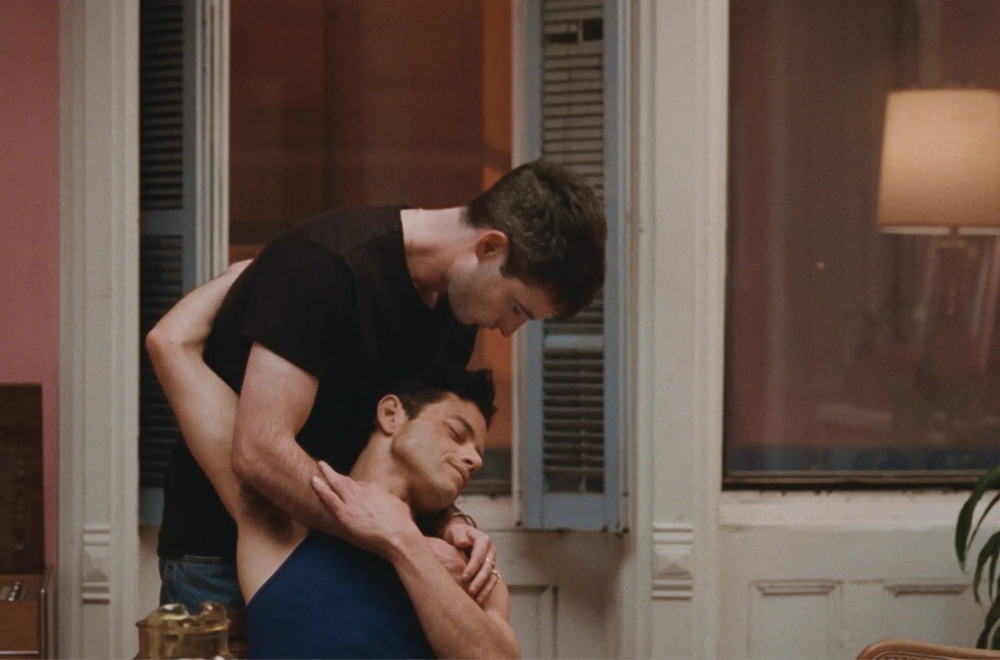
Of course, it’s Jimmy’s magnetism that draws others in. Vincent – played by Luther Ford [above]– is the ginger-haired ex-pat Brit neighbour who becomes Jimmy’s lover. Others include Dennis (Tom Sturridge), his partner who has been looking after Jimmy during bouts of ill health. And then there’s Rebecca Hall’s sibling Brenda, who loves her brother unconditionally, and her more wary husband Gene (Ebon Moss-Bachrach).
With plenty of rehearsal room scenes, the music is organically integrated into the story. At one point, Jimmy serenades a gathering with the 1970 song ‘What Have They Done To My Song Ma’ with touching sincerity. Malek even learnt the Japanese art of Kabuki for one sequence. Meanwhile, Hall’s Brenda also sings ‘How Are Things In Glocca Morra?’, the nostalgic tune from the 1947 Broadway musical Finian’s Rainbow, as others listen in raptures.
There’s no bursting into song here, like a traditional Hollywood Golden Age musical. “The films that I was thinking of were dramas that are laced with music, specifically All That Jazz and A Star is Born,” says Sachs. “Films not in which characters break out in song outside of performance, but in which music is the heart of the film. So, I think that was intentional.”
With vocals sung live on set, rather than in a recording studio ahead of the shoot, it wasn’t easy, admits Malek. “It’s still nerve-wracking to get up there and sing in front of a live audience. And what I loved is how curated Ira’s decision-making was in all of these songs. I mean, they’re so precise and they’re so meaningful, and they drive the story forward with such purpose. So, to be able to delve into those and invest in those … as an artist, you want to throw yourself into it with this kind of blind curiosity, but dedication as well.”
Sachs also found music thanks to Guy Gilles’ 1972 film Repeated Absences, the story of a bank clerk suffering from heroin addiction. “I was watching it while we were shooting the film,” he explains, “and I noticed this very romantic music for the score, and I Shazam’d it, and I got myself a score for my own film. I guess it just brings an elevation to the film.” In his eyes, the film uses music and melodrama to expand emotions. “There’s just this tension between high and low,” he adds. “Maybe between high art and low art.”
In some ways, the film takes Sachs all the way back to his very first film Vaudeville, the 1991 hour-long drama about a travelling theatrical troupe made up of largely LBGTQ+ actors. “I’ve been interested in this story for a long time,” he says. “I think what’s interesting is sometimes I see myself as Jimmy and sometimes I see myself as Vincent. But in the last couple of days, I’ve been feeling more Jimmy. It’s because of this energy where you realise you’re voracious.”
With the film competing in Cannes, for Malek, it was a chance to find a radically different role after more mainstream fare like James Bond movie No Time to Die, wartime drama Nuremberg and thriller The Amateur. It may be the riskiest film of his career, but he’s excited to see what will happen. “I think this film has an immense amount of power and reach, comparatively,” he says. “I don’t know where this film is going to go.” Suddenly, he sounds like Jimmy. “Well, I do believe that the sky is the limit.”
The Man I Love screens at the Melbourne International Film Festival on August 8, 16 and 23.
