




by Stephen Vagg
The 1950s Australian movies of Lee Robinson and Chips Rafferty, which started with such promise and ended in tears.
It is never easy to make feature films in Australia, but things were particularly grim in the 1950s. They didn’t have to be, incidentally – we had a solid talent pool of writers and actors working in radio and theatre to draw upon, a decent documentaries and commercials industry which could have provided trained crew, and several experienced directors around (particularly Charles Chauvel and Ken G Hall). Nonetheless, a number of factors combined to make it nearly possible to get anything financed, including conservatism to the point of hostility amongst distributors and exhibitors, failure to ensure any government protection and/or investment (despite this being an era of protectionist economics), Cold War idiocy (where supporting Australian culture was seen in some sections as Communist-leaning and anti-American), restrictions on raising capital for non-essential industry, and cultural hostility towards local product from journalists, politicians and the heads of cultural bodies.
Still, some people managed to get things made, particularly the team of Chips Rafferty and Lee Robinson, who produced six feature films as a team that decade, more than anyone else in Australia. Their story has been told in the past via excellent histories from such authors such as Martha Ansara, Albert Moran and Graham Shirley, but we thought it was worth revisiting to see what lessons can be learned for today, when feature filmmaking seems as hard as ever, even with government support.
Part one of the series examines their debut film, The Phantom Stockman.
 First, some background. By the early 1950s, Lee Robinson, while still only in his twenties, had already worked for a number of years as a journalist, military historian, documentary filmmaker and radio script writer. He had a particular reputation for his documentaries shot in exotic parts of Australia such as The Pearlers. He wasn’t inexperienced with drama, having written scripts for radio and directed actors in Double Trouble, a government film about immigration, but his background was more in the factual arena.
Robinson was keen to get into features and had almost succeeded with a thriller that he’d developed with the English editor, Inman Hunter – a story about German POWs taking over Pinchgut Island called Saturday to Monday. They almost got the money, but the project fell over, in part because of a particularly dumb government rule that prevented new companies being formed with capital over 10,000 pounds; this was to stop inflation, apparently, and maybe it worked, but it also prevented several Australian films getting up around this time, including Ken G Hall’s version of Robbery Under Arms.
Anyway, Robinson and Hunter sold the script to Ealing Studios, who made it years later as The Siege of Pinchgut.
Unbowed, Robinson tried another tactic. Among the radio shows that he wrote for was Chips, an adventure series starring Chips Rafferty, who was probably the most internationally recognised Australian-based actor at the time, and the closest thing that we had to a local film star. Rafferty could work a treat in the right role (The Overlanders, Bush Christmas, Bitter Springs, Kangaroo, The Desert Rats), but he had a narrow range and was easily miscast (Eureka Stockade, The Loves of Joanna Godden), which limited the acting work he was offered. Rafferty also wanted to get into production, out of survival instinct as much as anything else, so he and Robinson decided to team up to make a film together along with cinematographer George Heath.
The three men were strategic and decided to make a film that leaned into their respective strengths – to wit, the fame and screen presence of Rafferty, Heath’s skill with cinematography, and Robinson’s background in documentaries and writing radio adventure dramas. This dictated the sort of movie they would make – something not too expensive (so as not to exceed that silly 10,000 pound rule), featuring Rafferty in a tailor-made part (i.e. no absurd beards and accents like Eureka Stockade), and would be an adventure tale set and shot in some exotic corner of Australia, to give it a real point of difference from English or American films.
They decided to do an adventure story, The Phantom Stockman, which was heavily influenced by Rafferty’s two radio series to date. The first of these had been The Sundowner, devised in the late 1940s as a vehicle for Rafferty, by none other than Peter Finch, in conjunction with none other than Harry Alan Towers (a notorious producer once arrested for running a white slave ring); Rafferty played a swagman called “the Sundowner”, who travelled the outback and had adventures. The second series was Chips, again devised as a vehicle for its star, where Rafferty played a man travelling the outback having adventures – Robinson wrote a lot of scripts for this one.
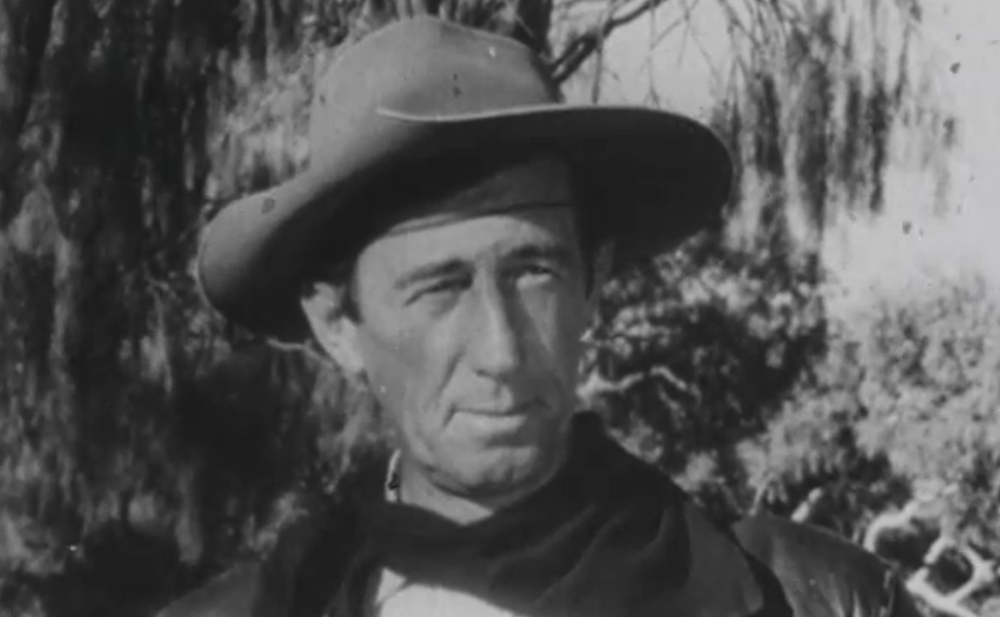
The Phantom Stockman’s screenplay featured Rafferty as The Sundowner, a bushman who travels the outback having – you guessed it – adventures, in this case called in to help a woman who has inherited a property from her father, who may have been murdered. We don’t think it was an official adaptation of The Sundowner or Chips, however.
Robinson wasn’t a natural dramatic writer, but he’d had over a year’s experience cranking out stories for radio and he was smart enough to get the basics right for The Phantom Stockman. In particular, he made sure that his script had:
– a beginning, middle and end;
– story that moved logically;
– goodies and baddies;
– interesting setting;
– a decent female character.

If you think that these things are obvious, you’d be right, but we’d also ask you to explain why so many films can’t do it. For instance, all the successful Australian films of the 1940s had a terrific female lead role, where a woman was active and key to the story (Forty Thousand Horsemen, The Overlanders, Smithy, Bush Christmas, Sons of Matthew), while the female characters in all the big flops basically just said “there there” (Rats of Tobruk, Eureka Stockade, Bitter Springs). And we feel that the lack of obvious baddies badly hurt Eureka Stockade and Bitter Springs at the box office. Yes, there were other factors, but as a general rule of thumb, if you want to throw out a well-proven story convention, have a good reason for doing so, other than incompetence.
The Phantom Stockman was shot in 1952, on location in the Northern Territory and in a small studio in North Sydney. The female lead was played by Jeanette Elphick, a model, while the rest of the support cast were experienced film, radio and theatre performers (even the main Aboriginal actors, Henry Murdock and Nosepeg, had been in a few movies by this stage). Robinson threw in a cameo from painter Albert Namatjira, who he’d made a documentary about previously.
The film got poor reviews in Australia but had a decent run in the cinemas and sold around the world, making its money back and enabling Rafferty and Robinson to produce more films (though Heath left the company – apparently, he didn’t get along with the other two).
The Phantom Stockman isn’t a great film. It’s too slow, much of it feels like a filmed radio play, and Max Osbiston isn’t handsome enough to play the romantic lead. But there’s enough good stuff to get by – the photography and locations, Rafferty being Rafferty, Elphick being pretty, Guy Doleman as a villain, Henry Murdock as a sidekick, that random Namatjira cameo. The Rafferty-Robinson collaboration would eventually turn sour, but on the first movie, they pretty much did everything right, within their limitations of talent, time and money.

What are the lessons that can be learned from The Phantom Stockman for filmmakers today?
- Get as much experience as you can from wherever you can. No film exists in a vacuum, it needs other mediums to flourish – this simple fact is often forgotten by the dimmer movie critics who judge movies solely in terms of other movies instead of appreciating different mediums’ influence on them. Yes, Rafferty was an established film name, but there would be no Phantom Stockman without Australia’s radio and documentary industries. The key to keeping Australia’s film industry healthy is to ensure other mediums (radio, television, theatre, digital) are healthy – they all feed off each other.
- Be ambitious. Robinson could’ve stayed in documentaries his whole life, ditto Rafferty with acting, but both wanted more. They actually had to want more because they were unlikely to have been able to continually support themselves in Australia otherwise. Being ambitious in the arts isn’t a matter of ego, it’s a requirement of survival.
- Have a back-up plan and more than one idea in your drawer. When their initial ideas fell over, Robinson and Rafferty didn’t cry (well, not for long, one assumes anyway) and assembled another project.
- Use your strengths. What are you good at? Robinson and Rafferty had Rafferty’s stardom, Heath’s photography, and Robinson’s documentary and radio experience. They leant into all of these. They didn’t put a beard on Rafferty, or try to write a chamber character drama, or filmed everything indoors. They showed off their best features.
- Get the basics of the story right. It doesn’t have to be great, but it needs a beginning, middle and end, protagonist and antagonist, decent female part, logic. If you don’t do these things, have a decent reason for not doing them.
- Use pre-existing IP if you can, even if indirectly. The Phantom Stockman wasn’t a direct adaptation of Rafferty’s radio shows, but it was heavily influenced by them. Nothing wrong with that – it meant that the material was road tested.
- If you want to use an inexperienced person, surround them with experienced people. Janette Elphick hadn’t acted before, but she did all her scenes with skilled performers – Rafferty, Doleman, Osbiston. They also dubbed her voice which was mean of Robinson, but probably the correct decision.
- Don’t think the local critics will help you, even if you are struggling and starting out. Australian critics have a strong track record of being mean when it comes to local product – something that still endures. The common response from them is “what, am I expected to go easy because it’s local?” without ever seeming to wonder if they’re judging it by a harsher standard because it’s local. That’s a broad generalisation riddled with exceptions but we’ve read a lot of Australian film, television and theatre criticism over the years – trust us, as a general rule, it holds.
- Make it for some sort of market. Have an idea of who might pay to see it. The Phantom Stockman was made with the adventure market in mind.
- You can get a lot done with a team. Rafferty and Robinson and Heath would never have gotten a feature going on their own. But together they could.
These are all things every filmmaker can learn from today. As can the mistakes that Robinson and Rafferty made – but that’s for a later article…
The author would like to thank Graham Shirley for his assistance with this piece. Unless otherwise expressed, all opinions are those of the author.
