



By James Mottram
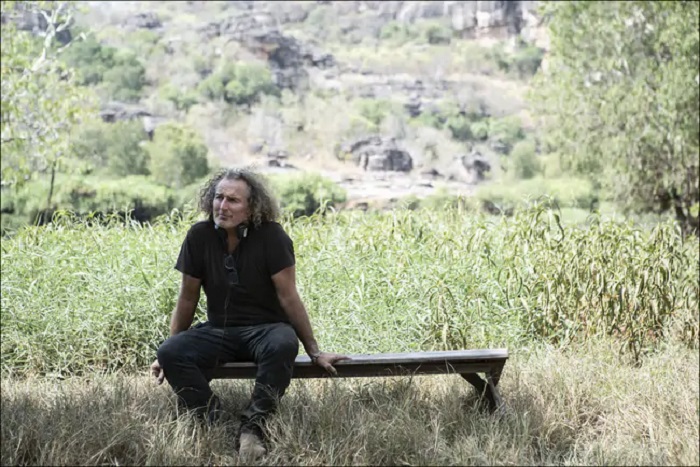
High Ground has been a long time coming. A true labour of love, director Stephen Maxwell Johnson has been working on the film for over twenty years, with a variety of actors and other creators attached and then unattached to the project. It’s also a very belated follow-up for Johnson, whose last film was his 2001 debut, Yolngu Boy, a charming, high-energy indigenous coming-of-age comedy drama. Working on a series of television projects in the interim, Johnson now re-announces himself as a filmmaker of prodigious gifts with the powerful High Ground. A searing but measured treatise on White Australia’s mistreatment of the nation’s first peoples, the film is punctured with violence and horror, but is also a richly humanist affair, as Simon Baker’s jaded and burnt out bounty hunter, Travis, slowly builds a deep connection with his tracker, Gutjuk (Jacob Junior Nayinggul), as they pursue a fierce Aboriginal warrior who has been terrorising white settlers across The Northern Territory in the 1930s. FilmInk spoke with Stephen Maxwell Johnson at The Toronto Film Festival…
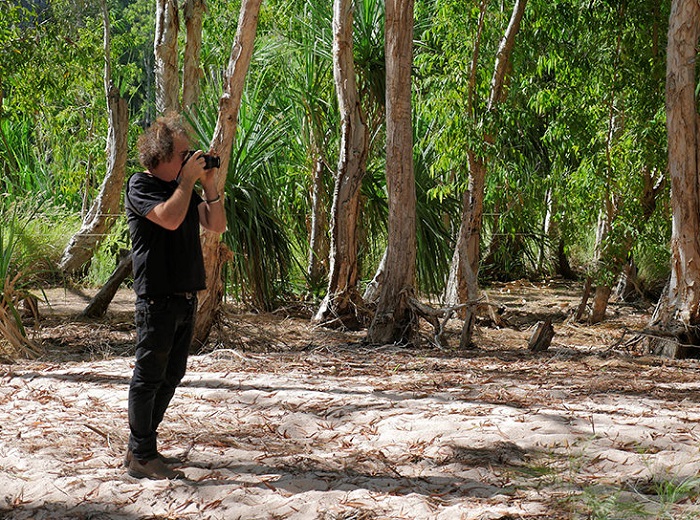
Obviously, it’s a very powerful and troubling film to watch…what was it like to make?
“It certainly was an incredibly challenging film to make, but I don’t think it would be what it is if it wasn’t. That’s why it took so long to do it. The process was really, really important to me. We wanted to work very, very closely with the families and the clans, the Bininj and the Yolgnu families, right across Arnhem Land. As you can see from the credits, there’s a lot of that, and I’m proud of that because it was a beautiful process to put this out there, ultimately, as their voice and tell a story from a Bininj/Yolgnu perspective.”
What do you think the reaction will be like in Australia when the film comes out? Indigenous culture and history has only been introduced into schools, for instance, relatively recently…
“I grew up as a young person in the Bahamas, Africa and the Northern Territory. My parents were teachers, so we moved around the world, but at school I was always questioned if I should ask something: ‘Oh, but I heard about this warrior.’ ‘Irrelevant.’ Attitudes are changing now, as the next generation of young people have access to so much, and they want to know more. They are reaching out and are open to it. I think that the timing of High Ground is perfect. People are ready for it. They’re ready to open their minds and their hearts. I always wanted to come at this thing through trying to create something that was an entertainment piece first and foremost, and would hopefully immerse an audience in an entertaining story, yet still pack a punch and tell something that is important.”
It’s a brutal film, but not overly so…
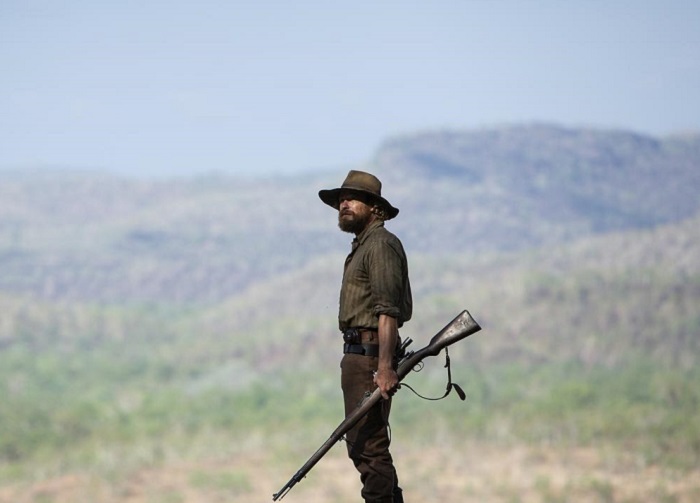
“Correct. It wasn’t about that, because it’s not about that. Obviously, that was part of what was happening, but there were human beings out there on that country, fellas coming back from the First World War, blackfellas who’d never seen white fellas before, miscommunication, misunderstanding, missed opportunities. It was tough out there on the frontier, and there were missed opportunities everywhere. I wanted to really try and tell the story from a Bininj perspective, and from a Yolgnu perspective, and I hope we’ve achieved that. It is a violent story, but I’m hoping I haven’t gone too far with that element of the story. I’ve tried to create an integration with nature…sure, there’s blood and gunshots in faces, but there’s also stillness and quiet. It’s a slightly different way of portraying violence.”
Is the nation’s soul scarred by what has happened to Australia’s indigenous population?
“It’s a very dark shadow on our history, but I didn’t want the film to be a polemic on indigenous affairs. I wasn’t trying to make anyone feel guilty. This is more a case of, ‘Hey, just come for a ride, and perhaps at the end of it you’ll rethink our story a little bit here.’ A lot of people are very confronted by it. There’s a dichotomy in our country that is very split; a lot of people feel this way and a lot of people feel that way, but there is a surge now of people wanting to accept and understand our history and take it on board. It’s a good time to keep that discussion flowing, and to enhance it. We should see each other and listen to each other in a different way, and through that process, we should become a stronger nation and a stronger people. We are all blessed with the fact that this is the oldest living culture left on Earth, and what they hold and what they sing and what they dance is as old as it gets when it comes to human history that’s left. That’s a beautiful thing for all of us to celebrate and to nurture, particularly with all this discussion about the environment. You couldn’t get a human aspect more connected to the environment than Yolgnu and Bininj culture.”
What was it like to shoot in Arnhem Land?
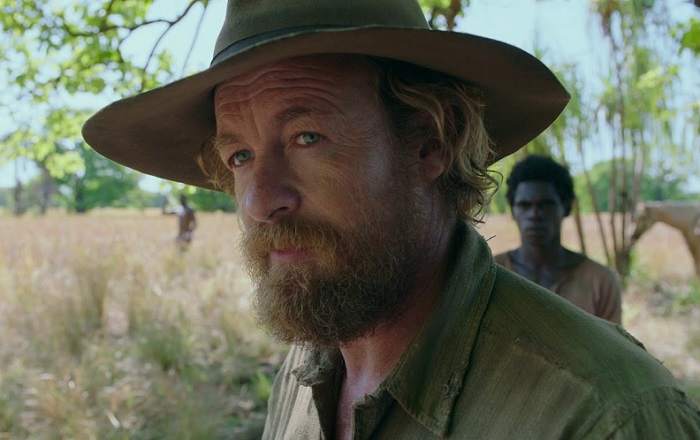
“The film’s shot within Kakadu as well, and because of my relationship with the families, we were allowed to shoot in places that have never been filmed before. These were very special, and in some instances sacred places, because the families and the elders wanted that to be a character, and a part of the story. Without that, it wouldn’t be real for them in that way. It was really important for that to be there dramatically in the film, and visually in the film. The amount of country that we looked at and had to decide upon, and to try and get to a lot of those locations, was very, very challenging. There are crocodiles everywhere, but that’s kind of normal. These mob don’t go walking around worrying about that. They know how to move through it, and how to talk to it and sing it and dance it and understand it. Ultimately, they’re related to it. It’s a beautiful experience in all those ways. It’s the safest place ever if you just don’t do the wrong thing. The only way that you’re going to get eaten by a crocodile is if you’re in the wrong place. You respect the animal, the creature, its domain…you have that knowledge, and there’s no problem. It’s with ignorance where danger comes in.”
Were you inspired by any American westerns?
“There are so many great films that’ve inspired me in my life, so I couldn’t define it in that way. I just love a great story. I love a story that actually rocks your soul and makes you think about stuff. Certainly, some great westerns have been made, but all sorts of things have affected me in my life, but nothing more than actually living, experiencing, and seeing what I’ve seen growing up. I’ve been privy to some very sacred ceremonies, sacred law, and I’ve had things shared with me…those kinds of things have been probably the biggest inspirations for this film. But I’ve always followed my own heart with how I wanted to go about making this film. I love Terrence Malick though…he’s absolutely brilliant.”

How did you go about casting?
“Jack Thompson has been with me on this thing for a long time. I met Jack on my first film, Yolgnu Boy. He came up to Arnhem Land and worked with me there, and connected with the families who I’d been growing up with. Jack’s had a big heart for this stuff for years. Jack’s been at my side for a long time with the idea of this film and he’s been a huge champion of it. I had a hit list for the role of Travis for a long, long time, and Simon was always on that list. As were Russell Crowe and Guy Pearce and Michael Fassbender…a lot of people. It’s been such a long period. Simon wasn’t available for a long time because he was working on The Mentalist, and then other things. Guy Pearce attached himself for a little while to the film, and that was exciting. I’d met Simon Baker thirty years ago doing a music video clip, and that was his first role on camera. Then thirty years later, I’m at an Aboriginal festival in Arnhem Land and I hear this, ‘Johnno!’ I turned around, and there’s Simon Baker, looking just like Travis with his beard and all. It was just like, ‘How you doing?’ We reconnected, and it just happened. It was perfect timing.”
What’s the state of Australian cinema today?
“It’s at an interesting point. I’d like to think that indigenous stories are finding ground and substance and, actually, momentum. Everybody’s trying to look at our history and our country in a much bigger way, which is wonderful. This is an exciting time for Australian cinema in those ways. It’s always very hard to get films funded in Australia. It’s hard anywhere in the world though, trying to make a movie. I really, really struggled with the budget and the mechanics of making this film. I put a lot of my own money into it. That’s fine, but working so remotely is extremely expensive. Bringing up horses, and just the logistics of looking after people in that remote part of the world, is bloody expensive. But I had an amazing cast, and an amazing crew. I had amazing support from all the indigenous communities, and the locals…everyone! There were big logistics to deal with, and lots of fuel. Lots of driving. Lots of four-wheel drives, lots of helicopters, lots of planes…”

What are you expecting in Australia?
“Well, I hope the interest in the film is good. What’s so absolutely wonderful about being here at Toronto or Berlin is that Australians will sort of go, ‘Oh. Well, maybe we’ll go and check this out. It must be okay.’ I’m going to take the film into Arnhem Land and screen it for the families on a big screen. There are two communities, and Witiyana would sing of the east and the west of Arnhem Land. The songline, the sister’s journey, goes right across, around the whole world. We’re going to do a screening in the west, which is where we shot the film, and a screening in the east. It’s going to be out on country with one of those big blow-up screens, and they’ll just come from all over Arnhem Land. Hundreds and hundreds and hundreds of people. Every conceivable form of transport, they’ll be there. I’ve already showed it to some of the elders and they couldn’t stop crying, which is really beautiful because they own it. I’ve spent many, many years sitting together and doing it; it’s not like I’ve just gone off and done this. It’s been a really beautiful process.”
High Ground is released in cinemas on January 28, 2021. Click here for our interview with the film’s stars, Simon Baker and Jacob Junior Nayinggul.
