


By James Mottram
Did it concern you that you were following in the footsteps of Sir Michael Caine and others, playing Alfred?
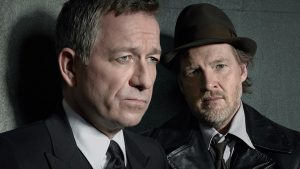
Well, it was huge shoes to fill of course, but I think the thing is, the idea of the show was about how the city moulds these people to becoming the characters that we all know and love later on. So it basically was…it’s not a reimagining but it’s a redefining of the characters that we later know. So it’s watching the process of them grow into the people that we know. So for us as actors – although it was terrifying, because you will be compared to people that played us later on – in actual fact it was us now giving these characters heartbeats to become the characters they later become. So that was the honour for us.
How did you feel when you first auditioned for Gotham?
None of us knew. The idea was this generic thing was flying around Hollywood – this prototype Batman show – but none of us knew what we were going up for when we read these generic speeches. Basically, my speech was… I went into this pub and broke someone’s larynx! What the hell is this? I didn’t know what this was. And then I saw [our showrunners] Danny Cannon and Bruno Heller walk past and they said, ‘It’s Alfred, it’s for Gotham.’ I couldn’t believe it. And then they actually incorporated that scene when I meet Lucius Fox in Episode 2 – I talk about tucking him up like a kipper. That actually was a huge chunk of my audition speech.
Did you set about reading the comics at all?
I started reading later on – there wasn’t a great deal written [about Alfred] apart from the fact is, he was called ‘Pennyworth’ because he used to carry a cyanide pill in a penny. I began looking into it actually after we started because, again, we’ve never seen Alfred ever at this stage in his life – a little younger than Sir Michael [Caine] or Michael Gough. So it’s the first time we’d seen him at this age, and why would a spy be working for the richest man in the world? We redefined our interpretation of Alfred, and that now seems to be influencing [other things]. We all went to see the Batman v Superman premiere and there are elements of our series in the movies. Little touches – the pre-history, the sub-textual stuff – that we incorporated. But in answer to your question, no, I started looking into Alfred after I started doing it. He was a marine and had one leg – that had to go. Too many limps in the series! And the fact that he met Thomas during the Iraqi war and that’s how he became under his employ… we talked about that kind of thing, his military background and history. It was only later on, after 76 years of mythology… there are so many different interpretations of Alfred…there is always this militaristic past, that he’d worked for MI5. So we redefined it that he was from the SS.
 Did you initially feel the characters were rather two-dimensional?
It was two-dimensional, but with Bruno and Danny its slowly-slowly-catchy-monkey. Of course you get frustrated as an actor because it takes a long time to shoot these things. I found myself making lots of cups of tea, being stuck in the Manor and saying, ‘Cup of tea, Master Bruce!’ I got really bored of it! But when we were basically unleashed, it was almost like a colonic in a way – literally! And I took Master Bruce to confront his school bully and that for me was a germinating element, where I suddenly realised the importance and influence of Alfred. It was that specific moment: we send him back to school after the death of his parents, he gets picked on by a bully and I take him to confront the bully and give him his father’s watch and I go, ‘Stand up for yourself.’ And that to me was the birth of Batman, and I suddenly realised what Bruno and Danny were doing.
Is that what makes a good showrunner?
As actors, you feel like you’re getting there yourself – but there’s always this gentle, guiding hand of our showrunners pushing us there. We think we get there ourselves all the time, but in actual fact, it’s a great deal to do with them. Also, for me, it’s being allowed to be physical – which was another aspect which we didn’t expect. That’s the great thing about being in our show and the joy about being in our show – elements will rise and we’re not sure whose following who now. Bruno has said, ‘You’re Alfred now, we’re following what you do.’ They saw that I was quite physical, they put in that he could fight. So things like that – it started off initially as a pastiche of an Alfred, who was constantly cross and brusque with this young boy. But they had a point – communicating with any teenager is difficult. However you do it, if you can create a language with a troubled young man… they find a way of working and communicating. So it started off two-dimensional but ended up being real.
Do you see Alfred’s relationship to a younger Bruce Wayne as key to the show?
Very much so. John Stephens likened it, when we first did Season 1, to throwing a bowl of spaghetti at a wall to see what elements, what strands would stick. Unfortunately, everything stuck! So there were 59 elements! In actual fact, initially, we were going to take very much a back seat – with the slow build up of young Master Bruce. It’s an extraordinary journey, growing up with this young man and seeing him empowered and seeing him learn. And also to be an architect in that.
 Do you feel paternal to your young co-star, David Mazouz?
I do feel very paternal. I have a son called Alfred, strangely enough, who is virtually the same age. So it is weird spending more time with my fake son than my real son! But he’s an extraordinary boy. I have to give a huge shout out to young David Mazouz because he’s a phenomenally focused, brilliant actor – a great human being. An absolute joy to work with, he really is. That’s the great thing about our profession – we’re not ageist. We work with people from 8 to 80 and there is no difference. And someone like that…his concentration and his focus…he’s nothing but a joy to work with, and I do virtually every scene with him. I’m truly honoured to be working with him.
You come from a big family of actors, right?
Yes, my father [Jon Pertwee] was the third Doctor [Who], my Uncle Michael was a writer, my grandfather was a writer with Charlie Chaplin… it goes on and on and on.
How did it influence your work?
I don’t really see it like that. The thing is, if my father was a butcher, I’d probably be a butcher. There was nothing particularly special; I knew something was strange. Everyone would stare at my Dad and I didn’t quite understand why, but it became later on in my life that this is what I wanted to do. To be an actor. And the thing is, you’re only as good as the person you’re in the scene with. The art of acting is reacting – this is the person you’re with. So it doesn’t influence you in any way; because we’re all in it together, you all feel the same.
Gotham: Season 2 is available on DVD and Blu-ray from June 7, 2017
