


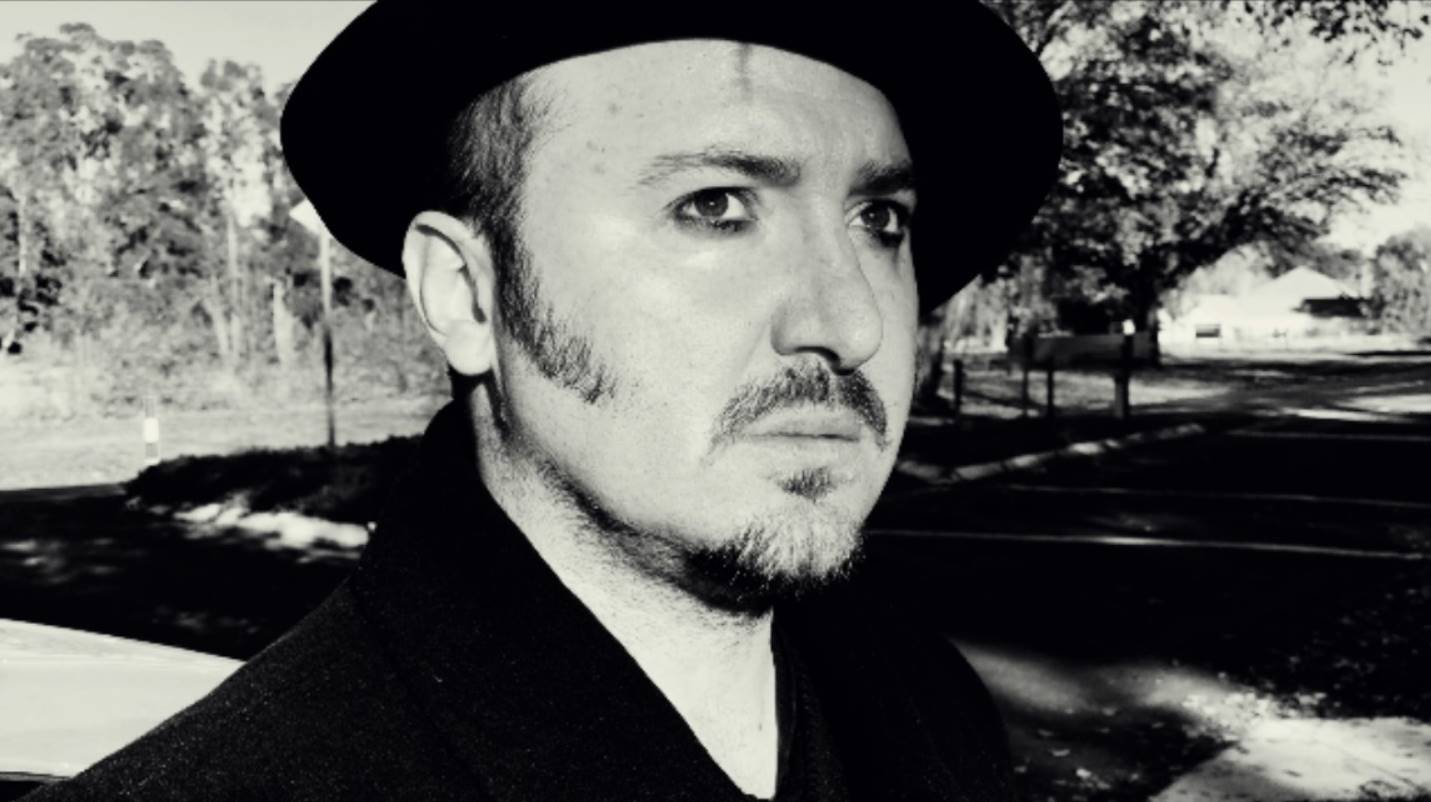
Do you find it frustrating that your films aren’t as celebrated as others in Australia?
Depends really on celebrated by whom? It is whether you make films to entertain Joes or you make cinema and attempt to leave a mark on collective human consciousness. And help evolve it and expand it in some way. The choice has always been clear. Unfortunately, the world is full of meagre intellectual and artistic perceptions whose poor subjectivisms have been given the reign officially, even institutionally. They are the arrogant, “powerful” gate keepers and as I developed as an artist, it was clear to me that these gates they are keeping are not really worth trespassing at all. What matters is the work itself. And these established structures are also changing, because the people within them are changing, bringing new hope, systematically. Being celebrated by people like Flaus, [Dirk] De Bruyn, [Bill] Mussoulis, [Chris] Luscri, [Fiona] Villella and others, in this country, is very important to me. The great perceptions have always been rare and always will be. This invasion of the mainstream (anti) cinema shall get more intense and more desperate, and the rare unique voices shall become even more precious and important.
Can you tell us about your relationship with [teacher, actor, Australian national treasure] John Flaus, how it started and how it’s developed and how it relates to The Last Days of Loneliness?
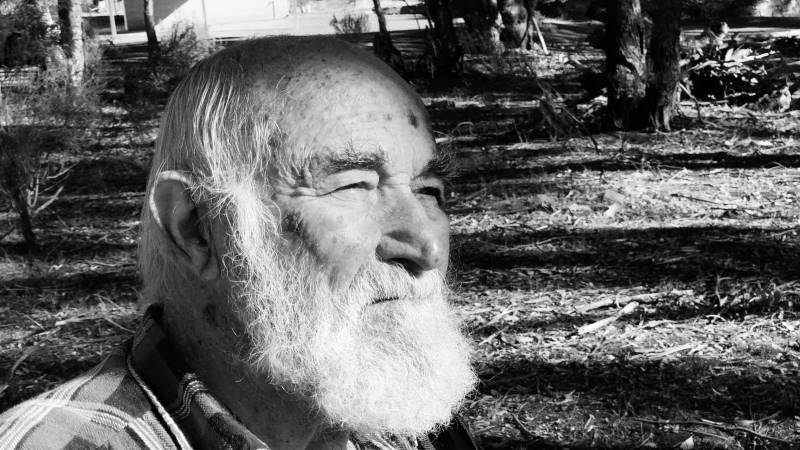
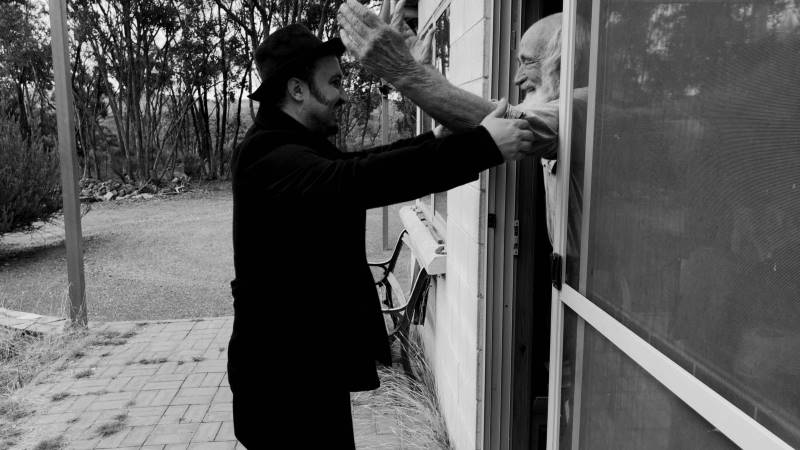
The friendship with Flaus is one of those deep profound things that happens rarely and unexpectedly, perhaps for both of us. John is after all about 50 years older than me, but I suppose the energies of human magnetism and cinema brought us together. John saw my film Silence’s Crescendo and said to me while giving me a hug while walking in Bendigo: “Now because of your film the whole Australian cinematography shall be more mature”. I was touched by that. I was touched by many other things John has said about my cinema and the trust grew to the point when he had to be in it, he was the only person to symbolise the time and its passing in The Last Days of Loneliness. It was a big deal for me to have other people in my films. We laughed so much while filming it, I think that laughter is still echoing through the fields of Castlemaine.
Can you discuss The Last Days of Loneliness, how it was conceptualised and what were you trying to express in its making? Was it inspired at all by the emergence of Covid?
Loneliness was there long before Covid and it shall be there long after Covid is gone. It is one of the crucial human states and emotions and only in it one has a chance to be free. This knowing for me has always been so important and so clear. In that sense, loneliness itself symbolises time and life, so The Last Days of Loneliness is really also about last days of life itself. It was conceptualised with intensity with the human connection and its metaphysical importance at the epicentre of the film and the life itself. The yearning for another, the yearning to be at least witnessed by another and that itself being enough for happiness. Cinematically, the film is attempting to evolve the form, the rhythm and the substance of cinema. Eliminating the nonchalant, pointless representation and pretending that dominates the mainstream (anti)cinema.
What’s the meaning of life?
I am almost sure that one of the meanings of life is not to talk about the meaning of life ? and to intimately know it for oneself, in silence. The meaning of life is the life itself, bare, passionate and true, free of pointless pretending and sensationalism that has invaded the mainstream (anti) cinema and with it the shallow, Instagram existence of its perpetrators.
Which artists/filmmakers inspire you?
When I was younger, I suppose I liked anybody and everybody. As I grew older, I realised I like very few or none at all. Bresson said a good thing, he said make visible what perhaps without you could never be. But the problem of cinema was never just the structure. The great work is the one that changes not only the mere structure, but the substance of cinema.
Can you tell us how you became interested in filmmaking in the first instance?
It was the part of, as Nietzsche said, becoming “who you are”. I felt the great need to make the film about Srebrenica genocide, where I am from. But I suppose my love for cinema was the process of becoming who I am. It is a hard question, almost harder than the one about the meaning of life ?.
Do you get deflated in this age of blockbusters and streaming companies?
Art is a deeply intimate thing. One of the most intimate and powerful achievements of human consciousness and subconsciousness. Such energy must be shared intimately. In the field of film and cinema, there are artists and then there are those who practise the established artistic forms. But they are not artists themselves, they are the ones who cashed in on the forms established by true artists. These people practising the mainstream cinema are not artists themselves, they are just practitioners of the form already artistically irrelevant. Yet you hear them in all their acceptance speeches, referring to themselves as artists. Surely, somebody has to finally laugh at these people. No, I don’t get “deflated”, I have always thrived sharing my cinema intimately. I like to personally know my audience, if possible. It is becoming less possible. And that is OK too.
Will you be travelling to Los Angeles for the South-East European Film Festival for the screening of The Last Days of Loneliness? Is your work more appreciated overseas?
I think I would have endeavoured to go, simply because I have not really travelled in years. Something keeps making me feel like not travelling anywhere really. Maybe luckily, like most of the festivals in US, the festival will be online, so that eliminates my dilemma. There are admirers of my cinema internationally. But like here, rare people are rare everywhere.
What’s next?
We are making another film this year. I think Flaus will be in it. We have a by invitation (closed to the public) session of The Last Days of Loneliness on May 21 at ACMI, who have been very kind to invite us. I have already completed a more recent feature with Flaus called The Final Hours in Paradise. I will probably be working on another film before the one with John later this year. I am creating visual works and new music. I have turned 40 recently and I feel spry enough to try and keep working with the same intensity. Please let me also thank you and Filmink for its support and its ongoing commitment to cinema that exist in the epicentre of itself, there where it is truly evolving, away from the mainstream. I congratulate you and I thank you for that.
