

by Nadine Whitney
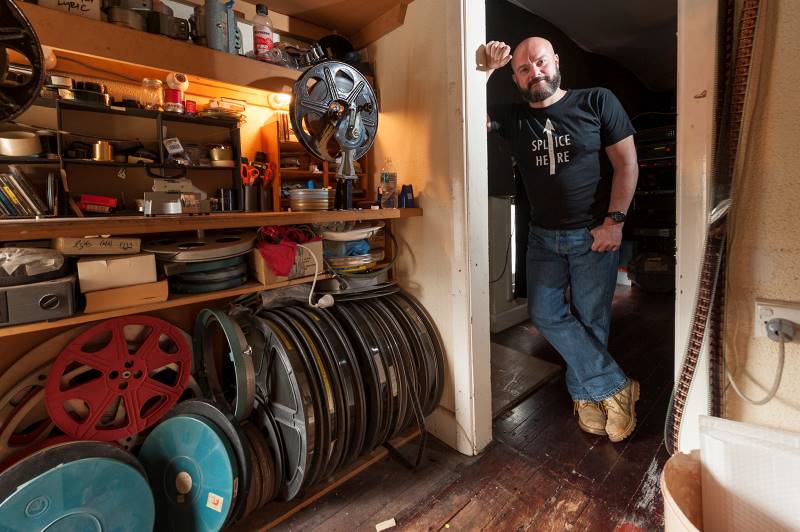
Splice Here: A Projected Odyssey is a fascinating documentary by Melbourne based projectionist and film buff Rob Murphy. Described as a “cine-ramic rollercoaster ride through the rise, fall and rebirth of projected film,” Murphy’s film is a love letter to a time lost and also a peek at what is to come.
Incorporating footage from the heyday of the Cinerama theatres and the local and central cinema palaces of yore, the film takes the viewer through the golden age of celluloid to the collectors and projectionists who have fought to keep the medium of film stock alive.
Splice Here: A Projected Odyssey features some familiar faces such as Leonard Maltin and director Douglas Trumbull, and some not-so-familiar faces who have contributed to preserving film – a medium that more people are seeking out for authentic cinema experiences.
FilmInk speaks to Rob Murphy about his (and others’) labour of sweat, tears, and celluloid.
Splice Here: A Projected Odyssey is a deeply personal film for you, it’s both your history and a capsule history of cinema. What made you decide to frame it as your story?
“It wasn’t a single moment. It evolved slowly as the project grew. It was a couple of years of shooting before we realised that we needed a presenter and about four years in before I started drawing on my own life as a way of structurally grounding the story; turning it into an adventure. I guess that’s where the ‘odyssey’ part got stitched onto the title. After The Hateful Eight (Quentin Tarantino) screening at the Sun Theatre in Yarraville in 2016, attended by the director himself, it was truly cemented in the narrative, and I found I just kept remembering things from my own life that would serve the story.”
Splice Here: A Projected Odyssey pairs very well with another documentary from this year, The Lost City of Melbourne. In both, we see once great cinema palaces that are no longer – Hoyts on Bourke Street, The Regent (which is now a live theatre). How do you think the loss of local cinemas impacted upon the general industry?
“Losing local cinemas was a reaction to the industry, not the other way around. Contraction and expansion have happened twice now. With the introduction of television, the cinema landscape that once stretched over the entire country contracted to just the city flagship cinemas. As the dust settled over the next forty years, multiplexes slowly crept back out to the suburbs so that the city screens became extinct. Now, with the changed viewing habits that Covid and streaming have fostered, we see the suburban cinemas under threat again. Covid also gave the studios the excuse they have been looking for, to shrink the theatrical window down to practically nothing. This perfect storm of conditions, I believe, is on par with the threat of television. Will the big chains move back into the city?”

Film is ephemeral, especially film stock, which as you point out, has a literal shelf life, but it is also something people do yearn to see. The success of places like The Astor and The Sun Theatre in Melbourne [The Ritz, Cremorne Orpheum and Dendy Newtown] partially come from filling a cinephiles’ desire to see a film as intended. What is it like being part of the preservation of that experience?
“It’s wonderful to be part of a movement of people around the world that are helping to save an art form. It’s really wonderful to think that this film; my story is part of that movement and that I am one of the lucky few projectionists in the world who still gets to exercise the art of showmanship and show these beautiful prints.”
You have some great talking heads, including Leonard Maltin and the wonderful Douglas Trumbull. Douglas especially sees a place for both digital and film but wants to create new and immersive ways for the digital experience to be delivered. Do you agree with him?
“Absolutely. Digital is not the bad guy in this story. I don’t want to get bogged down in the aesthetics of which looks better. Rather, I would say that making an ‘all or nothing’ judgment is silly and purely subjective. Digital will never be the replacement for film. It is a whole new medium and like the many, many, new mediums we’ve enjoyed in recorded storytelling, it will have to find its own way as a creative canvas. But it doesn’t look like film and film doesn’t look like it. What Douglas is doing with MAGI is incredible.”

George Lucas told one of your interviewees that he could do anything on digital and that was the moment they realised film was dead. Because Lucasfilm and ILM were pioneers, do you think George’s stance helped kill off traditional filmmaking?
“Well yes and no. Film technology had been stagnant for a long time. George Lucas has done more to advance the mechanics of filmmaking than any other single figure – ILM, THX, the start of non-linear editing with the edit droid. The list of post [production] technologies that we still enjoy today as filmmakers is endless. But film still plays a part. Many Hollywood pictures are still shot on film, scanned and then finished in the digital realm. But I do think digital projection has taken a good decade to even begin to approach film projection. Everyone bangs on about 4k and how wonderful it is, but 35mm film has been natively 4k for at least the last 80 years. There’s still a lot of misinformation and misunderstanding around digital projection.”
Splice Here: A Projected Odyssey is vitally educational. I’m sure many cinema goers don’t even realise what frame rates are, let alone how stressful the job of a projectionist can be. How important was it for you to inform the audience of the intricacies of film projection?
“This story was always first and foremost made for projectionists and cinephiles. But I also wanted it to be accessible to anyone with a passing interest in cinema; hence the adventure style storytelling with me as the protagonist.”
Collectors are an eccentric bunch — some are competitive and others collaborative. Has your experience in the world of film collection been mostly positive?
“Absolutely. These people are passionate about film survival. That’s not to say that I haven’t encountered personalities that needed ‘understanding’ and a certain amount of space on my approach to them. The worry is the hermits; the people who don’t mix with the collector community who spitefully hoard their treasures and are prepared to be buried with them when they go. The NFSA is attempting to work with collectors to archive the films. Some collectors are the reason we have access to many films considered lost. Being in Australia meant that studios often didn’t want to deal with the cost involved with shipping prints back to Europe or the US, so the companies asked that the prints be destroyed here. Luckily, many people decided to hold on to the prints rather than destroy them.”
The documentary is certainly melancholy in places, with a massive number of films being lost due to film stock issues (disintegration, vinegar syndrome, colour face) and even worse, just general destruction from studios. However, you don’t end the film on a hopeless note, rather a positive one about how both film and digital can work together. Going forward do you think there will remain a synchronicity between the two?
“There has to be. As assets decline, digital restoration is becoming more and more the best option, with a finish back onto film. Even digital still needs film as an originating medium and for archiving. There is still no feasible digital archiving solution.”
You spoke to some well-known film faces including Australian broadcaster Pete Smith and also Lee Zachariah. How important was it for you to get input from people who work in the industry in various levels?
“As the scope of the project expanded, this became more and more important – representation from different periods as well as different disciplines within the film world. Having a central plot driven backbone to hang all of these facets off, became more and more essential, the more I wanted to explore.”
If you had one thing to say to the general film going public, what would it be?
“Cinema is facing its biggest threat since television. Go back to the movies… NOW! Nothing can replace that communal, all enveloping big screen experience. If we don’t exercise our choice to experience cinema as it is meant to be seen, the complicated chain of production and supply will grind to a halt and once that happens; there will be no restarting it again.”
Splice Here: A Projected Odyssey Meet the Filmmaker Q&As: New Farm Cinema, Brisbane. Nov 27 2022 ; The Ritz, Randwick. Nov 29 2022 ; Hayden Orpheum, Cremorne. Nov 30 2022 ; Classic Cinemas, Elsternwick. Dec 1 2022 ; Lido Cinemas, Hawthorn. Dec 3 2022 ; Cinema Nova, Carlton. Dec 4 2022 ; The Pivotonian, Geelong. Dec 7 2022 ; The Astor Theatre, St Kilda. Dec 11 2022
