


By Geoff Stanton
“The barbarities of war are seldom committed by abnormal men. The tragedy of war is that horrors are committed by normal men in abnormal situations – situations in which the ebb and flow of everyday life have departed, and have been replaced by a constant round of fear and anger, blood and death. Civilian laws cannot be applied here.”
Major J.F Thomas (Jack Thompson) in Breaker Morant
INTRODUCTION
“One of the best things I ever heard Bruce Beresford say was when he was in New York doing publicity for Breaker Morant,” recalls Bryan Brown. “He was telling one interviewer that he would have liked more money to make the film. They said, ‘But you’ve got a great movie! What would you have done with more money?’ Bruce sighed, ‘I would have been able to fight The Boer War with more than eighteen bloody extras!’”
For a production mobilised on the back of a mere $650,000, Breaker Morant certainly punched above its weight. Suitably feted in Cannes, where it won Jack Thompson a Best Supporting Actor Award, the film also scored an Academy Award nomination for Best Screenplay, pocketed a trove of AFI awards, forged a span of international career paths for cast and crew alike, and rescued a local film industry from ruin. But let’s face it – indelible cinematic moments always occur when the little Aussie battler is getting pummelled with bullets. It’s rousing stuff and, as in the case of Breaker Morant, a few home truths and a little controversy don’t hurt either.
Bruce Beresford’s landmark film about the brutal backwater of The Boer War remains a masterfully engaging experience. The haunted glow of South Africa’s Transvaal Veldt could have rolled from the badlands of Sergio Leone’s imagination. It was on those windy sweeps in 1901 that a firing squad unloaded a volley destined to mint a controversial legend. For many, the ricochet of events that dispatched three Australian soldiers to their fate will be forever hinged upon the resonating brilliance of Bruce Beresford’s 1980 classic.
“Because of the subject matter, the story remains absolutely timeless,” says Bryan Brown. “It could be set in any era, and in any war. In fact, when I was in New York doing publicity for the film, a journalist actually said to me, ‘So, this film isn’t a real story, right? It’s about Vietnam and The My Lai Massacre and the William Calley trial, right?’ [During the Vietnam War, US Troops infamously brutalised and murdered approximately 500 unarmed civilians in the hamlet of My Lai; William Calley was the only officer convicted of war crimes] And I said, ‘No, this really happened! This is our own bloody story!’”
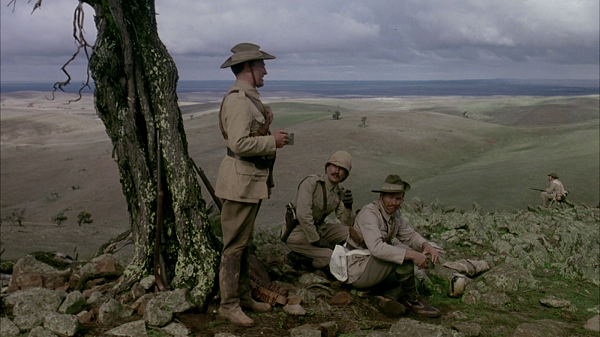
The Second Boer War – fought between The British Empire and the two independent Boer republics of the South African Republic (Transvaal Republic) and The Orange Free State – was not a popular conflict by any stretch. Trying to maintain their grip on a rugged corner of colonial South Africa, Britain launched a military campaign (bolstered by troops from its various other colonies, including Australia) against a mealy resistance of Dutch farmers desperate to get out from under the monarchy’s bullying control. It was during this guerrilla conflict – which raged quietly but bloodily from 1899 through to 1902 – that the British Army devised some of the more murderous hallmarks of modern warfare. The orchestrated squalls of concentration camps (a policy was instituted of rounding up and isolating the Boer civilian population), espionage (there were soldiers, volunteers and mercenaries from several nations involved in the conflict, leading to all manner of skulduggery) and extermination (it was a particularly ruthless conflict) were to become traits of 20th century warfare, and would redraw the savage limits of the modern world.
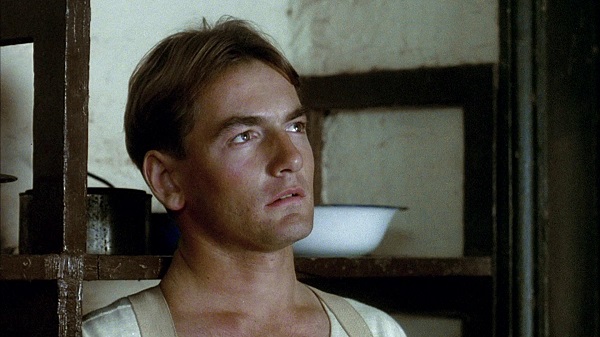
It was into these muddied lines of war that the erudite British-born Australian stockman, Major Harry “Breaker” Morant (Edward Woodward), and his younger lieutenants, George Witton and Peter Handcock (Lewis Fitz-Gerald and Bryan Brown), were drawn. During their service in the bloody conflict, the men come across the mutilated remains of Morant’s close friend, Captain Hunt, who has been brutally murdered at the hands of Boer commandos. When Morant tracks down the Boers responsible, he swiftly orders their execution. It makes for an unsettling scene – not least of all when a German missionary who witnesses the Boers’ execution is tracked down and killed by Bryan Brown’s likeable larrikin Peter Handcock. Skilfully woven through a series of flashbacks, Beresford’s film is based on the 1901 British court-martial of Morant and his men for the murder of the Boer prisoners. In a demonstration of highhanded hypocrisy, Britain had determined to execute the three men in an effort to leverage its way free of the unpopular war. The one scant hope offered the trio is inexperienced but gutsy Australian lawyer, Major J.F Thomas (Jack Thompson), who mounts their against-the-odds defence.
THE FORCES OF HISTORY
Much of the story’s source material comes from Scapegoats Of The Empire, an account written by the young survivor of the ordeal, Lt. George Witton, while he was imprisoned by the British military. Eventually released from his life sentence in 1914, Witton became bitterly outspoken about his experience. He remained adamant until his death in 1942 that the three had been the victims of an abhorrent miscarriage of justice.
“This was a little known chapter at the time, but I became fiercely possessed by the story,” says Lewis Fitz-Gerald. “Most of us got brought up on the story of Ned Kelly or Phar Lap or even Les Darcy – while all of those things made great films later on, the story of Breaker Morant was still not widely known. It was a fascinating journey to go on with that director and within that company of actors.”
Excavating history, however, initially resembled something more like a widely potted treasure hunt. While Scapegoats Of The Empire had provided Beresford with his starting point, he had hoped to refer to the wealth of source material signed off upon by esteemed historian (and father of Andrew Denton), Kit Denton, to help guide him to the heart of the story. Things were to play out somewhat differently. “It was a rather curious situation,” Beresford explains. “The South Australian Film Corporation had actually bought and paid for Denton’s research, but when I got to South Australia and told them that I’d like to read it, they said that Denton’s condition of selling it was that he kept it in his house in The Blue Mountains in Sydney. So I said, ‘What sort of a purchase is that?’ They told me to get in touch with him and arrange a time to read it all. So I called him, and told him that I was writing a script, and that I wanted to see the research material. He said, ‘Sure. That’ll be one hundred dollars an hour.’ That was in 1979! I called the SAFC back and asked them what they wanted me to do; this was going to take me at least a week or so. I asked them why they were being charged one hundred dollars an hour for material that they already owned. They said that they’d sort it out, but they never did. To this day, I still haven’t read Kit Denton’s book. They told me not to; if I did, it would put us in copyright strife. So I never read it, and I never met Kit Denton either. I ended up going to London, where I researched The Boer War in The Imperial War Museum.”
Beresford also began drawing inspiration from more eccentric sub-quarters. “I ended up meeting a whole lot of Boer War buffs,” the director explains. “They were completely mad. These were people whose entire houses were dedicated to Boer War memorabilia. They had old uniforms, statues, medals and so on. You can’t imagine how much junk they had.” Beresford also had uncles who had fought in WW2, and many of their stories were lent to the script.
MODERN PARALLELS
Ever since the diggers of Anzac Cove were seeded from carnage into the glorious din of A Hero Of The Dardanelles (1915), the rites of war have provided Australians with a visceral connection to the outside world. It had been thirty years, however, since the lean slouch of Chips Rafferty had churned the dust in The Rats Of Tobruk and Forty Thousand Horsemen, and by the time that Breaker Morant went into production in 1979, things had changed. With the fume clearing across Vietnam, we were perhaps willing to challenge not only the machinations of war, but also our own part in it. “I never gave the Anzac thing a thought!” exclaims Beresford. “Vietnam of course came to mind. There are similarities in every war. But I wasn’t interested in making these men out to be heroes. I wasn’t trying to whitewash the situation. What I was interested in was the issue of moral responsibility in times of war. I wasn’t trying to exonerate the Australians who were shot. What I was interested in doing was looking at the kind of pressure that they were under. That pressure forced these men to make the decisions that they did and behave in the way that they did.”
Says Lewis Fitz-Gerald: “There’s no question that Bruce isn’t telling you what to think with Breaker Morant. He pleads for the case of mercy through the mouthpiece of Jack Thompson’s character, but at the same time he’s very clear that these men have done dark things. We have to decide for ourselves how we would act if we were put in their situation. That’s a distinguishing feature of the film.”
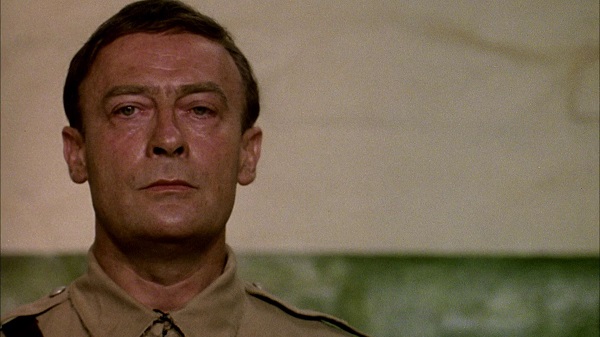
There’s a poignant scene towards the end of Breaker Morant where intelligence officer Captain Taylor (John Waters) takes Morant aside in the barrack gaol and quietly offers him a way out. “I can have a horse standing by for you” he suggests. “Some of the guards are sympathetic.” “Where would I go?” asks Morant. “You might take a boat. See the world.” The world rushes through Morant’s mind. “I’ve seen it,” he replies wearily.
“The idealism of youth and the loss of innocence is a national story,” says Fitz-Gerald. “Being a keen, young actor at the time, I was very excited about researching the role. I started by going to The Australian War Memorial Library and telling the librarian that I was to play a young soldier with stars in his eyes who was about to see the world through the tragedy of war. To my surprise, this man started crying and said, ‘I am that man’. He was a Vietnam veteran. He subsequently became my conduit to all sorts of resource material. It was also at The War Memorial that I held in my hand Harry Morant’s 455 Calibre Welby pistol. This was long before I had one placed in my hand on a film set.”
The passion in Lewis Fitz-Gerald’s voice remains palpable. “Witton was deeply scarred by what he perceived as a betrayal of the military,” he says. “He suffered terribly after this experience. He almost died of typhoid in a British military prison. We didn’t draw the parallels with Vietnam that were drawn by academic analysts years later. While the producer, Matt Carroll, and Bruce were certainly conscious of its relevance as a universal story, the specific tying in with The My Lai Massacre and William Calley were probably rather long bows to draw.”
Or, as Beresford simply puts it: “It wasn’t something anyone talked about when we were getting the film up.”
KITTING THE CAVALRY FOR THE TRANSVAAL
At The South Australian Film Corporation, the bows were indeed angled in a different direction…namely at Australia’s own headlining buccaneer – and one-time Cleo centrefold – Jack Thompson. Thompson was the one condition that Village Roadshow gave Beresford for getting Breaker Morant off the ground. “I didn’t think at the time that anyone at the SAFC was particularly interested at first,” Beresford says. “But then they said they wanted to do it and we had money from Village Roadshow if Jack Thompson played the main role.”
Bryan Brown: “Production was all over the place for a while. I wasn’t even going to be in it. Jack Thompson was going to play Handcock and John Hargraves was going to play the lawyer. Then Hargraves wasn’t to be released from some show that he was doing, so Jack played the lawyer. Then they realised that Jack only had two weeks to spare because he was in another production in the works. So I was asked to play Handcock. That character was all instinct for me. The only thing that I really knew about the bloke was that he had a moustache…which I hated wearing! I couldn’t wait to finish the movie and get it off. I was the ugliest looking bloke in the world with that thing” he laughs. “I was sure that I’d never get another job! But as it turns out, I’ve grown quite fond of the character. I might just add that every single moustache in Breaker Morant is real. The only problem with that was that [fellow actors] John Waters and Rod Mullinar came up with these tremendous looking things that made me feel pretty pathetic. But when the movie came out and I looked at it properly, my rough old moustache hangs on there pretty good, I reckon.”
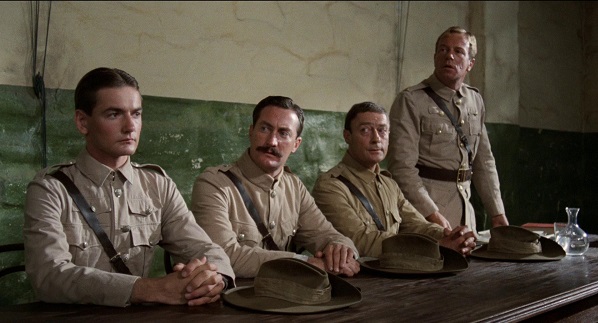
The story itself was proving even harder to assemble than the cast. “By now I’d been fiddling with the script for some time,” says Beresford. “It was only when I came across the play about Breaker Morant, by Kenneth Ross and Jonathan Hardy, that I realised something I should probably have realised before: if I did it from the point of view of the trial and then used flashbacks, we could make the film with the budget at hand. Although I never met the playwrights either! They’d written another script about Breaker Morant, and the SAFC gave it to me to read. I didn’t like it at all. It had a TV movie feel. I hardly used any of the play in the script; the actors addressed the audience and all that kind of thing. Many of the things that people think were in the play weren’t. That long speech that Jack Thompson makes – that’s not in the play. Everyone assumes that it was. But I wrote that.” Beresford pauses for thought. “Actually, you know what? I don’t know if that play was ever even staged!”
Bryan Brown: “I read three scripts in all. Bruce sent me a copy of the first script, and it was pretty good. Then he sent me a variation of the script, which I looked at and said, ‘Jeez, I don’t know about this’. There were a lot of flashbacks in it, and the second script had just lost the thread on how they all joined up. Structurally those things are difficult to pull together. Bruce went off on a tangent there for a while and it didn’t quite gel. I guess that’s what he thought too, because he ended up locking himself away in a room for eleven days. But Bruce is an incredibly well prepared director. He knows his story. He’s already cut it in his head. A bloke like him can make a story like this work. The last script worked very well and that was the one we shot.”
Lewis Fitz-Gerald: “Screenwriting 101 tells you not to use flashbacks. Funnily enough, I was in a seminar with American screenwriting guru Robert McKee, and he said, ‘I want to talk about flashback, because you guys have the one film in the world that does flashback just right. It’s called Breaker Morant’.”
With the tension tightening upon testimony and flashback, the centre of the drama now struck a tragic harmony. “You certainly have the feeling that the Aussies are on the wrong side,” Fitz-Gerald says. “The character of Morant actually talks about that. You’re also in the right landscape to be on the wrong side of something. The interior courtroom scene that matched so seamlessly with the flashbacks was where DOP Don McAlpine really plied his trade. It’s no mistake that he went on to win an Oscar. That guy is a genius.”
BRINGING DOWN THE BREAKER
Not unlike Morant’s court-martial, the production was also mounted with swift economy. Because of the scripting issues, the shoot was pushed back until the beginning of winter. The crew huddled amongst South Australia’s freezing foothills, beneath slicing rain, with only a handful of weeks and a strict film ratio at their disposal to resurrect The Boer War’s ghosts. “It was bitterly, bitterly cold,” Fitz-Gerald recalls. “I can remember breaking half an inch of ice in the horse troughs in the mornings when we began. It was freezing cold – more like Flanders than the Transvaal. The freezing, sucking mud on our boots was remarkable.”
Bryan Brown shares similar memories. “It rained non-stop for the first three days,” the actor says. “We had a hell of a time hauling things through that. By day three, we’d only turned over about three-and-a-half minutes worth of film.
Despite the bruising conditions and confused scripting process, Lewis Fitz-Gerald explains that his director was never afraid to muck in and get involved. “Beresford was all over that film,” the actor says. “In the flashback where Handcock rides off to kill the German missionary, there’s a single gun shot, the horse-and-carriage in which the missionary is travelling comes to a creaking halt, and then you see him dead inside. Then there’s a shot of a Bible fluttering in the breeze – that was Bruce Beresford blowing just out of frame to make the pages turn over. Also, during the capture of the Boer Commando Visser in the gully, you hear someone call out, ‘You’re in trouble, mate!’ That’s Bruce. There are all kinds of little marks over the film which was Bruce getting every ounce of production value out of the brief time that he had to make the film.”
THIS IS WHAT COMES OF NATION BUILDING, PETER!
The scenes leading up to the execution of Harry Morant and Peter Handcock represent a high mark in Australian film. “Do you want a clergyman?” asks the fusilier as the men are led from their cells. “No,” replies Morant. “I’m a pagan.” “What’s a pagan?” asks Handcock. “It’s someone who doesn’t believe there’s a divine being dispensing justice to mankind,” replies Morant wryly. Handcock turns his head. “I’m a pagan too.”
“The thing that I remember most clearly was the last couple of scenes where we’re sitting on chairs and the soldiers in the firing squad have raised their guns to shoot us,” Bryan Brown recalls. “We did that at dawn over two mornings. It was a very eerie moment, having those blokes aiming their guns at us as the sun was coming over the hill. We were trying to work out how to make our chairs fall over once we were shot. We were trying to work out the answer to this – maybe they could pull them back with some string or something. Edward said, ‘Let’s just push off with our feet’. That’s what we did, and it worked. We were just moments from shooting when Bruce said to us, ‘You know, they actually held hands as they walked out there to be shot’. So we did. All those details helped it become one hell of a memorable scene.” 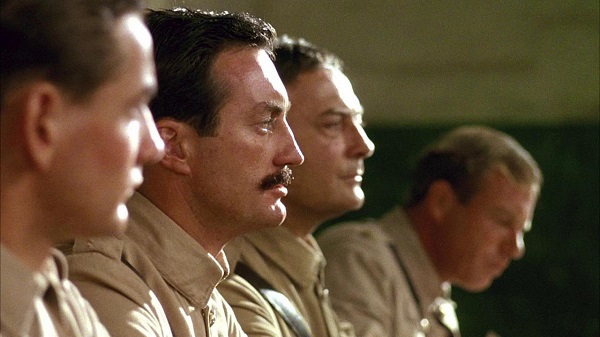
Fitz-Gerald: “When I was researching in The War Memorial, I held the letter that you see Peter Handcock hold – where he tells his wife that he’s going to find out the grand secret, and that he will face his God with the firm belief that he obeyed his orders and served his king – in one of those fabulous last scenes. We bent the truth a little bit there, because he wasn’t given a pen and ink – he wrote it in HB pencil.”
When Breaker Morant was released, The National Review called it “easily the most distinguished film of the year. Beresford makes no false move. The film is full of wit to the end.” But what else would you expect from a film which features Bryan Brown, Edward Woodward and Lewis Fitz-Gerald commandeering a mounted machine gun, like a brass-buttoned version of Sam Peckinpah’s The Wild Bunch, to stop renegade Boer Commandos storming their gaol cell? Along with the wit and tension, Breaker Morant also deserves accolades for its irony. It’s these beautifully fatalistic qualities that make it such an endearing and well-loved Aussie classic. “At the time, the Australian film industry was in such a state that Breaker Morant was almost expected to be one of the last films made,” says Lewis Fitz-Gerald. “At least, that was certainly the case in South Australia. It was the stated goal of the incoming Premier to dismantle the AFC. Matt Carroll and Bruce Beresford arranged a Parliamentary screening of the film by way of pleading with them not to stiff the AFC. They saw the film and changed their minds.”
Beresford’s recollections on the film’s success are, of course, somewhat more understated. “It took twenty years to get its money back!” he says. “And it only cost $650,000!” For years, the only copy of Breaker Morant that Beresford could lay his hands on was a US version from his local street market. Upon hearing that the film is now travelling fine on DVD, Beresford expresses surprise. “Really?” he laughs. “Is it?”
Fitz-Gerald is amused. “I’m sure that he knew that,” he laughs. “He’s something of a charming rogue, is our Bruce. I actually saw it evidenced during the Olympics. I spoke at an outdoor screening of Breaker Morant, and a new print had been struck. It was fantastic. Matt Carroll had wanted to remaster the sound, but didn’t get a chance. The reception that the film received, however, was extraordinary.
The final word on Breaker Morant, however, must go to Bryan Brown. “It was one of those projects where everything just came together,” he says. “We had the crew, the cast and the director to make the whole thing very special. It’s not only a fantastic movie – I reckon that it’s one of this country’s best films of all time.”
Breaker Morant is screening on Friday November 4, 2022 at the Veterans Film Festival as part of the Bruce Beresford Retrospective and Masterclass
