


By Philip Berk
For his third film, British visual artist turned director, Steve McQueen, showcased a continuing facility and fascination for tough subject matter, following up his films about imprisoned IRA soldiers (Hunger) and sex addiction (Shame) with a sweeping drama about the horrors of slavery in America. The director’s idea was to make a film about a free black man kidnapped and sold into slavery, a scenario which would allow the audience to “go through the assault course of institutional slavery with him.” While collaborating with writer, John Ridley, McQueen hit a brick wall on the subject, and the film started to stagger precariously. It was at that point that McQueen’s wife – cultural critic, Bianca Stigter – suggested that he look more directly at what was inspiring him: history. The pair started researching real stories about slavery in America’s Deep South, and it was Stigter who eventually unearthed Solomon Northup’s memoir, Twelve Years A Slave. “I turned the pages of the book, and each page was like reading a script,” McQueen told FilmInk at The Toronto Film Festival in 2013. “It was miraculous; each page was a revelation. I was upset with myself that I didn’t know of this book, but it turned out that no one that I knew was familiar with it.”

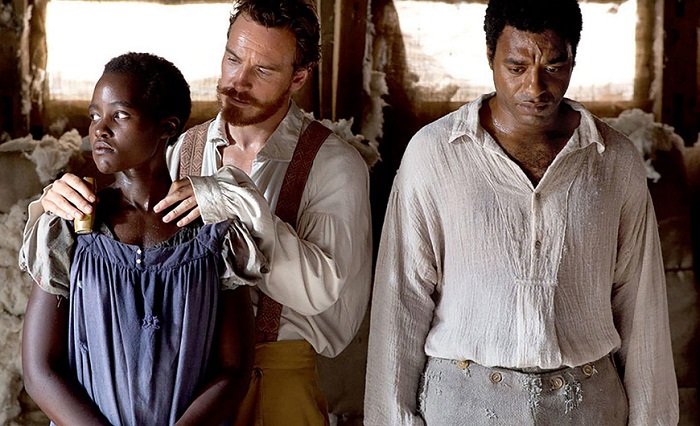
McQueen compared Northup’s book to The Diary Of Anne Frank in its truth and immediacy, but despite making an impact upon its initial release in 1853, it eventually faded from view after being quickly eclipsed by Harriet Beecher Stowe’s epochal anti-slavery novel, Uncle Tom’s Cabin. “It buried it,” McQueen explained. “And the fable became more popular than the truth.” In the pre-Civil War United States, Solomon Northup (Chiwetel Ejiofor), a free black man from upstate New York with a wife and children, is abducted and sold into slavery. Met with cruelty (most violently at the hands of vicious, drunken plantation owner, Edwin Epps, portrayed by Michael Fassbender) and occasional kindness, Solomon struggles not only to stay alive, but to retain his dignity in the face of almost unspeakable horror. In his twelfth year in chains, Solomon’s chance meeting with a Canadian abolitionist carpenter (Brad Pitt) forever alters his life.

Though the story seems wild and fanciful, McQueen is quick to assure FilmInk that it’s all true. “A lot of academics have researched it with a fine tooth comb. In fact, not long after the book was released, they visited plantations, and they met Edwin Epps. They asked him if this was true, and if it all happened. And they were told, ‘Yes, it is true.’ So it’s an incredible testament.”
While 12 Years A Slave instantly reaped extraordinary praise from critics and festival audiences (which the hard-nosed McQueen seemed neither surprised nor impressed by at The Toronto Film Festival), something still continued to eat away at the director: the fact that he could only tell part of the story. “Unfortunately, there are certain things that we do not know,” McQueen explained. “When he got back to New York, Solomon wrote this book, and then he went to do lectures in the Northeast of America. He also made a stage play out of it, and he did two productions of it. He even played himself. There was actually a riot at his last performance of 12 Years As A Slave, which was documented in an American newspaper of the time. But after that, he fell off the map. There’s no other recorded evidence of what he did afterwards. A lot of people have researched what happened to him, but all we know is that he was involved in The Underground Railroad…the rest, well, we just don’t know.”

How traumatic was it filming in the actual Louisiana plantations? “To be honest, it was very strange, because these places are very beautiful, but so many horrible things happened in those beautiful places,” McQueen replied. “It’s like filming in Auschwitz…it’s haunting. It’s not something that you play with; it’s something that you take seriously. It was a very intense time for the crew and for the actors, but by coming together as a family and supporting each other, we were able to make the film that we thought needed to be made.”
Despite having a large pool of better known black actors to choose from, McQueen only ever had eyes for Chiwetel Ejiofor, then on something of a roll with Dirty Pretty Things, Kinky Boots, American Gangster, Children Of Men, Serenity, and Salt. “He has a genteelness about him, and he’s a real gentleman,” McQueen offered. “He’s from the old guard; he opens a door for a lady, and he stands up and offers a chair. There’s a gentlemanly quality to him, and Solomon was that kind of person. He was similar to, say, Sidney Poitier, or someone like that. There’s also a certain kind of humanity with him. And I knew that in making this film, that humanity would be tested to the breaking point. I hoped that he would get through it, and he did. We discussed silent movie acting, because in the movie, we mostly watch Solomon’s face; most of the time, he isn’t talking. So we had to work on that, and on his eyes, which were very, very important in order to communicate. But even more important, when you look at Solomon, I want each individual in the audience to be looking at themselves, as if they were going on that journey. That essentially was the conversation that I had with Chiwetel.”

For Chiwetel Ejiofor, it was a surreal experience. “I couldn’t confront this story head on,” the actor told FilmInk. “I needed to come at it from a different angle, because if you confront it head on, then you bring in all that you know about slavery, and your own personal baggage. I didn’t feel that it was useful to bring that into the story. It felt too blunt. I always thought of it as a kind of fairytale, a kind of Alice In Wonderland, where you go down the rabbit hole, and then you’re in a completely surreal and different universe. That helped me take away the obvious elements. Like Alice, you’re trying to figure things out one at a time, and finding out what things mean in this different place, in this surreal world. So that was the angle that I took. That was probably how Solomon saw what was happening to him. So you’re trying to figure out one beat at a time, one instance at a time, and ultimately you’re piecing together how all these things fit into each other. You start off thinking that you’re in a war for your freedom, but really, as the net tightens, you’re in a war for your sanity, and ultimately that’s the battle that he faced.”

Equally impressive in 12 Years A Slave is Michael Fassbender (who starred for McQueen in Hunger and Shame), who plays Edwin Epps, the plantation owner who’s both weak and irredeemably evil. Was he able to let go of him after a day’s shooting? “The unpredictability of Epps was terrifying,” Fassbender replied. “It’s far beyond what we’ve seen in the first section of the film, and Solomon is now living at the whim of some unhinged character. Through the years, you learn to leave yourself out of the picture, or wash away the day’s work as best you can, but there’s always residue. But because we were putting so much into a day’s work, it allowed me to go home and leave everything behind, and just concentrate on the following day’s work, which is another bonus to the way that Steve films. It’s 35 days, which is a compressed amount of time, where you live alongside this character in these upsetting scenes. It’s quick, and you’re moving fast, so you don’t really have time to think.”
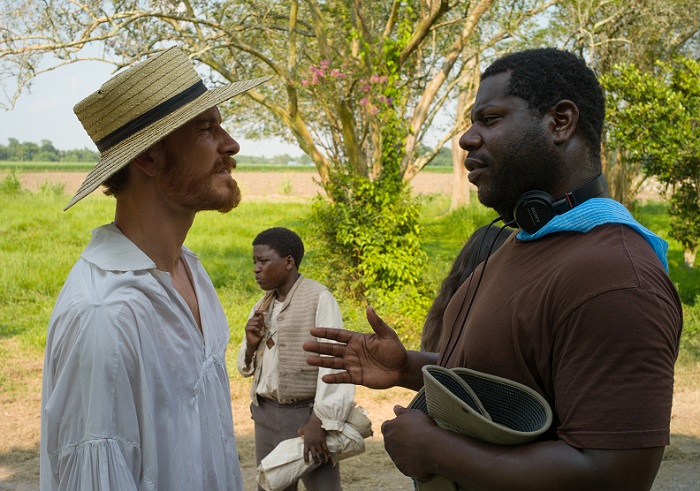
After playing the lead in McQueen’s Hunger and Shame, Fassbender has an undeniably special bond with the director. “When we get together, there’s chemistry there,” the actor explained. “And there’s an absolute trust. I know that he’s going to look after me, and also take me to places that I wouldn’t be able to discover by myself. That filters down to the whole crew. He expects and demands so much from every member of the crew, but in exchange, he gives you a lot of reinforcement. He gives you the confidence to go for your instincts and believe in those instincts. You know that whatever steps you make are going to be the right steps. And if not, that’s okay. It’s okay to fall flat on your face. In fact, it’s encouraged. We fail, and then we try, and we fail better, as he would say. ‘We’re all going to die one day,’ is another of the catchphrases that he uses to push you on set; it’s a really clean way to realise that we have nothing to lose.”
With 12 Years A Slave, McQueen certainly emerged a winner. The film scored a host of Oscar nominations, and took home three gongs (Best Film, Best Screenplay, Best Supporting Actress), instantly making McQueen one of the industry’s most in-demand talents (he has since followed up with the thriller Widows and the ambitious television project Small Axe) and the film an instant classic.
12 Years A Slave is available now through FilmInk’s new VOD service. Click here for more information.
