



by Andrea Baker
Worth: $18.00
FilmInk rates movies out of $20 — the score indicates the amount we believe a ticket to the movie to be worth
Cast:
Isabelle Huppert, André Marcon, Laurent Lafitte, Marina Foïs, Mathieu Demy
Intro:
A French Succession and perverse power game in the glossy beauty industry. Calling all Huppert fans, Francophiles, and fashionistas ….
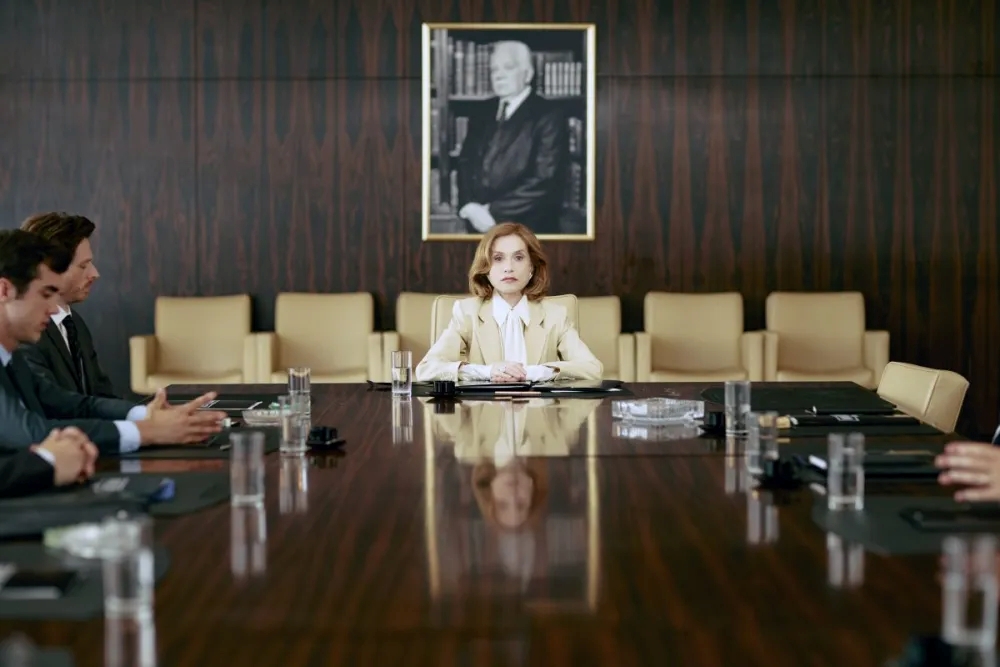
In The Richest Woman in the World, Isabelle Huppert plays Marianne Farrère, the Chief Executive Officer (CEO) of a fictional, globally successful cosmetics company, the Windler Group.
The film is a dark comedy drama loosely based on the real-life Liliane Bettencourt (1922–2017), a French billionaire businesswoman who inherited her father’s (Eugène Schueller) L’Oréal cosmetics empire after he died in 1957.
In 1963, L’Oréal went public, but Bettencourt continued to have a majority stake in the company. Often ranked as the world’s richest woman with an estimated fortune of more than 40 billion, her later life was marked by family feuds and legal scandals regarding her mental capacity.
Also known as the “Bettencourt Affair”, the scandals centred around battles with her only daughter Françoise over the L’Oréal legacy, assets, guardianship, and political scandals, such as allegations of illegal campaign contributions to former French President Nicolas Sarkozy.
In The Richest Woman in the World, Cosmetics Queen, Marianne (Huppert) has a loveless marriage to Guy (André Marcon), a grumpy French Minister who never smiles, and a fractured relationship with her sour-tempered daughter Frédérique (Marina Foïs).
Lonely in her twilight years, Marianne befriends a younger gay celebrity photographer, Pierre-Alain Fantin (Laurent Lafitte), who is based on real-life celebrity photographer, François-Marie Banier.
Marianne first encountered the flamboyant Marxist when he did a photoshoot of her for a magazine called Selfish.
While he admires Marianne’s white privilege and cultural status, he quickly argues that the French position themselves as broadly socialist and anti-class, viewing displays of accumulated wealth as vulgar.
Laughing it off, Huppert radiates elegance, intelligence and formidable star power, as her chameleon-like character veers from familial aggression to playful complicity with the gay photographer.
When Marianne plans to bequeath her fortune to him, the Farrères’ butler (Raphaël Personnaz) plots against the scandalous friendship, leading to her daughter filing legal action that her mother is losing her mind.
However, as the writer- director, Thierry Klifa and co-writers Cédric Anger and Jacques Fieschi demonstrate, there are quite a few scandals in this complex story.
Another scandal uncovered in the film is Nazi connections, as news reports detail that Marianne’s father and her husband were linked to fascism and antisemitism. This news does not sit easily with the daughter, whose husband, Jean Marc Spielman (Mathieu Demy) is Jewish, and her father-in-law was a Holocaust survivor.
In real life, Bettencourt’s father provided financial support and held meetings for La Cagoule, a violent, French fascist-leaning, antisemitic and anti-communist group at the L’Oréal headquarters. Her husband, French politician André Bettencourt, was also linked to La Cagoule.
As this troubling reenactment unfolds, The Richest Woman in the World is suffused with contemporary dark themes. Marianne reassesses who will inherit her empire while locked in a legal battle with Frédérique.
Historical events aside, this is a colourfully stylised, sophisticated film, where the fragile connection between one of France’s greatest actresses, Huppert (as the CEO) and Lafitte (as the photographer) is ‘Ça vaut le coup de le regarder’!
