


by Finnlay Dall
Worth: $4.00
FilmInk rates movies out of $20 — the score indicates the amount we believe a ticket to the movie to be worth
Cast:
Jonas Dassler, David Jonsson, August Diehl, Flula Borg
Intro:
… a subpar biopic about real life theologian and Resistance fighter, Dietrich Bonhoeffer.
Despite what the added subtitle and marketing suggest, Bonhoeffer is not a le Carré-esque spy thriller, or even an alternate history interpretation ala Inglourious Basterds (2009), but a subpar biopic about real life theologian and Resistance fighter, Dietrich Bonhoeffer.
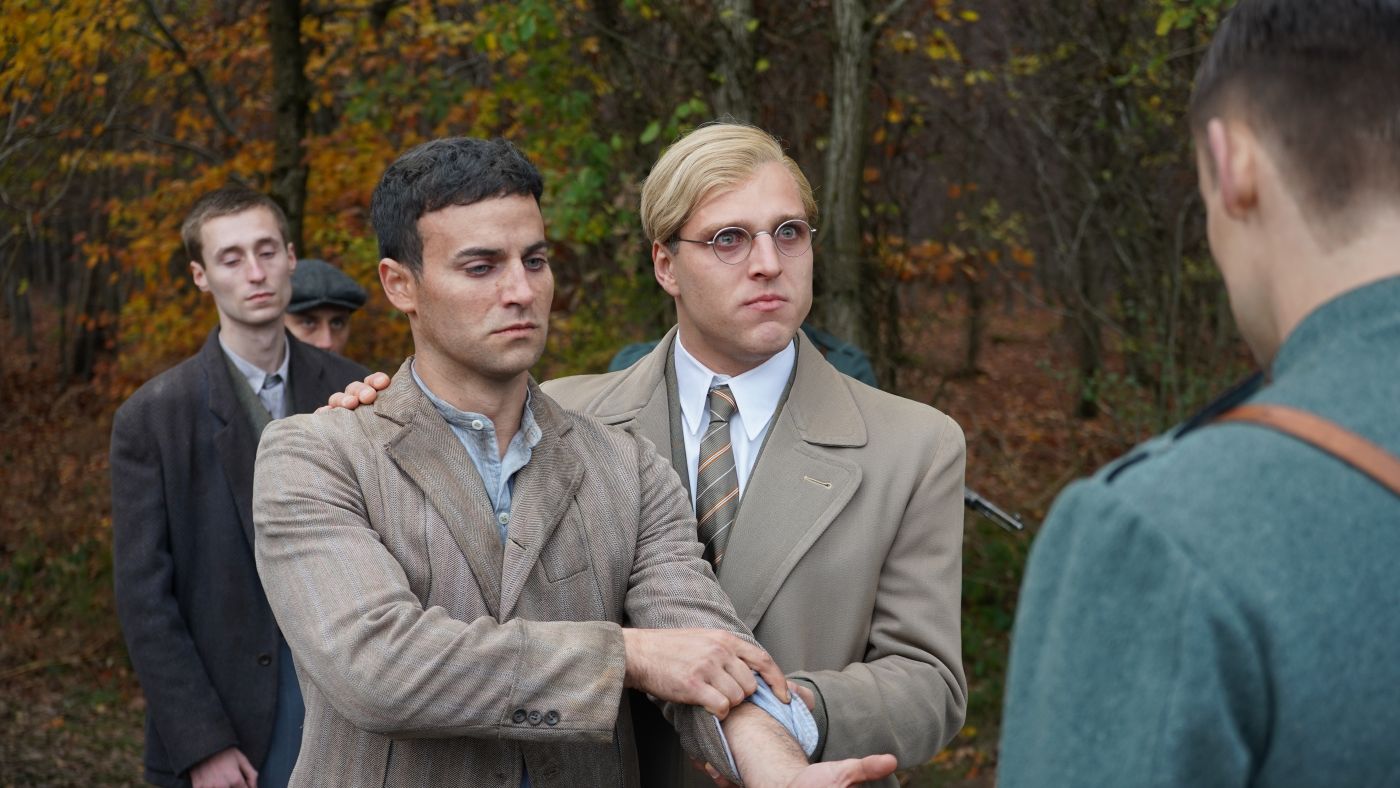
Recalling his childhood while imprisoned in a Nazi camp, young Dietrich devotes his life to religion after his older brother dies during The Great War, leaving him his treasured bible. In his early twenties, Dietrich (Jonas Dassler) leaves Germany for New York in an effort to study at the prestigious Union Theological Seminary and earn a Sloane Fellowship. There, he meets his lifelong friend and fellow classmate Frank Fisher (David Jonsson). As a black Sumerian, Frank introduces Dietrich to a whole new way of thinking. Through his experiences with the Abyssinian Baptist Church, Dietrich learns about Jazz, gospel and Harlem’s sense of community – all becoming formative parts of his world view. However, having been insulated by the University, the Church, and an Arian German upbringing, Dietrich is tasked with accompanying Frank on an expedition of the neighbourhood. Only then does he learn the true horrors and discrimination that black people face under segregation laws.
Jonas Dassler is the spitting image of an adolescent Dietrich, even if his performance lacks gravitas. And while Jonnson stumbles his way through an American accent, his minor role, combined with a decent amount of emotional acting, give him a nice chemistry with his co-star.
Writer/director Komarnicki, not satisfied with the already rigid plotting and predictable turns plaguing even the best biopics, often treats the audience like goldfish – repeating unnecessary details or having characters state the obvious – as if they can’t remember anything for more than five seconds. “That is Walter’s favourite song,” young Dietrich says to no one in particular. As he mournfully plays the piano at his brother’s funeral, he slams the lid closed in frustration. His mother, mere seconds later, clambers up to him, pleading “Don’t stop sweetheart! Walter loved that song.”
The inept screenwriting on display is insulting, especially when the director has to cover heavier topics like systemic racism. In a bid to show Dietrich their different social standings, Frank asks him to book a room for the both of them. But after Dietrich is assaulted for trying to defend Frank and the pair are held at gunpoint, Dietrich is left frustrated.
“This kind of hate takes something stronger than a punch,” he vents to Frank later, before commenting, “I’m so fortunate not having anything like this in Germany.” The line leaves space for a pause, almost as if the audience is supposed to laugh at what should be a disquieting revelation for Dietrich. Instead, the tender moment is undercut by this poor foreshadowing of the things to come.
Returning to Germany in the 1930s, Dietrich lectures at the University of Berlin. But as former murmurs of the Third Reich become shouts at the pulpit of his own church, he is shocked to discover that Hilter has his grip on the church and his fellow clergymen. Even his own bishop, Martin Niemöller (August Diehl) implores Dietrich to not stir the pot, for fear of their mutual safety. Not content with standing by as the church succumbs to unbridled hatred and antisemitism, Dietrich delivers his famous sermon. And while he angers most of the party officials in attendance, he wins over a majority of churchgoers. Yet, as Hitler’s stranglehold on the country leads to the persecution and arrest of Jews, Christians and political enemies, Dietrich’s continued dissent does not go unpunished.
The scene of Dietrich’s sermon is arresting and his new goal to form a school with the now disillusioned Niemöller, as well as the assassination plot with his brother-in-law Hans (Flula Borg), does give us something to root for. Yet, the film’s implication of Dietrich as some sort of martyr is not only confusing, but antithetical to Bonhoeffer as a person. He’ll sit in a circle with his students and teach the importance of gospel music, and when those students are forced to abandon him, he’ll suddenly compare it to “when Jesus was arrested” and all his disciples fled. Even more egregious is when Dietrich is bathed in golden light, as he quite literally breaks bread with his fellow prisoners, and once again compares himself to the prophet. This is done without a hint of irony and goes against his very character. As a priest who despises the Nazis precisely because they worship “a man who has dared to call himself a god”, Dietrich inadvertently turns into a hypocrite.
It’s this contradiction between Bonhoeffer the man and Dietrich the character, as well as Komarnicki’s inability to have us care about either, that makes Bonhoeffer not only a slog to sit through, but a disservice to one of the few Germans brave enough to speak up against the Nazi regime.
