


by Finnlay Dall
Worth: $13.80
FilmInk rates movies out of $20 — the score indicates the amount we believe a ticket to the movie to be worth
Cast:
Jürgen Baldiga, Jannis Veihelmann, Franziskus Claus, Tima die Göttliche, Ulf Reimer
Intro:
... at once simple yet profound.
Jürgen Baldiga’s life as an artist was short lived. But his photography of queer life in West Berlin – leading up to and during the AIDS crisis – has left a substantial legacy in the queer community; due in no small part to his refusal to shy away from his own sexuality, often displaying his most vulnerable moments in front of the lens. Unlocked Heart is Markus Stein’s way of paying tribute to that legacy, presenting a time capsule of Baldiga’s work that is at once simple yet profound.
The film, split into seven chapters, compiles the turning points in Baldiga’s life. Each section highlights the different eras and influences of his artistic practice. The brash and provocative work of his early days in Berlin (Jürgay); his newfound relationship with the charming Eros; the loss that accompanied the AIDS diagnosis and Baldiga’s desperate need to fill the hole in his heart with mindless hookups (Libido); his life back home in Essen; his documenting of the local drag scene, and the tension over “positive” queers in the community (Queens); The Full Spectrum of his deterioration in the AIDS clinic; and eventually his rebirth upon Something Better in his relationship with Ulf and spending his final days in New York.
All of Baldiga’s life is presented in the same stream of consciousness style that he wrote in.
Accompanied with diary entries (voiced by Jannis Veihelmann and Franziskus Claus), and backed by an extensive collection of photos (and discarded selects) from his career, Stein often lets Baldiga and his art speak for themselves. Recreation is used sparingly, often serving as a transition into the next set of photos. Yet, at its most creative, it allows time and space between Baldiga and the audience to blend.
Cinematographer Florian Lampersberger and drag queen Tima die Göttliche strikingly reconstruct her photo in which she looks up to the camera and shushes the viewer with pursed lips. Its placement side by side with the original speaks to Baldiga’s truly timeless work.
While Stein’s hands-off approach to the material is a respectful choice, it creates a lot of confusion for those unfamiliar with Baldiga, especially those outside Germany. Interviewees are never introduced and Baldiga’s diary entries refer to himself in third person. Not to mention the vocal performances of Eros and Baldiga are so dry as to be indistinguishable, making their scenes together especially disorienting.
At the very least, a lot can be intuited about the interviewees by what they say about Baldiga. However, for the people who aren’t mentioned by name in Baldiga’s diary entries – like Tima die Göttliche – audiences will find themselves scouring the credits to find out who they are. For a filmmaker wanting to shed light on the forgotten names and faces of the Queer community, Stein ironically chooses not to provide them with a proper introduction.
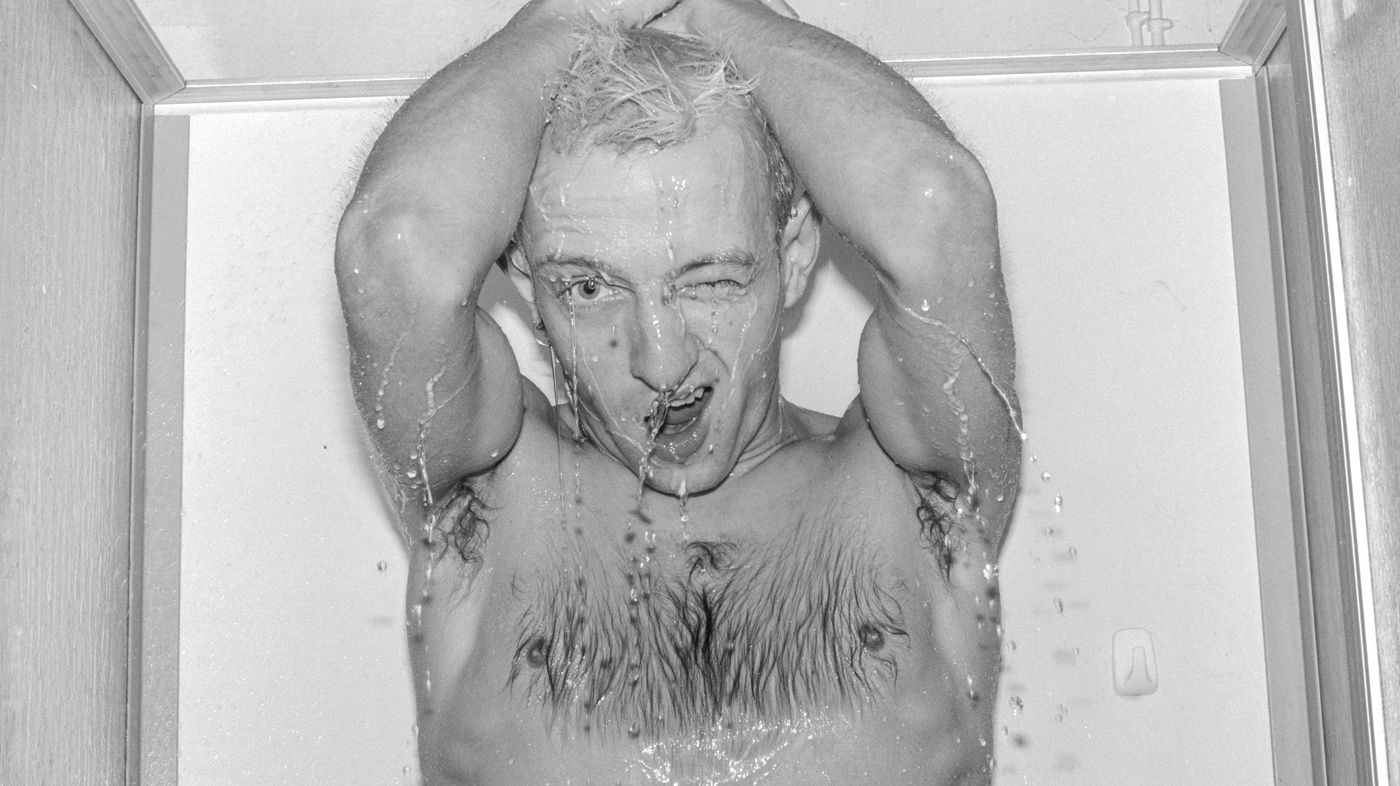
Baldiga’s most powerful photos, and by extension the film’s most poignant moments, are the ones taken during his more serious bouts of illness. His time at the AIDS clinic is as vulnerable, provocative and full of life as his earlier work. Yet, his visceral aesthetics are distorted into a tragic display of suffering. Gone are the wet penises and triple condommed sex scenes in Jürgay or Libido. Replacing them are his series of photos Life with The Virus. The works show emaciated patients, Baldiga puking into a pan, bouts of his extreme constipation as he stares at us through bloodied eyes, and portraits of him sitting on a hospital bed, his skin “marked” for death by Kasopi’s sarcomas. It may be uncomfortable or harrowing for some viewers, but Baldiga puts his pain front and centre, refusing to hide the uncomfortable truth of what suffering with AIDS looks like.
Despite this, there is also a positive side to the series. Talking of the collection Baldiga said, “It upsets me that many [HIV] positives completely isolate themselves and hide instead of participating in life.” These happier photos reveal a more playful side to the patients. Queens will dress up and dance in the cafeteria, Baldiga will side-eye the camera while breathing into a tube, and in New York with Ulf, he’ll kick his legs up in the bath like a model.
Unlocked Heart, for all its ups and downs, is ultimately a story of Baldiga’s resilience as an artist and that of the community that he helped capture. And while he may be gone, his mantra still inspires hope: “Jürgen, hang on. Take your photos. Be sad if you want to, but don’t forget to live.”
