



by FIlmInk Staff
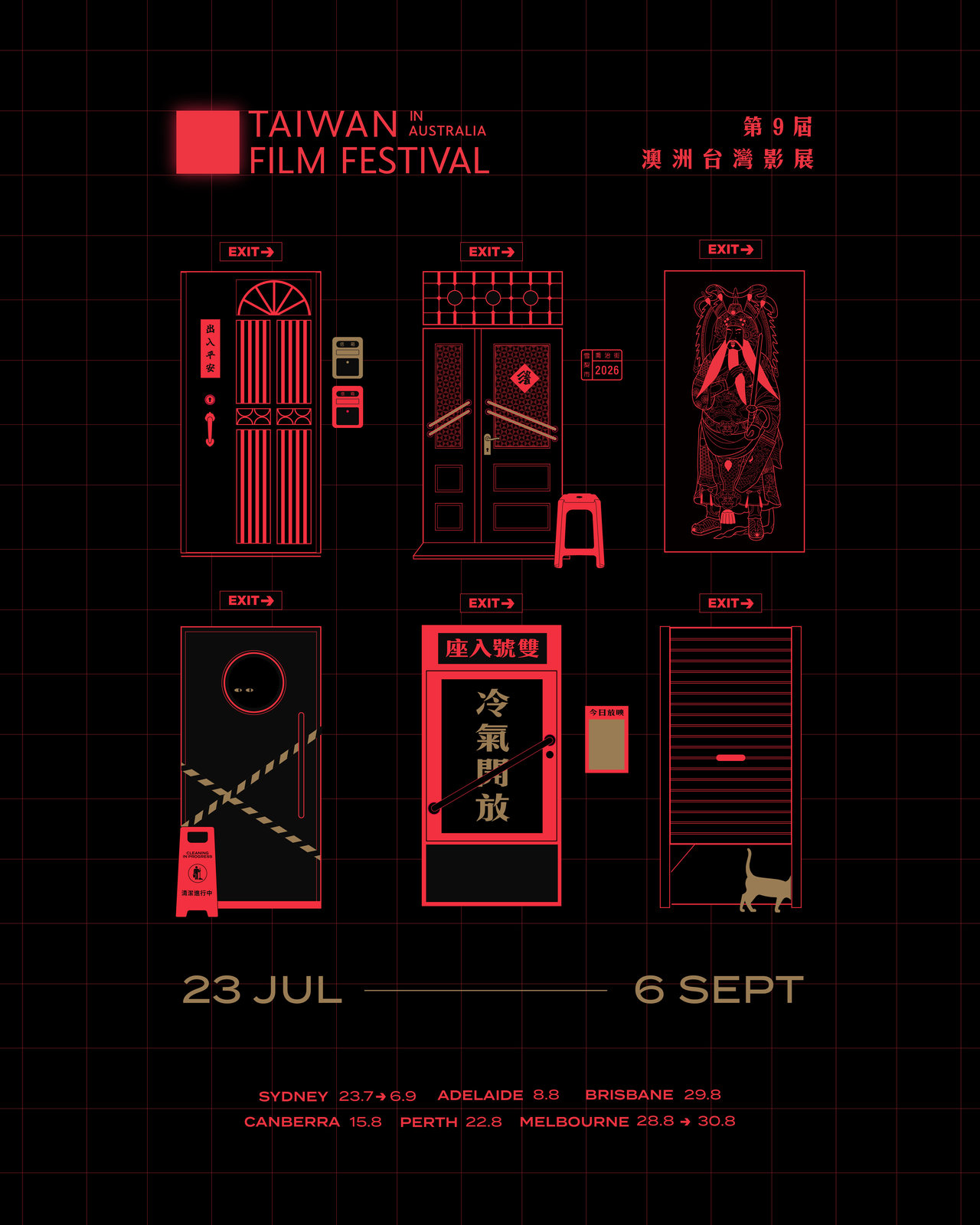 The 9th Taiwan Film Festival in Australia just announced this year’s key visual and full program, which will run from 23 July to 6 September across 6 cities in Australia.
For the first time, the festival is taking a unique approach—focusing not only on Taiwanese cinema but also on Sinophone and International Co-Production projects. This bold move goes beyond the limitations of its traditional programming style, bringing the identities of Taiwanese and Asian cinema to a global platform this year.
This year’s key visual focuses on the doors unique to Taiwanese culture. From household doors, temple doors, and karaoke doors, to traditional cinema doors and garage rolling shutters—each door uniquely tells the story of where we came from, reflecting Taiwan’s history of colonisation and the various imperial influences that shaped it. In particular, the distinct, heavy-metal door frames—almost jail-fence-like in appearance—remain deeply ingrained in modern Taiwanese society. Metaphorically, they voice the underlying repression, obsession with security, and tension that have long existed in Taiwan, which you will be able to see in this year’s program, such as the film LAST NIGHT IN TAIPEI and DEEP QUIET ROOM.
This year’s program also takes us on a historical journey with A CHIP ODYSSEY, tracing the half-century rise of Taiwan’s semiconductor industry. The documentary honours the early engineers who travelled abroad to secure foundational technology during times of extreme resource scarcity.
At the same time, the festival honours the original caretakers of the land through Taiwanese Indigenous culture in I DREAM OF THE OCEAN. This film showcases Tao/Yami culture through the eyes of acclaimed maritime writer Syaman Rapongan and his son, Si Rapongan. This screening pairs perfectly with this year’s “Taiwanese Bookshelves” event, Ocean in Literature. We are thrilled to announce that Syaman Rapongan will be joining us in person for this event in Sydney, Canberra, and for the very first time, Darwin!
OPENING NIGHT 開幕片
LUCKY LU《幸福之路》
Opening the festival is LUCKY LU, directed by Lloyd Lee Choi, a Korean-Canadian writer/director based in Brooklyn. The film premiered at Cannes Directors’ Fortnight and was also selected for the 2025 Melbourne International Film Festival. Lloyd’s recent short film, CLOSING DYNASTY, won the Crystal Bear for Best Short Film at the 73rd Berlinale, the Audience Award at SXSW, the Grand Jury Prize at AFI Fest, Best US Short at Palm Springs, and Best Short Film at Hawaii International Film Festival.
LUCKY LU is a tense, 48-hour journey through the underbelly of New York City, where an e-delivery driver’s world unravels after his bike—his sole livelihood—is stolen. With his long-separated family arriving imminently from Asia, Lu races against time and the city’s indifference to recover what he’s lost, navigating a fractured community and a system that’s left him behind.
“This was the world I wanted to explore in LUCKY LU. A world that is unforgiving and exists in near invisibility right in front of our eyes and even in our homes each day… yet one that we never truly notice. This daily grind and nearly invisible struggle that exists all around us is fascinating to me,” said director Choi.
CLOSING NIGHT 閉幕片
THE SANDWICH MAN《兒子的大玩偶》
Closing the festival is THE SANDWICH MAN, directed by HOU Hsiao-hsien, WAN Jen, TSENG Chuang-hsiang. This seminal three-part anthology charts Taiwan’s transformative Cold War-era industrialisation under the shadow of American economic influence. A towering, essential touchstone that redefined Chinese-language cinema on the global stage, the trilogy brilliantly captures the bittersweet absurdities of survival on the margins of a rapidly changing society.
Produced on a shoestring budget, THE SANDWICH MAN served as the ultimate crucible for the movement’s signature aesthetic, pioneering the use of gritty realism, long takes, and non-professional actors. Despite facing heavy censorship and fierce backlash from conservative critics who feared its raw depiction of poverty would tarnish the nation’s international image, the film triumphed to define an entire cinematic generation. Decades later, its emotional resonance and formal brilliance remain as urgent, heartbreaking, and politically sharp as ever.
