



by FIlmInk Staff
Indie feature film paired digital 65mm capture with a Blackmagic Cloud pipeline
Bedlam is set in 1750s London and follows bare knuckle boxer Jack Slack (played by Scott Adkins) as he attempts to free his sister from the notorious asylum that gives the film its name. Its world is defined by firelight, smoke, and constrained interiors, all of which placed significant demands on the cinematography. Director Jon Sheikh’s vision was for the dramatic sequences to carry as much narrative weight as the film’s fight scenes, with the visual approach needing to support that balance with consistency and detail.
For cinematographer James Butler, 18th century London was further into history than his experience of shooting period settings had previously taken him. Butler was taken by the idea of shooting in 65mm, believing it offered the presence and texture required for the story.
His long standing interest in medium format photography made the jump to large format cinematography an opportunity he couldn’t resist. But with 65mm cameras notoriously, and prohibitively, expensive for indie budgets, finding an affordable camera system would be the principal hurdle Butler would have to overcome.
Knowing he had Bedlam slated for later in the year, Butler began exploring whether the URSA Cine 17K 65 digital film camera could be the answer. “I’ve always loved medium format and the way it renders faces and depth,” he said. “It felt like the right match for this story.”
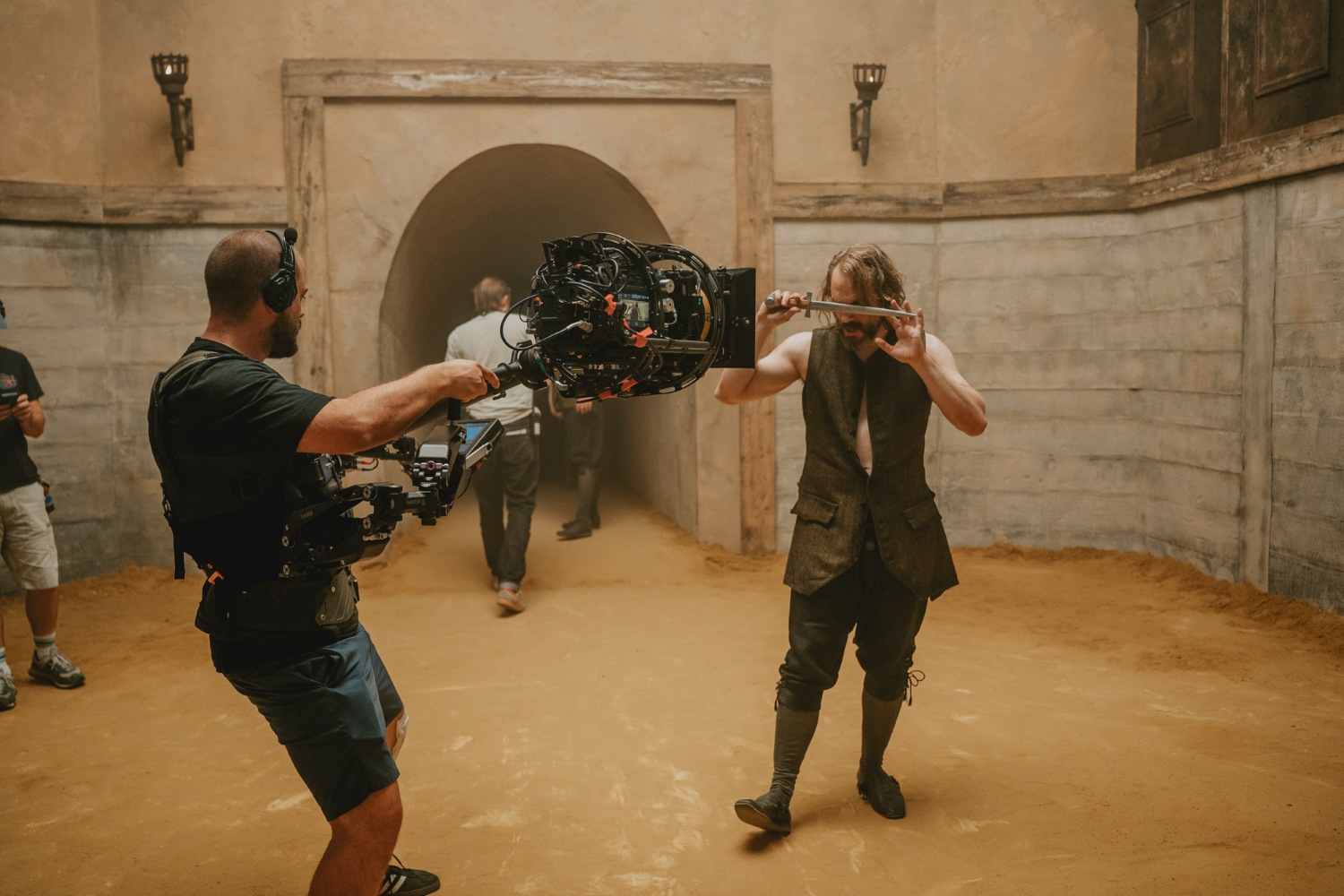
The production opted for two URSA Cine 17K 65 for A and B camera work and a PYXIS 12K for stunt sequences.
Cloud Based Dailies
Testing the URSA Cine 17K 65 gave Butler an opportunity to evaluate a fully integrated Blackmagic RAW pipeline, from onset capture to editorial running DaVinci Resolve Studio. Proxy uploads were sent to Blackmagic Cloud where connectivity allowed during principal photography
The production hired its assembly editor on day one. Working from London, he and his assistant received proxies as they came in, syncing and rough cutting scenes while the shoot was ongoing. Producer Kevin Harvey monitored progress from his home studio in Essex using a calibrated DaVinci Resolve setup. “Kevin became an extra pair of eyes,” Butler said. “He could review scenes earlier in the process and offer feedback that could help the story.”
This daily feedback loop meant the team could review progress during the shoot and plan pickups while sets and cast were still available. For Butler, that was the real benefit of running everything inside DaVinci Resolve Studio and Blackmagic Cloud: it “closed the loop” creatively and helped avoid discovering missing pieces months later in the edit.
“What I like about Blackmagic’s RGBW sensor is that it’s genuinely scalable,” said Butler. “Whatever resolution you choose, you’re still reading the whole 65mm sensor. There’s no crop, so you keep the native field of view and that big, shallow depth of field look in every frame.”
Recording the film in 17K RAW was impractical, so the production evaluated 12K and 8K capture, comparing compression ratios using Blackmagic Design’s data calculator. “For what we needed, the difference between 3:1 and 5:1 was negligible,” Butler noted. Because Bedlam was not VFX heavy, the production opted for 8K at 5:1, striking a balance between image quality and storage efficiency.
It also enabled the London post team to begin cutting while shooting continued, accelerating the overall schedule. “If you can build a robust feature film workflow that cuts cost at multiple points i.e. dailies, storage and finishing, that’s a game changer for independent productions like Bedlam.”
Vintage optics
Butler researched the sources available in 1750 and concluded that scenes would rely on combinations of sunlight, moonlight and fire. “The upper levels had softer blues and whites, and it grew harsher as you moved down,” he said.
The lowest level of Bedlam depended almost entirely on real flame, which pushed the camera into the bottom end of its latitude. Working around 1250 ISO in those sequences, Butler and Kozlowski were often operating at the edge of what they were willing to risk, but still within a range they knew would hold together in the grade. “Rather than underexposing into noise and trying to recover it later, we deliberately gave ourselves a little extra exposure on set and then brought the blacks down in Resolve for clean, structured shadows,” noted Butler.
Lens coverage was another central decision, with a consensus arriving that the standard Hawk65 anamorphic lenses were perfect for the visual direction of the film.
Building a robust rig around the camera required further customization. The URSA Cine 17K 65 paired with large format anamorphics formed a substantial package that needed to operate across cranes, tripods and studio builds. Butler’s team collaborated with Hawk and Ratworks Engineering to design a full cage system compatible with the production’s support requirements.
Depth of field management also played an important role during production. Butler avoided extremely shallow focus to keep characters rooted within their environments. Lenses were generally held between T4 and T5.6, stabilizing backgrounds and maintaining continuity across scenes. He recalls one key sequence lit by a single diffused moonlight source, where the combined effect of the sensor and anamorphic glass delivered the desired clarity and emotional weight. “It was a simple portrait,” he said. “The image gave us exactly what we needed to carry the importance and emotion of the scene.”
By the last day of principal photography, all of the material was already ingested into a shared DaVinci Resolve project. Kozlowski had backed everything up, applied viewing grades and turned over proxies, so that a few days after wrap Sheikh and Butler could sit down and watch a full assembly of the film, something Butler says he’d never had that quickly on a feature.
About Blackmagic Design
Blackmagic Design creates the world’s highest quality video editing products, digital film cameras, color correctors, video converters, video monitoring, routers, live production switchers, disk recorders, waveform monitors and real time film scanners for the feature film, post production and television broadcast industries. Blackmagic Design’s DeckLink capture cards launched a revolution in quality and affordability in post production, while the company’s Emmy™ award winning DaVinci color correction products have dominated the television and film industry since 1984. Blackmagic Design continues ground breaking innovations including 6G-SDI and 12G-SDI products and stereoscopic 3D and Ultra HD workflows. Founded by world leading post production editors and engineers, Blackmagic Design has offices in the USA, UK, Japan, Singapore and Australia. For more information, please go to www.blackmagicdesign.com/au.
