

by Stephen Vagg
Perhaps the most famous role for a young female actor in 1962 was Lolita, based on Vladimir Nabokov’s novel about a middle-aged man’s obsession with a 12-year-old girl. The novel was scandalous, ditto the 1962 film – it was still hot stuff when the 1998 version came out and we can’t see a remake emerging any time soon. Sue Lyon was the 1962 Lolita and it’s perhaps not so surprising that the rest of her career was an anti-climax.
She was born in 1946 in Iowa, the youngest of five children. Lyon’s father died when she was ten months old so to help the family financially, she worked as a child model. This led to moving to Los Angeles, which in turn led to appearances acting in shows such as Dennis the Menace and The Loretta Young Show. In an episode of the latter, Lyon played a young “nymphet” who tempts a middle-aged man unfairly, the poor diddums. The show was seen by Stanley Kubrick, looking for someone to play the title role in his version of Lolita. Various young women had been seen and tested for the part – Hayley Mills was reportedly offered it but her parents turned it down. Lyon was tested and got the gig.
Lyon was fourteen at the time – two years older than the character in the book, but still pretty young, and cast opposite a 53-year-old James Mason. She reportedly had a fling/was assaulted by producer James B. Harris during filming (or the press tour, accounts differ) – he was more than twice her age. You can read all about that here.
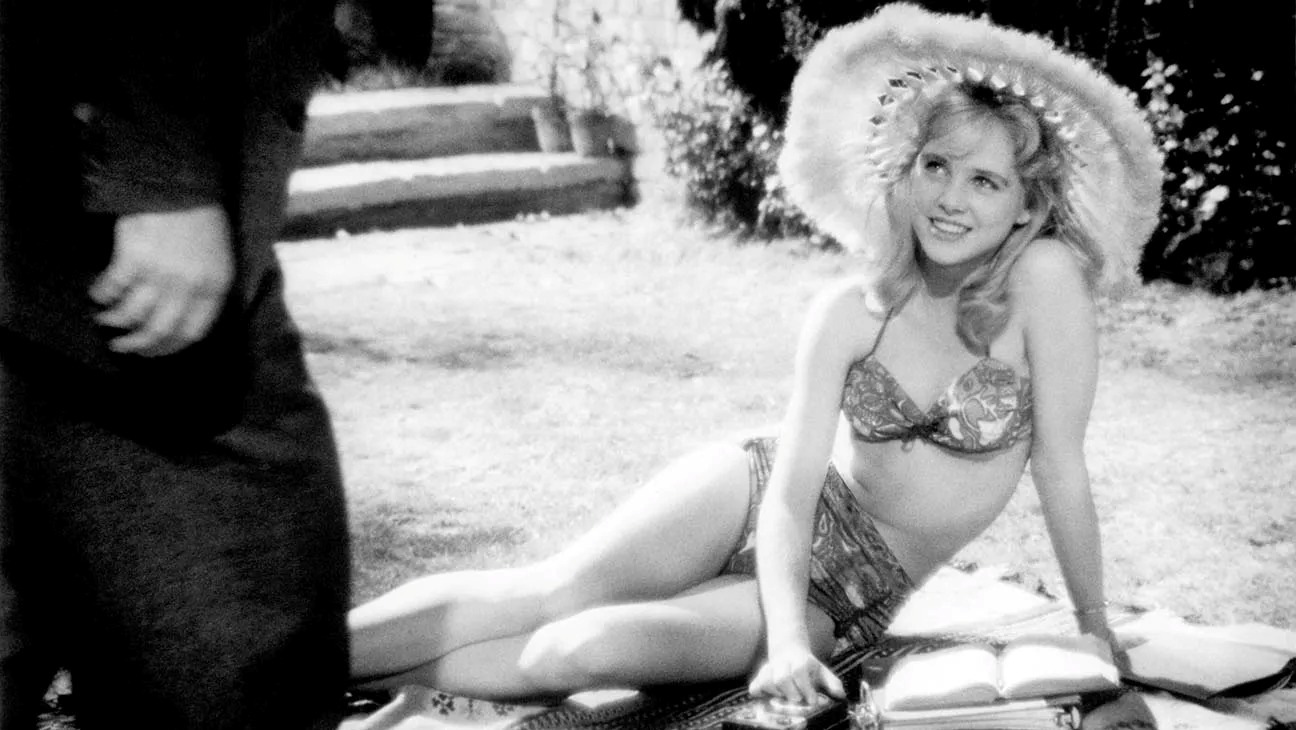
The movie of Lolita was, incidentally, a huge hit, turning Sue Lyon into one of the most famous women in the world. Her image, lounging in the grass, was plastered everywhere and remains iconic. Lyon’s performance never really got its due, in part because so many others in that movie were outstanding, but also there was an irate group of critics upset that a 12-year-old hadn’t been cast.
Part of the Lolita deal involved Lyon signing a long-term contract with Kubrick, Harris and the production company Seven Arts (who financed the movie). She didn’t work for Kubrick or Harris again, but her next movie was for Seven Arts. This was Night of the Iguana (1964), a fun adaptation of the Tennessee Williams play, with superb casting: Richard Burton as a horny priest, Ava Gardner as a cougar, Deborah Kerr as a secretly horny lady and Lyon as (again) a temptress. The film was a big hit and Lyon was batting two for two.
Her next movie sounded ideal – director John Ford, all-star female cast including Anne Bancroft and Margaret Leighton – but the result, Seven Women (1967) was not well liked. It’s a shame as Lyon was very good, being lusted after again by an older person, though in this case it was Leighton, which was at least different.
Lyon then played The Girl in some high-profile pictures: The Film-Flam Man (1967) and Tony Rome (1967), the latter being popular.
After that, the air ran out of her career quickly. She made a spaghetti Western, Four Rode Out (1969), did Arsenic and Old Lace on television (with that old swinger, Bob Crane), began guest-starring on television shows such as Love, American Style and Night Gallery, and was in Evil Knievel (1971). There were films in Europe (Murder in a Blue World) and TV movies (Smash-Up on Interstate 5). But Sue Lyon never became the film star that it seemed she would after Lolita – or, indeed, Night of the Iguana or Tony Rome. Why?
There were several reasons. First, it’s harder for women stars – it just is. As Hollywood morphed into “New Hollywood”, female parts available for actresses got worse and worse. Lyon was also stuck under contract when she was most in demand and probably missed opportunities.
It also must be admitted that Sue Lyon’s personal life was erratic. On top of the Harris situation, she got married when just seventeen (to actor-writer Hampton Fancher, who later wrote Blade Runner). She had four more husbands, all marriages ending in divorce. One was to a black man (photographer Ronald Harrison) in the early ‘70s, leading to a lot of racist press coverage. She also married an imprisoned armed robber and murderer. Her brother died of a drug overdose. She was in a bad car accident along with her mother, who took her own life soon after. There were reports of mental illness. She turned over her New York penthouse to poor people in need.
In the late 1970s, Lyon popped up in a series of low-budget films: Crash (1977), End of the World (1977), The Astral Factor (1978), Towing (1978), and Alligator (1980). The best of these was the latter, but her part was small. There were also stints on Police Story and Fantasy Island.
Then Lyon pretty much retired. In 1996, when the remake of Lolita was announced, Lyon said, “My destruction as a person dates from that movie. Lolita exposed me to temptations no girl of that age should undergo. I defy any pretty girl who is rocketed to stardom at 14 in a sex nymphet role to stay on a level path thereafter.” She died in 2019.
Sue Lyon was a beautiful, compelling screen performer who perhaps never really wanted to be an actor but could be hugely effective if cast in the right part. She worked with some iconic filmmakers and stars, but struggled with personal problems and an environment that was hostile to female talent. We hope she had plenty of happy moments in her life.
