



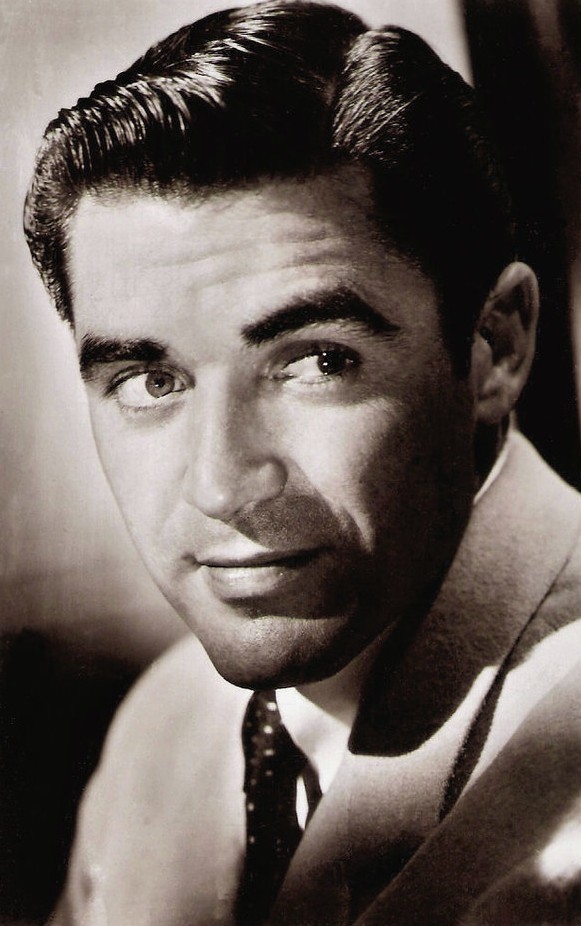
by Stephen Vagg
He was born Robert Alexander Cochran in California in 1917, and tried his hand at a few jobs before drifting into acting as a young man. It took him a number of years to break in, and he spent a lot of time scrounging what theatre gigs he could get around the country. A heart murmur meant that he wasn’t drafted during World War Two, and Cochran’s big break came in 1943 when cast opposite Constance Bennett, in a touring production of the Broadway hit Without Love. He was spotted by scouts from the Sam Goldwyn Organisation, who arranged for a screen test and signed the actor to a contract.
Goldwyn only made a few films a year, all prestige ones, so he got Cochran’s feet wet by loaning him to Columbia to appear in a “B”, Boston Blackie’s Booked on Suspicion (1945). Goldwyn then used the actor in one of his films, a Danny Kaye extravaganza, Wonder Man (1945), playing a gangster – something which suited Cochran’s dark good looks and sinister air. The film was a solid hit, and Goldwyn reunited the actor with Kaye (and leading lady Virginia Mayo) in The Kid from Brooklyn (1946), this time given a more sympathetic role, as a boxer. In between, Cochran was loaned out to appear in Boston Blackie’s Rendezvous (1945) (as a murderer), The Gay Senorita (1945) (a Jinx Falkenburg vehicle), and The Chase (1946); of these, the most notable was The Chase in which Cochran was superb as a gangster.
Cochran was given his showiest role to date when cast by Goldwyn in The Best Years of Our Lives (1946), as the man who hooks up with Virginia Mayo while her husband Dana Andrews was overseas; this movie became one of the biggest hits in Hollywood history, although it must be admitted that Cochran was only on screen briefly. He was in Copacabana (1947) with Groucho Marx, playing a producer, and A Son is Born (1948) again with Kaye and Virginia Mayo, where he was once more a gangster. Then he left Goldwyn.
Cochran’s looks attracted the interest of Mae West, who cast him in a Broadway revival of her play, Diamond Lil. During the show’s run, West broke her ankle and the production was put on hiatus. This enabled Cochran to take up an offer from Warner Bros to play James Cagney’s second in command in White Heat (1949), co-written by Australia’s own Ivan Goff. The film was a huge hit and Warners signed Cochran to a long-term contract.
This seemed like an ideal match – Warners had long been the home of tough guy stars, from Humphrey Bogart and George Raft to Cagney and Edward G. Robinson. However, the Warners-Cochran association would not be that profitable.
It’s not as though the studio didn’t try: it put him in The Damned Don’t Cry (1950), a Joan Crawford noir, as a gangster; Highway 301 (1950), another noir, as a gangster; Dallas (1950), a Western, opposing Gary Cooper; Storm Warning (1951), a ripped-from-the-headlines drama, married to Doris Day and secretly a member of the KKK (this is a very good movie); Raton Pass (1951), a Western with Dennis Morgan; Inside the Walls of Folsom Prison (1951), a prison picture best known today for inspiring a Johnny Cash album; Tomorrow is Another Day (1951), a melodrama of lovers on the run with Ruth Roman; Jim Thorpe (1951), as Burt Lancaster’s rival; The Tanks Are Coming (1951), a war film; The Lion and the Horse (1952), a Western, Operation Secret (1952), a war movie; She’s Back on Broadway (1953), a musical with Mayo; The Desert Song (1953), another musical.
Look at those credits – none of them were particularly memorable except for Storm Warning; certainly none of these movies was a big hit. Thus, Cochran had a fair crack at stardom and never crossed over. This was partly, it must be admitted, due to material – the actor never had a career-defining vehicle as superb as say Bogart had with The Maltese Falcon, Cagney with Public Enemy, Robinson with Little Caesar or Raft with Scarface. But it’s also clear that Steve Cochran never had the individuality and flair of those stars. He could be brilliantly effective in support parts like The Chase and White Heat, but lacked the gravitas to carry a lead. There was something holding him back. Come to think of it, you could say that about most of the new crop of stars that Warners tried to develop in the late 1940s – Virginia Mayo, Dennis Morgan, Ruth Roman, Gene Nelson, Gordon MacRae, David Brian, Patricia Neal. (There were some exceptions, notably Doris Day.)
Anyway, Cochran left Warners, started doing TV, and the budgets of his features got lower: Shark River (1953); Back to God’s Country (1953), being mean to Rock Hudson; Carnival Story (1954), shot in Germany with Anne Baxter; Private Hell 36 (1954), a good noir, from Don Siegel.
Feeling that he needed to take more charge of his career, Cochran turned producer, and managed to secure funding from Republic Pictures for a different sort of project: Come Next Spring (1956), a drama about an alcoholic (Cochran) trying to get back with his ex-wife (Ann Sheridan). This was a sensitive, caring movie – Martin Scorsese is a fan – but the public did not go for it; it probably needed to have been done as a Western.
Cochran tried going artistic again when he did a film for Michelangelo Antonioni in Italy: Il Grido (1957), which he co-produced, although we are unsure of the level of his creative involvement. He also supported Van Johnson in Slander (1957) at MGM, a drama that flopped.
If Cochran could not escape “B”s at least his movies became more interestingly odd as the years went on: The Weapon (1957) shot in Britain with Val Guest, a film that resulted in lawsuits; Quantrill’s Raiders (1958), a Western; I Mobster (1959) for Roger Corman at Fox; The Beat Generation (1959) for Albert Zugsmith, a fascinating beatnik rape drama co-starring Ray Danton and Mamie Van Doren, from a script by Richard Matheson; The Big Operator (1959) again for Zugsmith, only this time playing a hero out to get Mickey Rooney; The Deadly Companions (1961), Sam Peckinpah’s first feature; Of Love and Desire (1963) with Merle Oberon; Mozambique (1964) for Harry Alan Towers, with a script by Australia’s own Peter Yeldham. Cochran wrote, produced and directed his own picture, Tell Me in the Sunlight (1965). He also worked constantly as a guest star on television series; his company made a pilot for a TV series about John C. Fremont but it was not picked up. He was never out of work.
Cochran had a colourful private life – he was married and divorced three times, would bash his girlfriends, and had a few brushes with the law for things like speeding and hitting boxers with baseball bats. He raced cars, sailed boats and flew planes, and slept with many of his co-stars; author James Ellroy commented on the size of Cochran’s member several times in various novels such as American Tabloid.
In 1965, Cochran was sailing on a yacht from Acapulco to Costa Rica in order to scout locations for a proposed movie along with three Mexican women (aged 25, 18 and 14) who were his “housekeepers”. Cochran fell ill on board with a lung infection and became paralysed; the women did not know how to sail the boat or perform first aid and Cochran lingered for two days before dying. The boat drifted for several more days, with these three women and Cochran’s corpse, until another vessel took them in tow and brought them to a port in Guatemala.
Steve Cochran was never going to be a movie star. He simply didn’t have X factor to command the screen. Compare I Mobster with another crime film made by Roger Corman the year before – Machine Gun Kelly (1958), with Charles Bronson. Bronson has a natural star charisma; Cochran doesn’t. His performance in Come Next Spring is absolutely fine – he just lacks that extra “gear”.
That does not mean that Cochran’s career was negligible – far from it. He was a skilled actor who rarely gave a bad performance, and he could be brilliantly effective if cast correctly. His filmography is littered with splendid work and fascinating credits. Consider the directors worked with – Antonioni, Albert Zugsmith, Sam Peckinpah, Roger Corman, Raoul Walsh, Don Siegel, William Wyler, Howard Hawks, Michael Curtiz, Richard Rush. His co-stars included everyone from Groucho Marx and Carmen Miranda to Ronald Reagan and Mamie Van Doren. Incredible life and career. Just not quite a movie star.
