



by Stephen Vagg
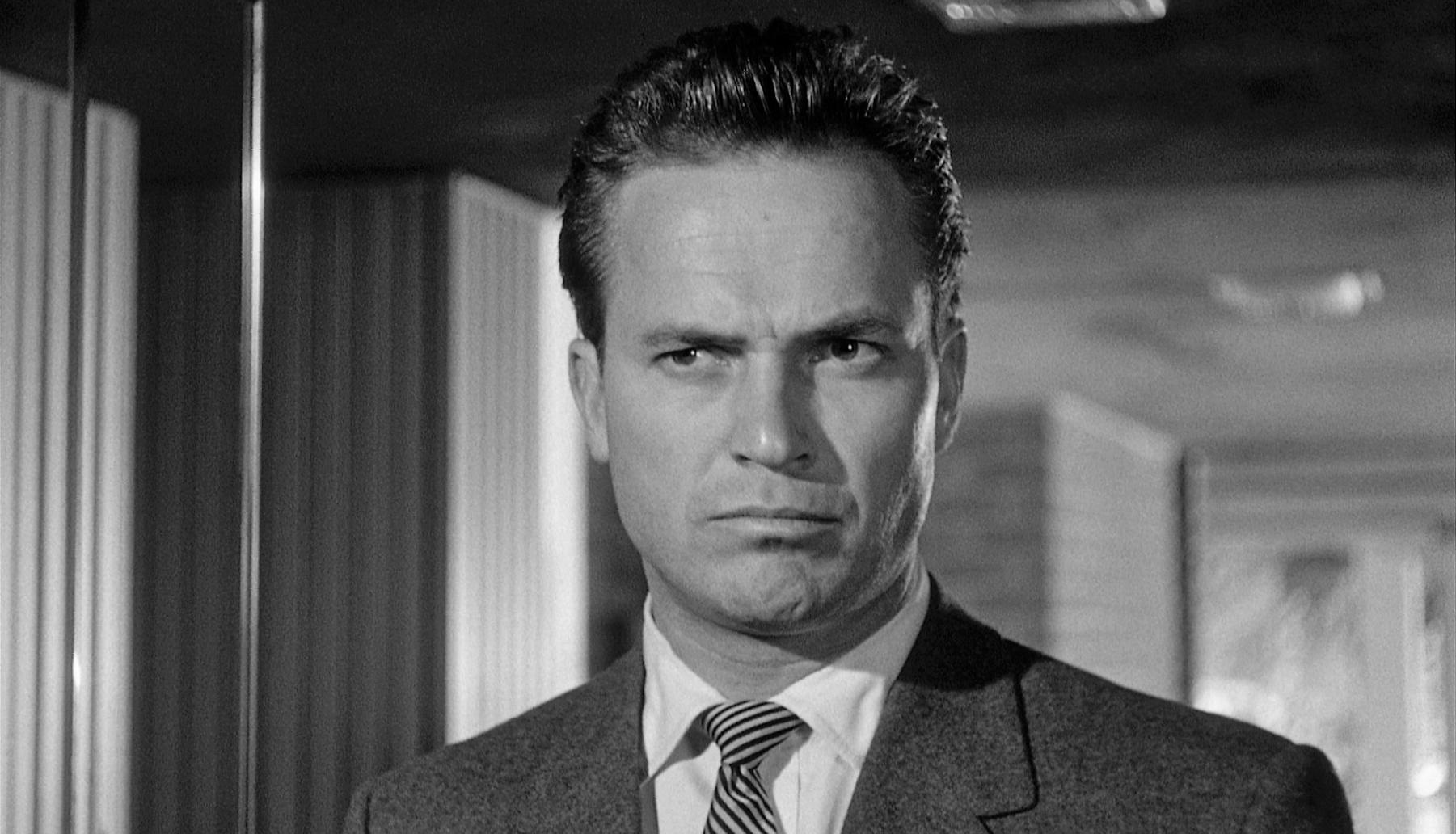
Ralph Meeker was one of the great lost Hollywood stars of the 1950s. He had looks, talent, presence, lead roles in three Broadway hits when that really meant something, significant parts in classic movies, and the backing of a major studio. Yet it never happened for him. How come?
He was born Ralph Rathgeber in 1920 in Minneapolis, and went to Northwestern University, where he started studying music before doing a few plays and getting the acting bug. “I’d tasted the poison,” he laughed later. Meeker appeared in some shows with Jean Hagen and Patricia Neal.
In 1943, Meeker toured in a play called Doughgirls, playing a bellboy, after which he went to New York, where theatre was flourishing at the time. He did summer stock then Jose Ferrer gave him minor roles in two Broadway shows, the race drama Strange Fruit and the classic Cyrano de Bergerac. Josh Logan cast Meeker in the wartime play Mister Roberts as the sailor Mannion; the actor also understudied star Henry Fonda. This play was a critical and commercial sensation, running for ages; it was turned into a 1955 film where Phil Carey played the part of Mannion.
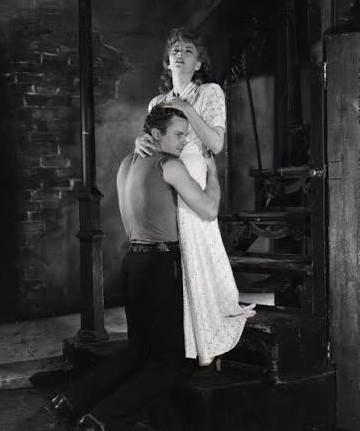 Meeker’s really big break came in 1949 when Marlon Brando decided to leave the cast of A Streetcar Named Desire on Broadway to star in movies and Meeker took over the part of Stanley Kowalski. This made him famous, although “New York famous” – still, Meeker got to play opposite the original Broadway cast (Karl Malden, Kim Hunter, etc.), which was cool. Other actors who played Stanley in that initial run included Anthony Quinn and Jack Palance.
Hollywood started sniffing around Meeker – here was a new Brando, only cheap! Warners screen tested him for the film version of The Glass Menagerie along with Tallulah Bankhead, who apparently got drunk and felt up Meeker, wrecking the test (Arthur Kennedy and Gertrude Lawrence were in the final film). MGM cast Meeker in a support part as a soldier in Teresa (1951), Fred Zinnemann’s popular American-soldier-meets-Italian romance, which made names of Pier Angeli and John Ericson for a brief moment. (Rod Steiger also made his film debut in the movie). Meeker shot some scenes for this movie in Italy; not long after, he returned to Europe to appear in the Swiss movie, Four in a Jeep (1951), as a sergeant.
Teresa was a hit and a delighted MGM put Meeker under contract and promoted him to leads, albeit in “Bs”. However, they were “classy Bs” rather than “fun trashy Bs” – MGM’s head of production Dore Schary was a big fan of the “classy B” which helped make his reputation as a producer at MGM in the early 1940s. Meeker was in Shadow in the Sky (1952), a drama about a recovering veteran, which co-starred Nancy Davis, the future Nancy Reagan, and like all MGM movies starring her, flopped. Glory Alley (1952) was slightly classier, with Meeker as a boxer opposite Leslie Caron, but it was another flop. Paramount borrowed Meeker to play Betty Hutton’s leading man in Somebody Loves Me (1952), a musical biopic of Blossom Seeley and Benny Fields, with Meeker as Fields (his singing voice was dubbed). It did okay but reviews were unkind: Variety wrote “He is not geared to playing a song and dance man”.
MGM put Meeker as third male lead in a great film, the James Stewart-Anthony Mann Western The Naked Spur (1953); it was a solid hit, but Meeker’s part was definitely not as good as Stewart’s or Robert Ryan’s. He was an effective villain in Jeopardy (1953) as a convict tormenting Barbara Stanwyck and Barry Sullivan; John Sturges directed. These two movies were popular and MGM tried Meeker as a star again in a “B” about motorcycle cops, Code Two (1953), but it only did so-so.
These films probably typed Meeker in Hollywood’s eyes – villain yes, hero no. Meeker had tremendous power and vitality but lacked warmth and empathy, possibly vulnerability. He made a superb villain, but audiences didn’t like him as a hero the way they did, say, Wallace Beery or Anthony Quinn. Quinn is a useful comparison because he also played Stanley Kowalski on Broadway. So too did Jack Palance, who became a much bigger film star than Meeker; Palance didn’t have Quinn’s warmth but he did have something Meeker lacked… an incredibly striking face. Meeker’s face was handsome enough, but lacked individuality – it sort of blended into the scenery, which you could never say about Palance. Also, Palance launched his career with choice roles in classics (Shane and Sudden Fear which earned him an Oscar nomination), while Meeker was in flops and/or overshadowed by others (eg Naked Spur).
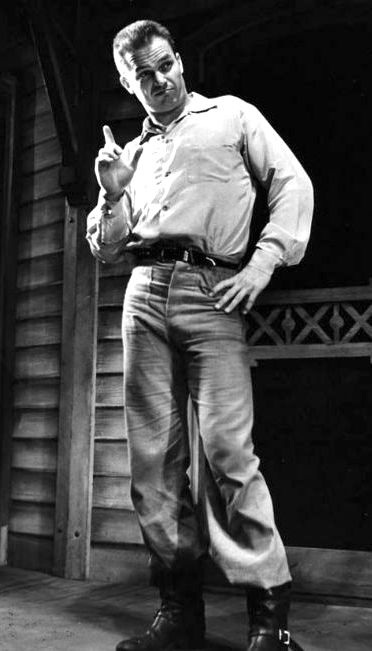 Meeker returned to Broadway with William Inge’s Picnic, playing the drifter who arrives in a Kansas town and gets all the ladies hot and bothered. Director Josh Logan said the part “required an uninhibited actor who could brag, pose, disguise his shabby background with golden stories and then collapse” and they picked Meeker who had “the attractive qualities the role needed as well as the emotional range”. The cast of this production also included Janice Rule, Paul Newman (as Meeker’s best friend), Joanne Woodward (Rule’s understudy), Kim Stanley, Eileen Heckart, and Arthur O’Connell.
The play was a huge hit and Meeker was hot again…. To a degree. When there were doubts Marlon Brando would do On the Waterfront, Meeker was in the frame for the role of Terry Malone – Kazan wrote to Budd Schulberg saying that Meeker was “the second choice”, adding “that’s not a cause for enthusiasm, Ralph Meeker, is it?” And the lead in the film of Picnic (1955) went to William Holden not Meeker, while the biggest film star from the Broadway cast turned out to be Paul Newman, who played Meeker’s friend – Newman was so affable and likeable in Picnic, he was offered a Warner Bros contract and went straight into lead roles (The Silver Chalice).
Still, Meeker was in demand for movie leads again, albeit in unsympathetic parts. He was a convict in the crime picture The Big House (1955), then was cast by Robert Aldrich as Mickey Spillane’s private detective Mike Hammer in Kiss Me Deadly (1955). “I thought he was a very exciting actor, new and fresh,” Aldrich said about his star. “Plus, I didn’t need a real star to get the money for the film. The name ‘Mickey Spillane’ was enough.” Kiss Me Deadly was a fantastic film in part due to Meeker. He’s huge, like a prop forward, with bulky shoulders and a close-cropped haircut; he’s also mean, sadistic, selfish, hilariously irresistible to women (seriously – one in particular at a party just comes up and shoves her tongue down his throat), not particularly smart (his secretary does more hard detecting… he gets information mainly by beating people up), dedicated, compulsive. The movie wasn’t a huge hit, but it soon developed a massive cult which shows no sign of subsiding.
Universal cast Meeker in a French Foreign Legion story, Desert Sands (1955), and he appeared in “Revenge” – the first episode of Alfred Hitchcock Presents, under the direction of Hitchcock himself.
Meeker did a fair bit of television in the 1950s, including a version of Hemingway’s Fifty Grand directed by Sidney Lumet and the TV version of Dino with Sal Mineo. He also did a bit on The Ed Sullivan Show where he did a scene from Good News with Grace Kelly.
For Republic, Meeker starred in a noir, A Woman’s Devotion (1956), with his co-star from Picnic, Janice Rule. He tried a change of pace, The Fuzzy Pink Nightgown (1957) with Jane Russell; he was a last-minute replacement for Ray Danton – according to Russell, Meeker was cast over Dean Martin, who wanted to do it.
Meeker played a racist cavalry officer in Sam Fuller’s Run of the Arrow (1957), who gets [spoilers] mercy killed at the end by the hero a la the 1992 Last of the Mohicans (a lot of baby boomer directors rip off Fuller). He was in another classic movie, Paths of Glory (1957) as one of the innocent soldiers sentenced to die – his work is visceral, real and powerful, a magnificent contributor to a wonderful movie.
In 1959, Meeker starred in his own TV series Not For Hire as an army investigator, but it only lasted a season. He was John Dillinger in a pilot for a proposed TV series The Lawbreakers that wasn’t picked up. There were unsuccessful Broadway shows, but then he was in another theatre classic – Rhinoceros, opposite Zero Mostel, replacing Eli Wallach.
He kept busy in movies too – Ada (1961) with Dean Martin, and more memorably, the remarkable Something Wild (1961), as the man who saves assault victim Carroll Baker and then traps her. (This movie isn’t as well known as it should be).
He was a gangster in Wall of Noise (1963) with Ty Hardin and did some plays for Kazan on Broadway: the little-remembered But for Whom Charlie and the half-classic After the Fall (Arthur Miller’s account of his marriage to Marilyn Monroe, with Meeker playing a man who named names based on Kazan).
By now, Meeker’s days as a leading man were over – he was too chunky for one thing – but he remained hugely in demand in movies, theatre and television, typically as a villain and/or authority figure. He popped up in Robert Aldrich’s The Dirty Dozen (1967) as a shrink, and Roger Corman’s The St Valentine’s Day Massacre (1967) as Bugs Moran. Quentin Tarantino later called Meeker’s work in the latter “just perfect.”
Many of Meeker’s credits, however, were very interesting: The Detective (1968) as a cop; The Devils 8 (1968), a Dirty Dozen rip-off and the first script credit for John Milius; I Walk the Line (1970) as Tuesday Weld’s moonshining dad, confronting a miscast Gregory Peck; The Anderson Tapes (1971) with Sean Connery; the legendary The Night Stalker (1972), with Darren McGavin; Bird of Prey (1972) with David Janssen; Brannigan (1975), John Wayne’s attempt to be Dirty Harry; Bert I. Gordon’s Food of the Gods (1977); and Winter Kills (1980). He also did House of the Blue Leaves (1971) on stage.
Ill health forced Meeker to retire. He suffered a series of strokes and died of a heart attack in 1988. He was briefly married to actor Salome Jens, and a woman called Colleen Neary, and was survived by his wife Millicent. We heard that he had a drinking problem, like most tough-guy actors of his generation, but at least when researching this, we didn’t come across any articles about him being arrested for drink driving or punching someone.
The actor’s great champion in recent years has been Quentin Tarantino, who listed Ralph Meeker as an actor he would have loved to have worked with. Bruce Willis’ character in Pulp Fiction was very much a Ralph Meeker-Aldo Ray type role. When preparing Leonardo DiCaprio for Once Upon a Time in Hollywood, Tarantino sent the actor some episodes of the Steve McQueen show Wanted Dead or Alive (an inspiration for Ric Dalton’s Bounty Law) and apparently DiCaprio was hugely responsive towards guest villain Ralph Meeker. “It’s actually one of the proudest things of this entire movie that I have made Leonardo DiCaprio this huge Ralph Meeker fan,” said Tarantino.
The writer-director claimed DiCaprio watched St Valentine’s Day Massacre and said “one of the things that Meeker does that makes him so powerful… He doesn’t blink… And there’s really only one way to do that. You just have to work on the muscles of your eyes and everything and it takes control and it’s a hard thing to do. But he’s learned how to do it – Meeker. And people aren’t going to notice it, but it has this power to it.” Dakota Fanning does the non-blinking thing in Once Upon a Time.
Looking back at the career of Ralph Meeker, it is surprising he isn’t better known or more celebrated. He was in a string of iconic plays (Streetcar, Mister Roberts, Rhinoceros, After the Fall, House of the Blue Leaves) and iconic movies (The Naked Spur, The Dirty Dozen, Paths of Glory, Kiss Me Deadly, The Night Stalker, Jeopardy, Something Wild, Run of the Arrow). Maybe it was his lack of warmth and relatively anonymous face. Maybe he lacked a really juicy scandal. Anyway, he left a fine legacy.
