



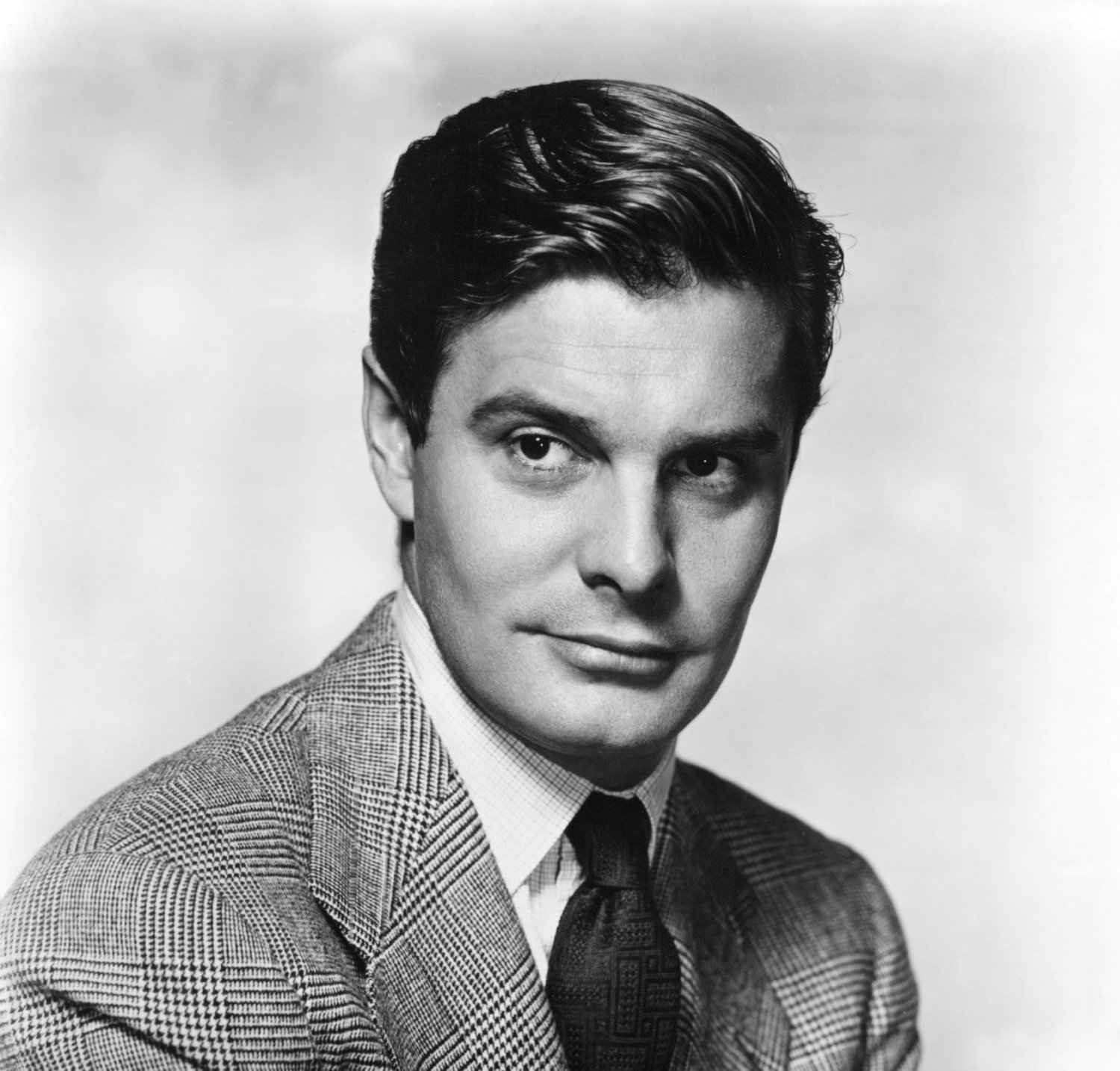
by Stephen Vagg
If you want to be a movie star, it helps to be beautiful – from Rudolph Valentino and Vilma Banky to Brad Pitt and Sydney Sweeney, there have always been jobs going in Hollywood for dreamboats. Sometimes, however, movie stars can be too beautiful – they become otherworldly, unrelatable. This was possibly the case for Louis Jourdan, one of the prettiest film actors to grace the screen, who never quite reached the top rank of stardom. The other thing that might have held him back was his being French, a country whose actors have enjoyed mixed success in Hollywood. Nonetheless, he had a long, varied career of extreme interest.
Jourdan was born in Marseilles in 1921. He started acting relatively young and was at drama school when his looks attracted the attention of famed director Marc Allegret, who cast Jourdan in a film called Le Corsaire, opposite Charles Boyer. Filming was interrupted when war was declared in September 1939 and never resumed – the film remains unfinished.
Jourdan was cast in a movie shot in Rome, La Comédie du bonheur (1940); production was interrupted by Italy declaring war on France, although in this case, the movie was finished. Then he made Premier rendez-vous (aka Her First Affair) (1941) in Paris with Danielle Darrieux.
By this stage, France had surrendered to Germany – the north of the country was occupied, the south became the collaborationist, rugby league-banning Vichy France. But you can’t keep a good pretty boy actor down: Jourdan managed to escape south and started appearing regularly in films shot in Vichy France, mostly playing the romantic male lead. Titles include Parade en sept nuits (1941) for Allegret; L’Arlésienne (1942), for Allegret, with Raimu, the tubby superstar; Félicie Nanteuil (aka Twilight) (1942) for Allegret with Michaeline Presle and Claude Dauphin; La Vie de bohème (1942, released 1945), an Italian co-production; The Beautiful Adventure (1942) again with Allegret, Presle and Dauphin; The Heart of a Nation (1943), directed by Julienne Duvivier, set during the Franco-Prussian War; Les Petites du quai aux fleurs (1944) for Allegret with a young Gerard Philippe. He didn’t become a star, but he worked very regularly – Allegret clearly liked him.
Towards the end of the war, Jourdan joined the French resistance, printing and distributing illegal leaflets. It wasn’t garrotting the Gestapo with cheese wire in back alleys, or joining the Free French Army (as some French stars did, such as Jean Gabin and Jean-Pierre Aumont), but it wasn’t collaborating either (as some other French stars were accused of doing, such as Arletty, Maurice Chevalier, Corinne Luchaire, and Sacha Guitry). After the liberation of France, Jourdan married his childhood sweetheart, Quique – they would be together until her death in 2014.
None of Jourdan’s French films had been international hits, but his handsome-ness did not go unnoticed by Hollywood – a talent scout for David O. Selznick saw him, which led to the Hollywood producer offering a contract in 1946.
At that point, a number of French stars had tried their luck in Los Angeles – some made a great success of it, like Charles Boyer and Maurice Chevalier, but more typically, they struggled (Jean Gabin, Michèle Morgan, Annabella). Selznick launched Jourdan in a dream role, as the sexy, possibly murderous valet in The Paradine Case (1947); the movie had a huge budget, some big stars (Gregory Peck, Charles Laughton) and the direction of Alfred Hitchcock (who wanted Robert Newton in Jourdan’s role), but it was a flop.
Selznick announced Jourdan for a series of other films that were not made (the producer only did one or two a year). Max Ophuls borrowed him to play the love object in Letter from an Unknown Woman (1948), pined after for years by Joan Fontaine. The movie was a masterpiece – but it was not a hit.
Jourdan went to the short-lived Enterprise Studios for a comedy, No Minor Vices (1948), from one of the least comically adept directors in Hollywood (Lewis Milestone); it flopped. More surprisingly, so too did an MGM movie, Madame Bovary (1949), where Jourdan played one of the lovers of Jennifer Jones. He broke it off with Selznick, and went freelance.
Jourdan was friendly with Darryl F. Zanuck, head of 20th Century-Fox (the two men regularly played croquet together) and that studio offered the Frenchman leads in two adventure movies: Bird of Paradise (1951) and Anne of the Indies (1951). He’s not great in either – not helped by playing dislikable characters admittedly – and the public did not flock.
Jourdan had a good chance in The Happy Time (1952), about a French-Canadian family, but audiences didn’t really like it, nor did they go for Decameron Nights (1953) with Joan Fontaine. He finally got to appear in an English-language hit with Three Coins in the Fountain (1954), though he was part of an ensemble.
Jourdan did shows on Broadway – The Immoralist and Tonight in Samarkand, of which the best remembered is the former because it (a) (briefly) starred James Dean, and (b) Jourdan played a repressed homosexual when such characters were not common to see on Broadway. Neither play had a long run. Jourdan tried the lead in a TV show, Paris Precinct, but it was not a hit. Nor was a romance he made for MGM, The Swan (1956) despite it being Grace Kelly’s last film before retirement. The public did, however, like Jourdan as an abusive husband in the thriller Julie (1956) with Doris Day.
Jourdan returned to France to make The Bride is Much Too Beautiful (1957) with Brigitte Bardot, which was popular at home – though due to Bardot, one surmises, rather than he. Jourdan stayed in France to make Escapade (1957), then played the hero in a British swashbuckler that no one liked, Dangerous Exile (1958).
Jourdan was given the role of his life in MGM’s Gigi (1958) as Gaston, the bored man-about-town who roots his cousin and ward (Leslie Caron). The part was written with Dirk Bogarde in mind, but the British actor was unable to do it, so producer Arthur Freed suggested Jourdan instead. Writer-composer Alan Jay Lerner worried Jourdan was too serious for the role, later writing the actor “is not without humour but his humour does not include a twinkle in his soul.” So, Lerner rewrote the script for Jourdan, making Gaston angry at himself for being bored, to give him more energy; this was spelt out in a new number that Lerner wrote to underline this point, “It’s a Bore.” So, Jourdan’s casting in Gigi had a truly significant influence on the movie, which was a huge commercial and critical success.
It is interesting that Gigi did not lead to Jourdan being inundated with offers for leads in studio pictures – we think that Hollywood attributed the film’s success more to its music, Leslie Caron and Chevalier. Still, there was lots of work: he was one of several cads in The Best of Everything (1959), another hit, and supported Frank Sinatra and Shirley MacLaine in Can Can (1960). Then he was absurdly miscast in Amazons of Rome (1961), as an Etruscan allied barbarian bent on invading Rome.
Jourdan went home to appear in Count of Monte Cristo (1962), which was a huge domestic hit, and Disorder (1962) and Mathias Sandorf (1963), which weren’t. In The VIPs (1963), another all-star film, he tried to lure Elizabeth Taylor away from Richard Burton; it was a blockbuster, though any good reviews went to Margaret Rutherford and Maggie Smith. Jourdan was in the original Broadway show of On a Clear Day You Can See Forever (later filmed with Barbra Streisand) but dropped out before it reached Broadway.
He kept busy in films and TV in Hollywood and Europe: Made in Paris (1966) for MGM, The Sultans (1967), To Commit a Murder (1967), Cervantes (1967), To Die in Paris (1968), A Flea in Her Ear (1968), Fear No Evil (1969) and Ritual of Evil (1970).
Through the 1970s, Jourdan increasingly played villains and/or support parts: The Count of Monte Cristo (1975) (with Richard Chamberlain as the hero), Count Dracula (1977), Swamp Thing (1982), Octopussy (1982) (terrific as a villain), Australia’s own Double Deal (1983), The First Olympics: Athens 1896 (1984), Return of Swamp Thing (1989) (hugely fun) and Year of the Comet (1992) (super disappointing). Then he retired. Jourdan died in 2015 having outlived both his wife and his only child, a son who died of a drug overdose, possibly a suicide.
Louis Jourdan played leading roles for pretty much his entire fifty-year acting career – if he wasn’t the hero, he was the romantic male lead, or the villain. He was a competent, very handsome actor who was a “name” but never quite became a star. The public turned up when he was a baddie (Octopussy, Julie), part of an all-star ensemble (The VIPs, The Best of Everything, Three Coins in the Fountain) and/or played a dream object for a story that was about a woman (Gigi). But they did not like him much as a hero.
Why was this so? The prettiness? The Frenchness?
We think it was this – there was something aloof and inaccessible about Louis Jourdan. This made him ideal for lust objects and villains, but not so much heroes. Stephen Harvey, who wrote an excellent book on Vincente Minnelli, felt that Jourdan was held back in his career by conveying “an air of disdainful composure.” The big stars let the audience in to how they are thinking and feeling; they let us sympathise with them. Jourdan never quite had that.
Still, he had a hell of a run. As Jourdan himself once said, “If I was not a great success in American films, neither was I a failure. I have been working for years without setting the world on fire, but managing to keep Quique, my wife, in caviar and champagne.”
Well said, Louis.
