



by Stephen Vagg
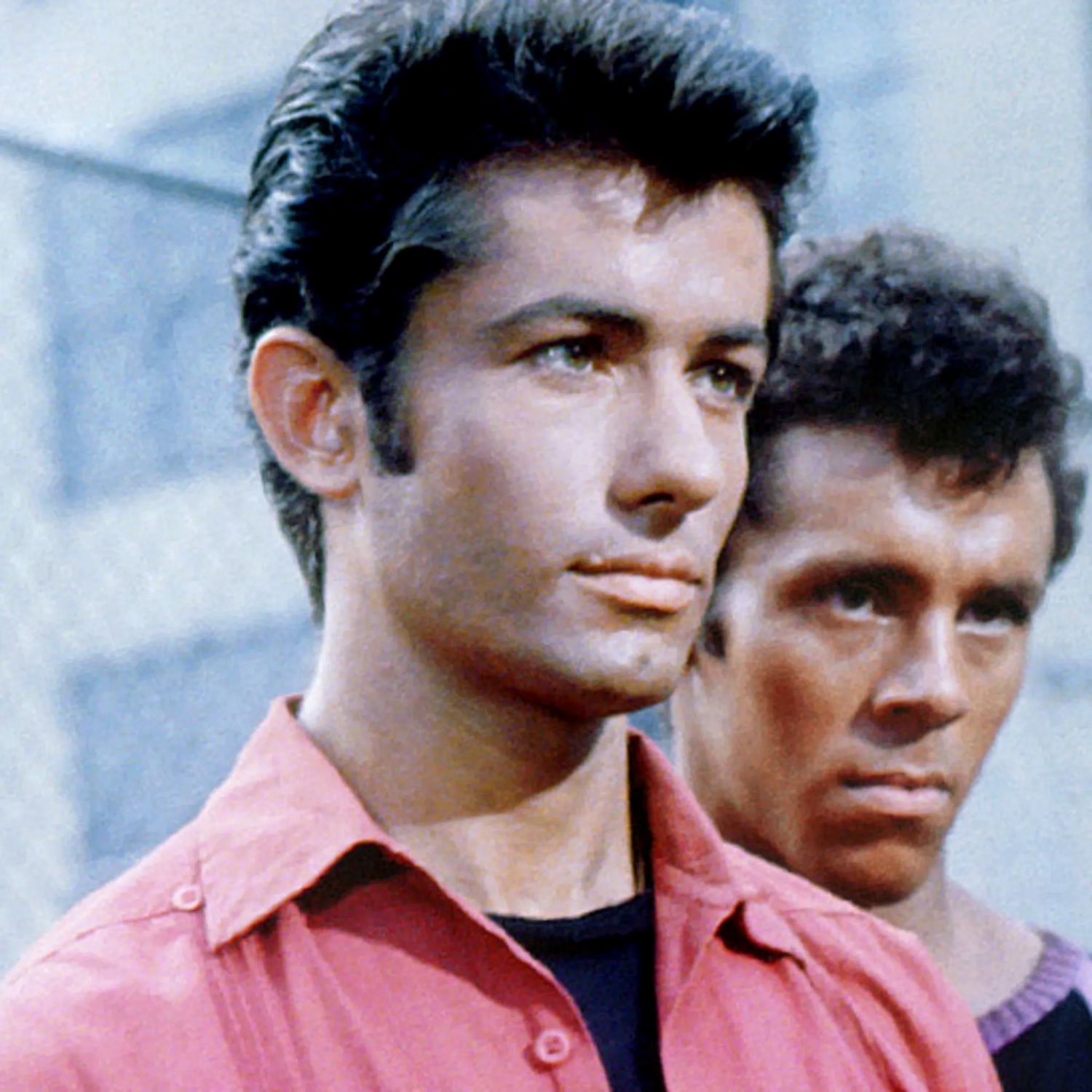
We just finished George Chakiris’ 2021 memoir, My West Side Story, which prompted us to think back on the life and times of Chakiris, aka that bloke who won an Oscar in his first decent film role but never quite became a star.
Indeed, in 2002 he was dismissed as “the saddest and most obscure” Oscar winner – even more than F. Murray Abraham, Mira Sorvino, Linda Hunt, Louis Gosset Jr., Olympia Dukakis, Beatrice Straight, Louise Fletcher or Marlee Matlin. Was this fair? Or did he ever have a chance at being a star?
Chakiris was born in 1932, the son of Greek immigrants from Turkey. He developed a love for dance at an early age, and being based in Los Angeles rather than New York, soon found himself dancing in movies. You might spot him in films like Call Me Madam (1953) and The 5,000 Fingers of Dr T (1953) – he can be clearly seen dancing with Marilyn Monroe in Gentlemen Prefer Blondes (1953) and There’s No Business Like Showbusiness (1954).
Chakiris was briefly under contract to Paramount, who gave him tiny roles in White Christmas (1954), The County Girl (1954) and The Girl Rush (1955) but not much else – musicals went into sharp decline in the late 1950s and Chakiris found jobs harder to come by. He danced in Las Vegas, then managed to be cast as Riff in the London stage production of West Side Story, which was a huge success. When the 1961 film version of West Side was going to be made, several cast members were invited to audition and Chakiris wound up in the movie – only playing the part of Bernardo, while Russ Tamblyn stepped in to play Riff. The movie of West Side Story was not an easy production – co-director Jerome Robbins was fired during the shoot – but became a huge critical and commercial success on its release. Chakiris’ performance earned him an Oscar, over Montgomery Clift (Judgment at Nuremberg), Peter Falk (Pocketful of Miracles), Jackie Gleason (The Hustler) and George C. Scott (The Hustler) – we wonder if Gleason and Scott cancelled each other out. Still, Chakiris gives an excellent performance, full of danger and charisma – and he has that one great scene (‘America’) that every Oscar winner needs.
Chakiris was, for a time, the hottest new face on the block, but his luck was bad. Well, mostly. He was given a recording contract, had some minor hits, but his manager eventually pulled him out of it against his will (so he claims). A British company rushed him into a comedy, Two and Two Make Six (1962), but it flopped. Then he played a support part – a Good Hawaiian – in a decent melodrama starring Charlton Heston (in a role meant for Clark Gable), Diamond Head (1962), that was a hit. He did Bebo’s Girl (1963) with Claudia Cardinale. The Mirisch Corporation, who had produced West Side Story, signed Chakiris to a three-picture deal: two of the movies featured Yul Brynner and flopped – Kings of the Sun (1963), about Mayans in North America, and Flight from Ashiya (1964), an adventure tale; however, the third, the war film 633 Squadron (1964) was a solid hit.
In the mid ‘60s, Chakiris went off to England to play (quite well) a Greek-Cypriot terrorist/freedom fighter in The High Bright Sun (1965), a decent movie that underperformed at the box office but was always on television. Then he was in the Italian The Mona Lisa Has Been Stolen (1965) and the French-American attempt at The Longest Day, Is Paris Burning (1966), playing an American soldier. He was announced for some films that weren’t made – Young Lucifer, Carnival! – and danced memorably in The Young Girls of Rochefort (1967) for Jacques Demy. Chakiris did Kismet (1967) on TV in America, something called Hot Line (1967) in Europe, and was Lana Turner’s leading man in The Big Cube (1969) and… that was about it for George Chakiris the film star.
This didn’t mean that George Chakiris wasn’t employed, far from it: he danced in Vegas, appeared on stage in shows such as The Corn is Green and Company, and guest starred in lots and lots of television, everything from Fantasy Island to Scarecrow and Mrs King. He also made jewellery.
We think that it’s unfair to call George Chakiris a victim of the Oscar curse because West Side Story was his first decent role in a film – he came out of nowhere. That Oscar saw him receive chances that he never would have gotten otherwise – and some of those chances turned into something decent: Diamond Head, The High Bright Sun, Squadron 633, The Young Girls of Rochefort.
In hindsight, he probably spent too much time in Europe. He definitely should have done more musicals – it’s amazing that he became famous in one but didn’t do any apart from Rochefort. To be fair, the musical was in decline through the 1960s but there were some, especially after The Sound of Music. He could’ve gone to Broadway, like his fellow West Side Story Oscar winner, Rita Moreno. His looks may have limited him but there were “swarthy roles” (for lack of a better term) going around at the time – Guns of Navarone, Lawrence of Arabia, Zorba the Greek, Magnificent Seven sequels (we should just say ‘Anthony Quinn films’). He might’ve been hurt by the fact that so many 1960s Hollywood leading men were called George (George Peppard, George Maharis, George Segal, etc).
But most of all, we think that the number one thing behind the non-stardom of George Chakiris was this – he didn’t have the fire in the belly. He had plenty of work ethic but (based on his memoir at least) at heart, he was a bit of drifter, a vagabond going from job to job. If he’d had that hunger, it doesn’t mean he would’ve become a bigger star – but without it, he didn’t have a chance.
Still, he seems to have had a happy, fulfilling life. And making one classic movie is more than most of us get to do.
