



by Greg Dolgopolov
The BFI London Film Festival is a huge affair that makes an impact despite spreading out across a city that has an abundance of events vying for audience attention. It is a big city festival that clearly needs to please many masters. It features some 240 films from 67 countries and ranges octopus-like across 18 screening venues around the city. This dispersal is both attractive in terms of engaging multiple audiences and a hindrance to creating a unified audience body that converges ant-like on a mound of cinemas.
The reality is that this is a decent festival fighting for oxygen in a big city with heaps of other cultural events in an economic climate that is taking pause; a festival providing audiences with fresh opportunities that would be otherwise unavailable to many.
The London Film Festival is a bit of a strange beast – it bills itself as providing the opportunity to SEE THE WORLD’S BEST NEW FILMS. FIRST. This needs to be read with a caveat. The majority of the films screened at London are neither world premieres, Londoners are not seeing them first, nor are the film selections ‘the best’.
With such a large selection of films, it is hard to conjure a unifying theme. Festival Director, Australian expat Clare Stewart (formerly of Sydney Film Festival and ACMI) has come up with 11 themed groupings ‘Love’, ‘Debate’, ‘Dare’, ‘Cult’ etc and a ‘first feature’ competition section. It is an organising principle but when genre expectations are not met – especially in the cult section – tempers can get frayed. Hagazussa – a Heathen’s Curse must be commended for continuing the stereotypes of Austrian cinema being perversely fascinated in bestiality established by such auteurs as Ulrich Seidl in Animal Love (1995). Although stunningly photographed this so-called cult film was a desperately sluggish meditation on witchcraft in the mountains with no sense of horror and only a touch of impending doom. After reading the program notes, we demand a moratorium on comparing anything to Tarkovsky – it is tardy shorthand for slow, thoughtful, or mystical but it just has to stop because it is inaccurate and lazy.
Interesting to note how some films can get on a bit of a roll from one festival to another. Brawl in Cell Block 99 (S. Craig Zahler) starring Vince Vaughn has hoodwinked a bunch of festivals. It is a dopey-wanna-be gangster prison film that only comes alive for the final 15 minutes and is certainly not worthy of the attention of a number of festivals, London included.
It is always pleasing to witness some innovative and bold programming and there was the opportunity to do this with local filmmakers. LFF matters to local and emerging filmmakers given the paucity otherwise of having the best venues in the country screening their work to mainstream audiences. With some 39 local films, the festival has seen an upsurge in local production with new filmmakers moving away from period dramas, comedy of manners and gritty slice of council estate life. The new diverse British voices include a comedy about a Zambian witch-doctor (I Am Not a Witch), a serial-killer thriller set in Jersey (Beast) and a drama about Jehovah’s Witnesses directed by a former member of the church (Apostasy), all part of an exciting new wave of young British filmmakers.
In 2016, the London Film Festival screened to a total audience of 184,000 people, making it the UK’s largest film festival by a big margin. But it is still smaller than the Sydney and Melbourne film festivals despite London’s inordinately larger population. The venues do tend to fill up, but they are small by Australian standards with average audience capacity of around 250.
For all the colonial posturing, the London Film Festival is a great avenue for Australian cinema with some 13 films screening including a mix of shorts, docos, features and Warwick Thornton’s Sweet Country in competition. The standout films were the unexpected Shakespearean tragedy biker genre film, 1% by Stephen McCallum, written by and starring Matt Nable, with Ryan Corr, Abbey Lee and Simone Kessell in support. The other unexpected film was the Chinese-Australian-USA co-production, King of Peking (Sam Voutas) – a loving father-son tale of the emergence of the DVD piracy business in the 1980s that plays out like a Chinese version of Cinema Paradiso – the film is a tender portrayal of a love for popular American cinema in China at a time when this was not party appropriate. The story of how this film was made by Sam Voutas and Producer Jane Zheng is fascinating in its own right as they both grew up in China in the 1980s and Sam has continued to appear in a number of Chinese films as the ‘white guy’.
Sally Aitken’s documentary, David Stratton: A Cinematic Life continues to wow audiences and maintains their fascination in Australian cinema effortlessly blending a delicate portrait of one of Australia’s most loved film critics with an updated anthology analysis of the Australian films that have had a major cultural impact. It was fascinating to observe how well Australian films are known in the ‘old dart’ and how much of a passion there is for more.
The standout films of the festival so far have been the emotionally devastating drama Mudbound by Dee Ress about two WWII war veterans who return to Mississippi after the war to find that racial tensions are far more disgusting than what was perpetrated in Europe. It is a searing portrait of a white family (headed by our own Jason Clarke) thigh deep in mud trying to eke out a living off the land and a black family who lease a section of their land and the racial tensions that explode around them. This is a smart, emotionally thunderous film that must be seen.
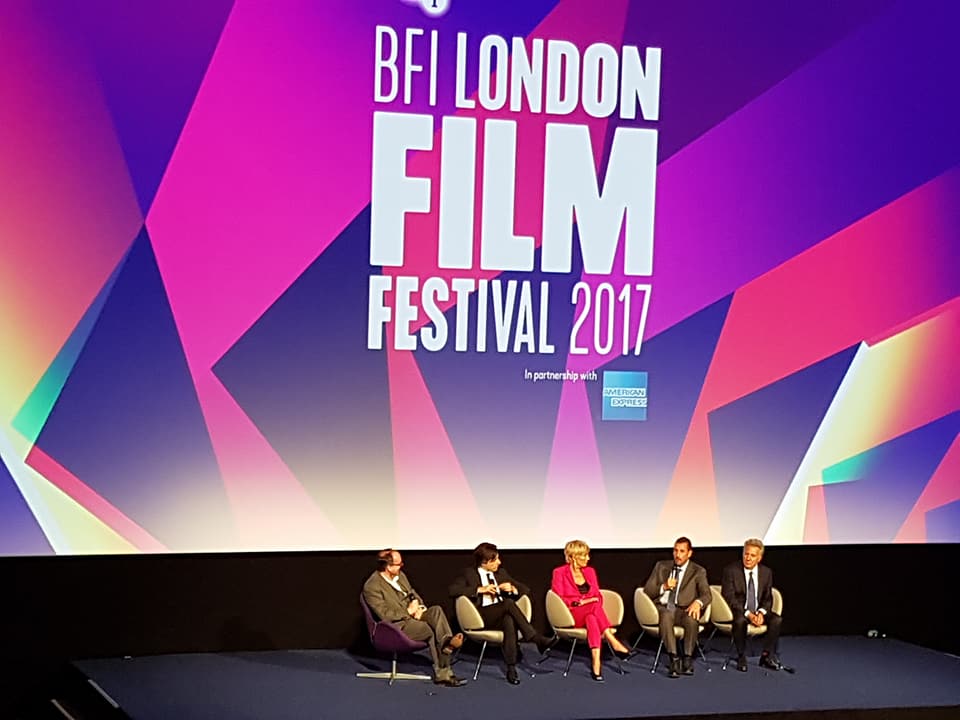
Similarly, another must see is The Meyerowitz Stories (New and Selected) [available on Netflix] written and directed by Noah Baumbach with a delicate ear for everything New York and the mechanics of a seemingly dysfunctional family headed by the insanely narcissistic Dustin Hoffman as a perhaps once great sculptor and his squabbling family of Adam Sandler, Ben Stiller and Emma Thompson, in just some of the roles. It is a dry comedy hoot that is stunning for its bold portrayal of family dynamics where all subtext is thrust forward without compromise.
Finally, a documentary, Lots of Kids, A Monkey and a Castle that was 14 years in the making, a remarkable portrait of a bumbling chatterbox, at times childlike, but always extremely positive mother of filmmaker Gustavo Salmeron. She is a hoarder and incessant commentator and her obsessions provide rich ground from which to observe the complex dances that a larger family are necessarily involved with when times are changing. It is also a very clever portrait of Spain as it moved from the Civil War to the Dictatorship and to the new democratic phase through the prism of this very open but disarmingly whacky family.
The BFI London Film Festival does gather a large abundance of films that have resonated at other festivals earlier in the year. It plays an important role in breaking through the distributors’ menu of limited offerings and providing a broad selection of genre films, gala screenings – stars on the red carpet as well as a vast range of options for cinephiles and mainstream audiences feeling a little adventurous.
For more on the BFI London Film Festival, click here.
