




by FilmInk Staff
The One Day of the Year, correct?
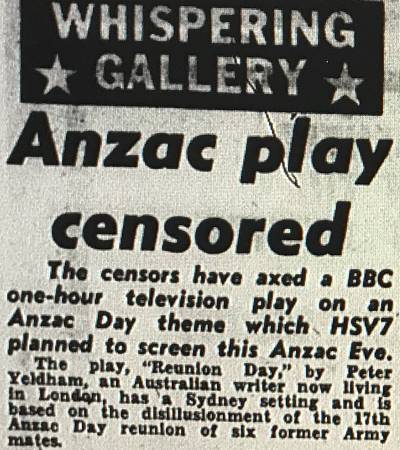
No – The One Day of the Year was never banned, it just scored a few bomb threats. I’m talking about Peter Yeldham’s Reunion Day, a 1962 television play that is amazingly about to have its first performance in Australia sixty years after its banning.
FilmInk talked with Stephen Vagg, who wrote an article about the play last year and is producing the live reading.
What’s the performance?
It’s a rehearsed reading of the script for Reunion Day, being held at AFTRS in Moore Park, Sydney, on Sunday 26 June at 2pm.
What is Reunion Day?
A television play by Peter Yeldham, one of Australia’s top writers – you’d probably know him best for his historical miniseries like Captain James Cook but he has written all sorts of things, novels, film scripts, stage plays, etc. In 1960, he was living in England, working for British TV, when he decided to do something about Anzac Day. There was quite a market for Australian-themed stuff in London at the time – indeed, there was more than there was back in Australia – and Yeldham sold his script to the BBC who filmed it for TV in 1962, with its Manchester Studios standing in for Sydney.

So, it’s like Alan Seymour’s The One Day of the Year?
Not really. I mean, both are Australian works about Anzac Day done on British television, and Alan Seymour was a contemporary of Yeldham’s, but One Day was originally a stage play while Reunion Day was specifically commissioned for the small screen (although I think it would make ideal material for a stage play). Also, the tones of the stories are very different: One Day is, at heart, a father-son saga, while Reunion Day is more of a Big Chill–type tale about several middle-aged soldiers who meet up at a reunion.
 What’s with this banning?
The BBC filmed Reunion Day with a mostly Australian expat cast (then, as now, London was teeming with Aussie actors) – people like Ray Barrett and Ron Haddrick. This production was sold to TCN-9 in Sydney who were going to show it on Anzac Day, but the censor refused to pass it on the grounds that it was insensitive. It’s never been seen in Australia. It’s remarkable as it is a terrific script and from all accounts the original production was great (no copy exists).
Why was it banned, then?
I think (some) people were super sensitive about Anzac Day at the time. As a broad generalisation, Australia was very insecure culturally in 1962, and while we were very proud of our war record, we (“we” meaning the censor and/or Powers That Be, incidentally, I think the average person didn’t care) were prone to over-react at the thought that any of our diggers were anything other than noble, sacrificial bronzed warriors whose lip would tremble movingly at the sound of the Last Post. Reunion Day dared to show that veterans might be unhappy and dissatisfied with their lives. It’s a topic we have become more comfortable dealing with post-Vietnam, although it’s one still depressingly relevant with what our recent Afghanistan and Iraq War veterans are going through. But I think in 1962, to suggest everything was not alright with our diggers was just too touchy. Remember, there had been bomb threats at the opening of The One Day of the Year.
 How did you find out about Reunion Day?
A literary critic called Susan Lever wrote a fantastic article on the play and its production, including a copy of the script and an introduction by Peter Yeldham. I read it and was knocked out by how good the work was. I thought Reunion Day was overdue for a reading. We were going to do it last year, but COVID intervened, so we are trying again this year. In a way, it’s better because this is the 60th anniversary, which is a nicer, rounder number than 59.
Tell us more about the reading
I contacted Denny Lawrence, a super experienced actor-writer-director with a strong interest in Australian cultural history, and he agreed to direct. Denny got together a fabulous group of actors including Brandon Burke, John Derum, David Franklin, Laura Gabriel, Deborah Galanos, Huw Higginson, Sarah-Jane Kelly, David Lynch, Colin Moody, Tilly Oddy-Black, Christopher Stollery and John Stone. Laura’s grandmother Ethel was in the 1962 BBC production which is pretty cool! They’re going to do a reading of the script, then we’ll have a discussion. I also got in touch with Susan Lever, who agreed to give a talk about the play and its historical context. We’re hoping Peter Yeldham can make it – he’s still with us, 95 years not out – and the afternoon is also a tribute to his magnificent career. The cost is a gold coin donation.
So, if the play was banned, is this performance technically still legal?
OMG, wouldn’t it be awesome if there was a raid!
