



by Samantha Whitmore
For two seasons, Baron Sordor’s Theatre of the Doomed has invited listeners into an anthology of monsters, murderers, alien invaders and assorted things that go bump in the night. Its third season, however, is taking a considerable leap into the future.
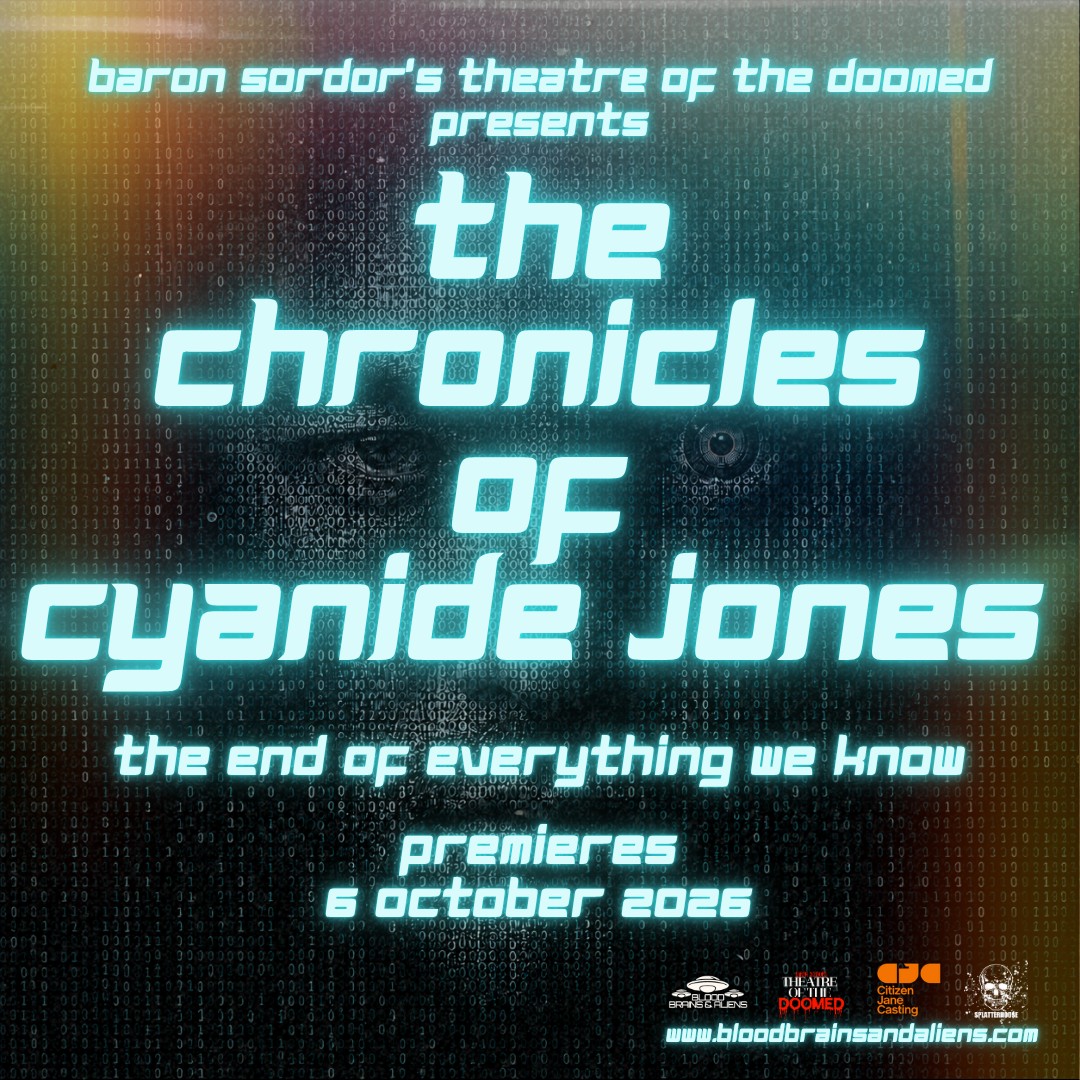
The Chronicles of Cyanide Jones: The End of Everything We Know transforms the series into a weekly 14-part Neon Noir epic, adapting creator Aaron Harvie’s novel into a full-cast audio production led by actor Kristian Schmid, with The Tea Party frontman Jeff Martin returning as the magnificently menacing Baron Sordor.
Ahead of the season’s premiere, I sat down with Harvie, Schmid and Martin to discuss the pleasures of audio drama, the darkness of Cyanide Jones and what it takes to restore a horror host’s dignity after the laughter begins.
Aaron, for those who haven’t yet entered the Theatre of the Doomed, what is Baron Sordor’s Theatre of the Doomed? Give us the show in a nutshell.
Aaron Harvie: It’s a horror and science-fiction audio drama inspired by the great radio plays of the past. The original spark came from Orson Welles’ famous broadcast of The War of the Worlds, which convinced many listeners that an alien invasion might actually be happening. My thinking was that if I could create something immersive enough to pull people into the story like that, to make them genuinely invest in what they were hearing, then I would be doing something right.
Kristian, audiences know you from your work in television, but here they’re experiencing your performance entirely through sound. You’ve appeared in almost every episode of Baron Sordor’s Theatre of the Doomed. What first lured you to the show, and how does audio drama differ from working on screen?
Kristian Schmid: One of the things I really enjoy about audio drama is how immediate it can be. Putting together a film or television production, or even a theatre show, can involve an enormous number of people and take months or years. With this, Aaron can have an idea, write it, and before too long, we’re in the studio bringing it to life. There’s something wonderfully freeing about that.
I’ve also always been drawn to people and stories that are a little left of centre, and Aaron and I definitely share that sensibility. He has this fantastic, slightly eccentric imagination, but he’s also incredibly motivated and prolific. There’s a childlike excitement to the way he creates things that’s very infectious, and you never quite know what he’s going to come up with next.
One of the great pleasures for me is that so many of the characters I’ve played in Baron Sordor’s Theatre of the Doomed are roles I probably wouldn’t be considered for on screen because of how I look. In audio, all of that disappears. You’re limited only by what you can create with your voice and what the listener can imagine. As an actor, that has opened up this wonderful playground that I’ve really enjoyed exploring.
Jeff, most people know you as the frontman of The Tea Party. What appealed to you about becoming the voice welcoming listeners into this strange universe and taking on the great tradition of the horror host?
Jeff Martin: First of all, I was intrigued by the idea of developing a character and personality who could be considered an extension of myself. The human psyche is a very complex thing, and I found embodying Baron Sordor a worthwhile journey into the unknown.
Needless to say, the creativity of Aaron Harvie has made my role in this endeavour an absolute pleasure. He took a chance on me, knowing this would be outside my comfort zone. But no, my friends, the chair is rather comfortable!
Aaron, this season marks a major change for the show, moving from a twice-monthly anthology of standalone stories to a weekly serial telling one epic story across 14 episodes. Why did you decide to change the format, and what new creative opportunities has it given you?
Aaron Harvie: The story of Cyanide Jones had been sitting there for some time. It began as a graphic novel before evolving into a full novel, but I still felt that it hadn’t quite found its true home. The novel is awesome, but Cyanide is an action hero—a movie star—and I wanted to give him the opportunity to reach another audience and exist in another medium.
When I started thinking about ideas for Season Three, I realised this was the perfect opportunity to adapt the novel. I threw out all the standalone episodes I had outlined, decided to roll the dice and completely changed the format of the show. Plus, I’ve got some killer ideas for parts two and three!
Kristian, looking back over the first two seasons, which episodes or characters were the most fun to perform? Was there ever a script that made you ring Aaron and ask, “You want me to do what?”
Kristian Schmid: My reaction is never really, “You want me to do what?” It’s much more, “Oh, brilliant, you’re actually giving me the opportunity to do that.”
Because it’s audio drama, I’ll often come in and play more than one character, sometimes characters who are completely different from each other, and that’s enormous fun as an actor.
I particularly loved The Satanic Rites of Ashley St Ives. I think it’s a brilliant episode, and I had a fantastic time doing it. The Infernal Circle of Eternal Return is another one I really enjoyed. There’s something wonderfully film noir about it, and I loved allowing myself to disappear into that world. It’s certainly not a joyous piece, but there’s something quite thrilling as an actor about being given permission to go that dark.
One of the things I really admire about Aaron is how much he invests in the quality of these productions. He takes the work seriously without ever taking the fun out of making it. I’m incredibly proud of what we’ve produced together, and I genuinely think the quality of the podcast stands alongside audio drama being produced anywhere.
Jeff, the Baron sounds as though he knows exactly what horrors are coming and can barely contain his delight. How do you balance that wicked humour with genuine menace, and does your musical instinct for atmosphere help you find his voice?
Jeff Martin: What a great question! I approach my delivery as the voice of Baron Sordor in the same way I would approach a guitar solo. I always attempt three different tangents and then land on one that combines elements of all three. There are always nuances to mess with in a wonderful way.
Aaron, there’s retro radio theatre, cyberpunk, horror and electronic music running through this series. If we raided your film and record collections, what would give away where The Chronicles of Cyanide Jones came from?
Aaron Harvie: They say the secret to creativity is knowing how to hide your sources. I don’t think I’ve done that particularly well, because I’ve always been pretty open about who and what inspires Cyanide Jones.
He is a celebration of all things retro: John Carpenter and trashy novels, synth music, William Gibson and Neal Stephenson, comic books and exploitation flicks. He rejoices in 8-bit video games, rock music on vinyl, video nasties, shitty science fiction, dusk-till-dawn drive-in marathons and cheeseburgers.
Kristian, now you’re stepping into the role of Cyanide Jones. What was your first reaction to him?
Kristian Schmid: What struck me about Cyanide straight away was that he doesn’t actually say very much, but there’s an enormous amount going on inside his head. Because I’m playing Cyanide as well as narrating the story, I have access to that internal world, which is a really interesting place to be as an actor. He can be quite contained externally, while internally there’s all this thought and complexity going on.
The character comes from a novel Aaron wrote, and before he even sat down to write the book, he had done an extraordinary amount of work creating the world around it. He wrote detailed backstories for the characters and developed all this information that never actually appears in the novel, but it gives everything depth and makes the world feel completely believable.
That’s particularly interesting because the story feels incredibly relevant to the world we’re living in today. Beneath all the science fiction and technology, there are some very human ideas in there.
I’m also excited that Cyanide’s story is going to unfold in shorter episodes over a longer period. Hopefully, that gives the audience time to really get to know him and become emotionally invested in what happens to him. Once people have listened to the podcast, I’d absolutely encourage them to read the novel, because there’s so much more of Aaron’s world in there to discover.
Jeff, the Baron gets some wonderfully twisted alliteration. Have you ever received a script containing something you thought you simply couldn’t get through, and how many takes did it take to restore the Baron’s dignity?
Jeff Martin: The way Aaron writes is somewhat complex, even for me as a lifelong lyricist. I’ll peruse the script and highlight words I have encountered while absorbing and reading many books throughout my life, but which I have never actually spoken aloud. That, in itself, is a joy for me.
Thanks, gentlemen. Finally, complete this sentence: “This is the future…”
Kristian Schmid: Be careful what you wish for. AI might not just be coming for your job.
Jeff Martin: A complex duality of consciousness versus technology. Where do we stand? Let’s take the high road. Let ethics, empathy and compassion prevail.
Aaron Harvie: And nothing can stop it.
Stay in the loop about everything to do with Baron Sordor’s Theatre of the Doomed here and find The Chronicles of Cyanide Jones: The End of Everything We Know from October 8 wherever you listen to podcasts.
