



by Ronnie Pepper
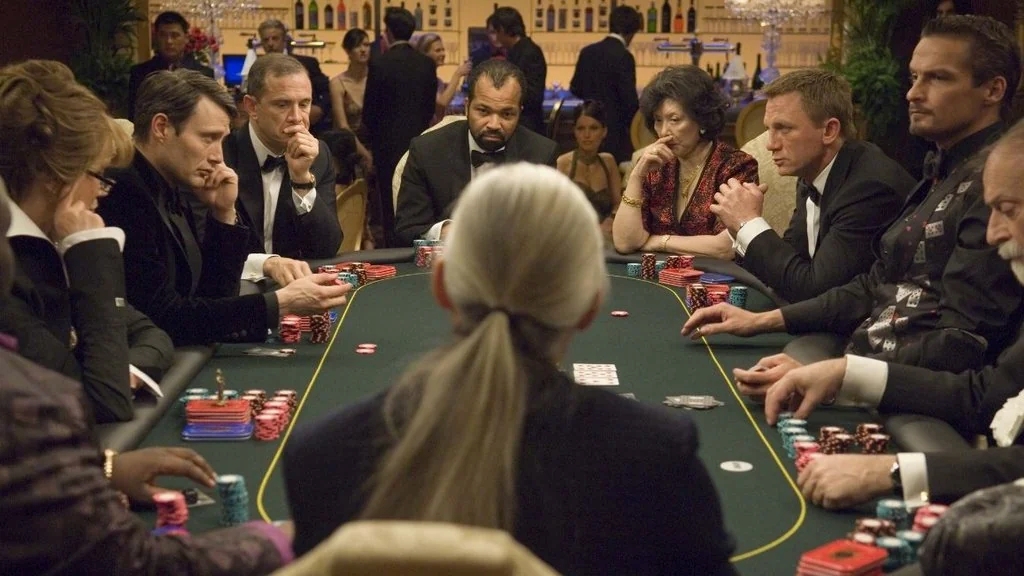
Bond plays poker with $10 million from the British Treasury. His target, Le Chiffre, needs to recover a fortune.
Bond’s buy-in arrives by bank transfer, not a case of cash. Real payment guides can be almost as detailed: reviews of debit card casinos compare accepted cards, deposit steps, withdrawals and bank limits. Bond’s problem is simpler. Vesper Lynd controls another $5 million.
The $10 Million Is Part of a Trap
In Martin Campbell’s 2006 film, Le Chiffre is no ordinary card player. He manages criminals’ money and loses heavily when Bond prevents an airliner attack. His plan relied on the aircraft maker’s share price falling. The plane survives. His clients want answers.
Le Chiffre sets up a tournament in Montenegro. Ten players pay $10 million each to enter, with a $5 million rebuy available. The winner takes the prize. M reckons the pot could reach $150 million, enough to solve Le Chiffre’s immediate problem.
MI6 wants exactly the opposite outcome. If he loses, Le Chiffre may have to exchange information about his clients for British protection. Bond is there to win a card game, but the real prize is a man who knows too much.
Vesper Lynd Has the Money and the Last Word
On the train to Montenegro, Vesper (Eva Green) explains that the Treasury has sent the first $10 million to Bond’s account. She can approve another $5 million, but only if she thinks it is worth spending. Few people can stop 007 with a simple no.
Bond thinks he has spotted Le Chiffre’s weakness. The villain has a tell, a small physical habit that seems to give away a bluff. Bond trusts his reading of the man, bets heavily and loses his original stake when Le Chiffre turns the trick against him.
Vesper refuses the extra funds. Bond’s mission looks finished. Then Felix Leiter, playing for the CIA, offers to pay for the rebuy. The price is political rather than financial: the Americans get Le Chiffre when the game ends. Bond takes the deal and returns to the table.
A Poker Game Shot Like an Action Scene
The players are dealing no-limit Texas hold ’em, with two private cards each and five shared cards on the table. The opening blinds are $5,000 and $10,000. By the final stage the big blind has climbed to $1 million. Even before anyone speaks, those numbers show how little room is left for caution.
Campbell’s camera studies hands, eyes and small changes in expression. Daniel Craig barely needs to move to suggest that Bond has made a decision. Mads Mikkelsen stays rigid and watchful as Le Chiffre, right down to the tear of blood.
The film never stays at the table. The story says Montenegro, but the poker scenes were filmed in Prague studios, with Karlovy Vary standing in for the setting. A brutal stairwell fight interrupts play. Later, Bond’s drink is poisoned, and he struggles to use the medical kit in his Aston Martin before Vesper saves him. He returns to the table. Apparently, poker is the relaxing part.
Four Strong Hands and a $115 Million Pot
The last hand pushes movie-poker luck to its limit. Four players stay in, and the pot reaches $115 million. Each reveal appears strong enough to win, until the next player turns over something better.
- Fukutu shows an ace-high flush.
- Infante reveals a full house, eights over aces.
- Le Chiffre beats him with aces over sixes.
- Bond produces the five and seven of spades, completing a straight flush from four through eight.
A straight flush is five cards in sequence, all of the same suit. It beats every hand shown before Bond’s. Four monster hands in a row hardly resembles real poker. It makes fine cinema. Every player gets a moment to believe he has won before Bond calmly takes the lot.
The Win Cannot Save What Comes Next
The bank holds the tournament money until the winner enters a password for the transfer. That detail sounds like dull paperwork at the start. By the end, it has become a weapon. Le Chiffre kidnaps Bond and tortures him for the password. The cash was always the point.
Mr. White kills Le Chiffre, but the money never makes it back to the Treasury. Vesper has been forced into a betrayal, and the story follows them to Venice, where her death gives the film its cruellest blow. Winning $115 million does not mean Bond gets to keep what matters.
That is why this poker sequence lasts in the memory. The bets are outrageous, the final cards are almost absurd, and the man in the tuxedo can barely control any of it. Bond wins the table. The film makes him pay for the victory elsewhere.
