


By Gill Pringle
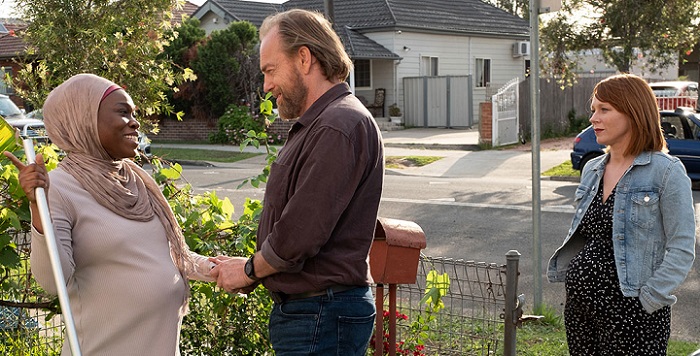
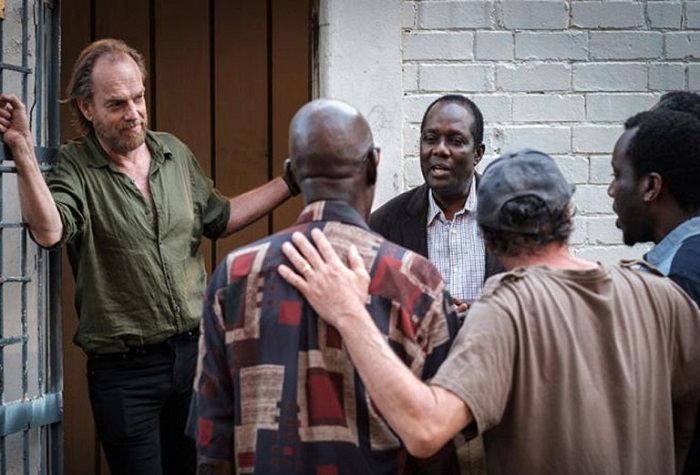
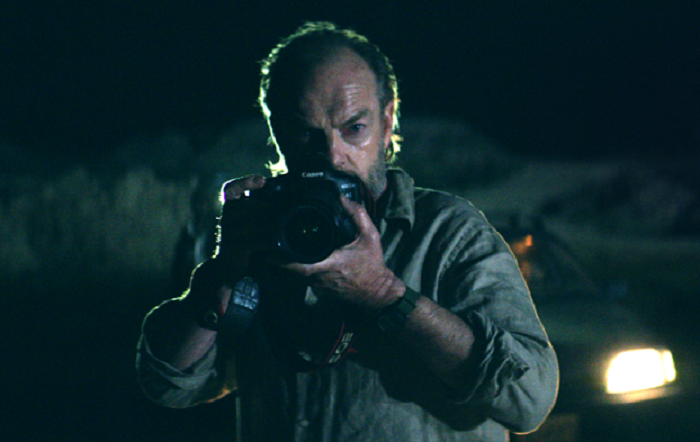
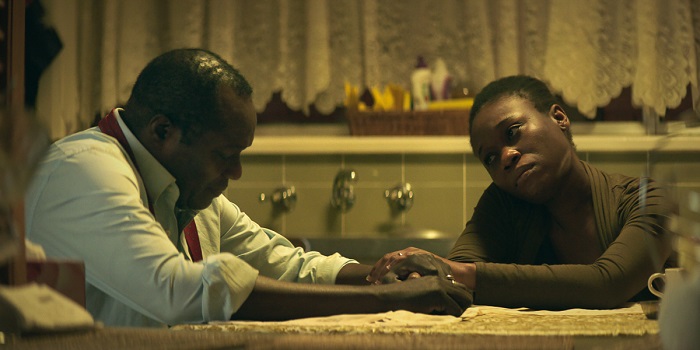
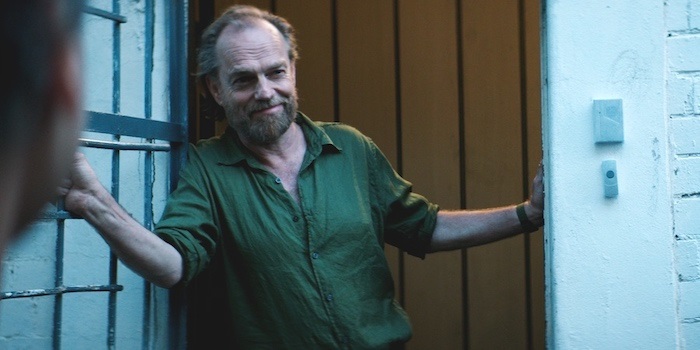
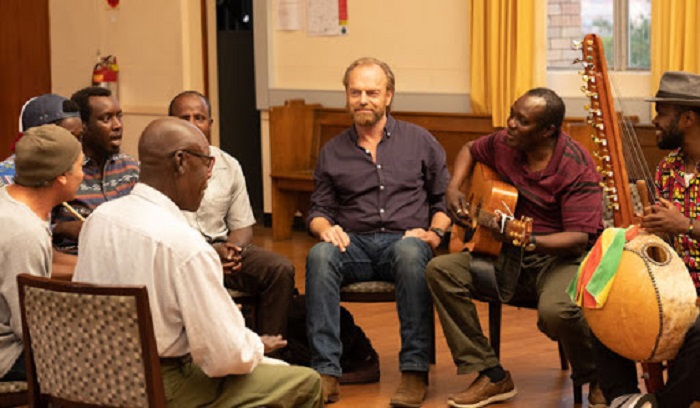
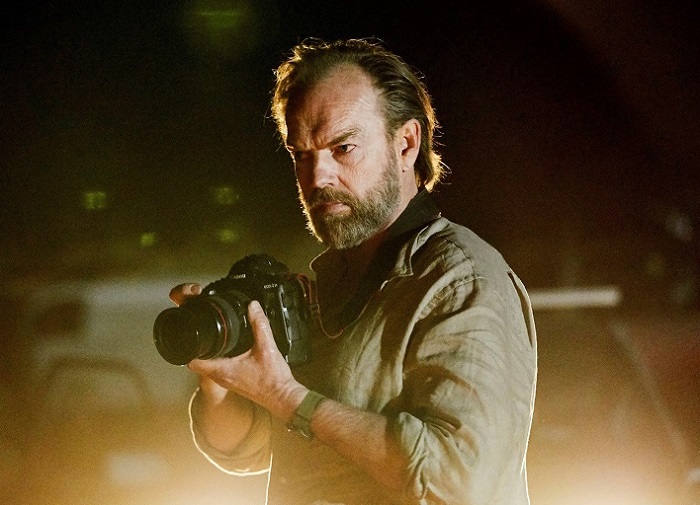
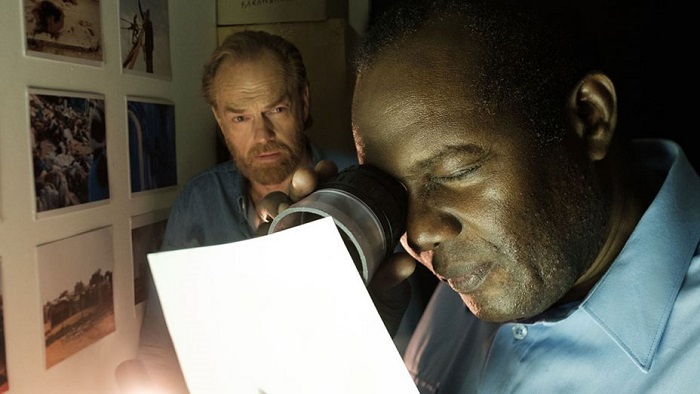
“Trauma…I’m fascinated by it,” Australian writer/director Ben Lawrence tells FilmInk. “A distinct level of trauma can reverberate through a lifetime. I was interested in exploring that, and giving all the characters some level of something that they were grappling with.” Lawrence is certainly true to his word. His much discussed 2018 full length debut – the documentary, Ghost Hunter – drove down deep into the troubled and fractured life of a security guard trying to make sense of his abusive upbringing. The film garnered rave reviews and festival awards, making a move into fictional filmmaking almost a foregone conclusion for Ben Lawrence. The son of prolific commercials director and acclaimed filmmaker Ray Lawrence (Bliss, Lantana, Tracks), Lawrence keeps it tough, emotional, gritty and stylistically assured with Hearts And Bones, in which he finds a more-than-worthy collaborator in Hugo Weaving. The veteran actor plays Dan Fisher, a photojournalist now mentally askew as a result of shooting in too many war zones. Further unbalanced by his wife’s surprise announcement of their impending child, Dan finds an unlikely kindred spirit in the form of Sebastian (gifted first time “non-actor” Andrew Luri), a refugee from South Sudan who approaches the weary photojournalist to photograph his amateur choir, which is made up of men from many African countries. Both men are suffering from their own forms of post-traumatic stress disorder (PTSD), and though they form an almost instant bond, a wedge will soon be driven into their friendship.
Ben, how did the story for Hearts And Bones come to you?
Ben: “There are two stories that come to mind. I did a campaign for Amnesty International, back in the Howard era in Australia. We did mini-stories about recent refugees in Australia, and I was introduced to a Bosnian Women’s Choir. I walked into a community hall in Auburn in Sydney and there were fifteen women there. They were introducing themselves, and one woman started crying. Just hearing a name and a place triggered something within them and then they all started hugging each other. Then they sang John Denver’s ‘Country Road’. These connections between Australia and the rest of the world really interested me. Growing up, I felt very remote and isolated from what was going on in the rest of the world. So, this door was open into a space that connected me to the rest of the world. That really interested me. Photojournalism is the other thing. A French photographer who had had a gun held to his head was visiting Sydney and bringing his work with him. We had all of these people bringing their stories, and it just grew from there. There were two distinct moments.”
Sydney has a long history of new arrivals…
Ben: “It’s built on people who have come to rebuild their lives. They’ve come to start afresh and in that way, there is layer upon layer of migration and refugees. Proportionally, it’s good. We could do more and subsequent governments elevate and play with the numbers and stuff like that. When the civil war came up in South Sudan, probably going back fifteen years now, we started to see a lot of Africans come to Australia. That was a new thing. Traditionally, it’s more been Southeast Asia and The Middle East, so that was really distinct. There are probably 200 languages spoken in Sydney. It’s incredible in that way.”
Hugo: “It is a very multicultural society but we do have a very restrictive policy about turning back refugee boats. It’s very, very heavy. It’s a kind of strong arm policy, and I get very angry about that. Those sorts of issues are absolutely threaded throughout the film, and the heart of the film is very much the reason why I was interested.”
Hugo, you were born in Nigeria? And then went to live in the UK?
Hugo: “I was not yet one when we went to the UK, and then I went back and lived in South Africa. I was politicised, as a 9-year-old boy before I left. It was the heart of apartheid, so my political education really started in Johannesburg in 1968. I just didn’t understand what that society was doing and why they were doing it. At that age, you don’t. You can see it all around you. I learned a lot from traveling around the world, and realising that we’re all essentially the same. We have different opportunities depending on who we are.”
Were you at a segregated school in South Africa?
Hugo: “Absolutely. There was nothing else. I went to an all-boy, all-white school. I learned Afrikaans, French, and English. It was a classic English prep school, but in Johannesburg. We wore khaki uniforms, but it wasn’t a military school. Everything I did there, every breath that I took, everywhere I looked…it’s a beautiful place, but there are all these questions that you have as a kid. We had a gardener who had worked at our house. I really liked him and talked to him a lot. Then I didn’t see him for six or seven months and he came up to the fence line and I ran up to him. Nicodemus was his name. He was so sweet. He just told me that he had been arrested, and what happened. I remember him telling me that they made him eat floor polish while he was in detention. The sight of this beautiful man, taking great care with me, and then he said that. I’ve never forgotten that. But there’s a million other stories about that…about inequality in the world. Then there was the censorship in my father’s Sunday Times, which arrived from England. There were whole streams of stuff blacked out, literally by hand, by the government. I understood all sorts of things about censorship at that age.”
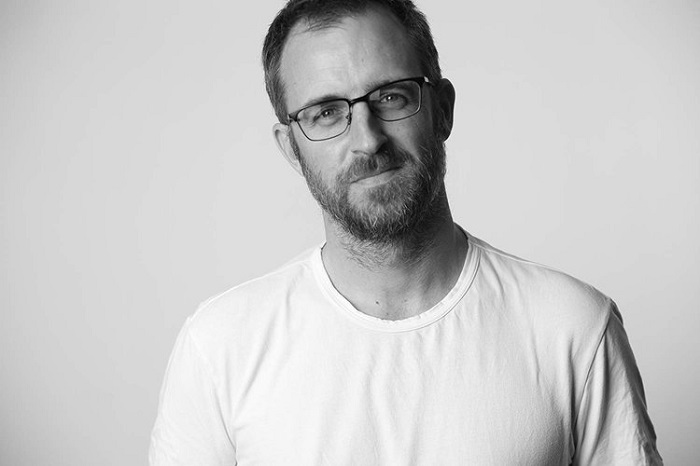
Ben, how much has your father’s career shaped yours?
Ben: “Enormously! How could it not? I give equal credit to my mother as well – she’s a social worker. So the idea of social justice and the filmmaker father combined to make me very passionate about documentary and non-fiction filmmaking and things like that. His eye for human interaction and the psychology of characters, the stories of men and woman and the way that they interact…that all fascinated me. He shared so much with me. That is what our relationship is built on, my father’s and mine: talking about film. That’s how we connect. That’s distinct, compared to my friends growing up. Their fathers were all about sport, and I couldn’t understand that. Dad was not into sport. I knew it was unusual then and I think that as I get older, I can make more sense out of that. My son is nine now and I see him growing up. My daughter, she’s 11 and my relationship with them is similar in a way, but I wouldn’t wish them to be in the film industry. Dad said that to me. It’s a tough road. It is that passion for film that obviously came from him.”
Hugo, you saw an earlier script that you felt wasn’t there…
Hugo: “It was still in development but I really liked it. I didn’t think it was quite ready. When I saw it again, I thought it was really fantastic. I saw Ghosthunter and was really impressed by that – the idea of male trauma and the particular journey of this man into himself, unravelling or discovering all these things which are buried within him and within his childhood. It was really fascinating. There’s a lot of unravelling that happens in Hearts And Bones as well. There’s hidden trauma within the characters. In that way, Ghosthunter and this one informed each other.”
You are certainly attracted to the concept of trauma…
Ben: “I’ve really thought about this a lot. I don’t think I actively went out and sought it out but maybe it’s kind of in the air in society. The work that I’d done at the ABC, with the Man Up series, was about male suicide. I can draw a line between that, Ghosthunter and now Hearts And Bones. It must have been brewing away. I’ve been researching PTSD and talking to people for a long time. It’s fascinated me. There is so much research on that now. There is one more thing that I just want to say. You brought up my father and the films. So, my middle name is Kane, K-A-N-E. His favourite film is Citizen Kane. He created this family middle name. My sister and I have it and now my kids have it as well. It is integral to the way we grew up.”
Hugo, did you go out and talk to people with and about PTSD?
Hugo: “There is such a wealth of material out there too. When you start looking into photojournalists’ stories, you realise that this is a serious issue with a lot of war photographers. There’s a wealth of stuff with people who have been on the frontline over many, many years. With anyone who’s in a war zone, not just photojournalists, there is trauma that sticks to them over many, many years.”
Is there one particular person that guided you?
Hugo: “We talked about the famous photographer Sebastião Ribeiro Salgado, and I read his book too. A profound sense of trauma shifted his whole practice. Now, he’s replanting this whole property that his parents owned in South America because it had been deforested. So all of his energy has gone back into regrowing nature, re-wilding this place because of all the hideousness he had seen in Rwanda. The African experience really got to him. It massively affected him to the extent that he moved back to his old place and was planting trees. That was his healing. It’s a great book. I was just following all these different stories and increasingly they became about photojournalists. I’d also played other characters who really had PTSD, for other reasons. It’s a funny thing being an actor, because often the experience of playing a character, either in theatre or in film, kind of becomes part of who you are. You’re literally following the shapes of someone’s life and saying the words that someone is saying in a way that needs to feel truthful, and it does to you. Part of that process becomes… I’m not saying that I have PTSD, but I have a sense of it in a kind of organic way through working in it and thinking about it and being an actor.”
Did you show it to any PTSD sufferers?
Ben: “I didn’t intentionally, meaning I didn’t seek out people who were suffering. Probably the closest that I came to that is the South Sudanese community. They have probably been the most interesting and satisfying viewings. I showed the script to Deng Adut, who is a former child soldier, and was a New South Wales Person of the Year, going back some years. He is now a lawyer in Sydney. I showed him the script early on, and as a very good lawyer does, he went through the script and annotated the whole thing. We sat down for hours and talked about it. He’s written this amazing book, Songs Of A War Boy, about his life as a child soldier. He’s very successful now, but he has had this experience in his life. He came to a screening and I understand that he was not able to watch the whole film, but he knew the story. It’s about respecting the experience, but you can bring other things to it, like your relationships in your own life and stuff like that. That was really important to me.”
Did you speak to any of the UN people? UNICEF?
Ben: “No, but I’d like to show it to organisations like that. They bang their heads against the wall for so long, and I think a film can just condense a point of view on experience. I’m really interested in being able to show it for and with those organisations and then bringing other people in who might not have as good an understanding. It’s those discussions afterwards and those little connections that I think films are good at. They are a public thing. They’re safe, and they can talk about important things. It’s about what happens afterwards…it might be just one connection. It’s touching people in different ways.”
It’s definitely a film to talk about afterwards. Hugo, what’s your experience with photography?
Hugo: “I didn’t have a really good camera. I’ve always wanted one. I’ve used my phone. But weirdly enough, I have a massive collection of beautiful photographic studies. I love photography. I love looking at it and reading about it, but I’m not a photographer myself. Ben made up a beautiful book of his own photos that I looked at very early on. It was a lovely present from him. So that’s now in my collection. I had to figure out the whole thing of how do I physically hold and carry and operate this particular camera. We had a guy that came around and just talked me through the whole thing. I just needed to look like I knew what I was doing because I technically don’t. I have a great love, and a great passion, for photography, but I’m not a photographer.”
Ben, this has been in the process of being made for such a long time. Have there been other people along the way?
Ben: “Hugo was always in my mind. I wanted to work with a very experienced actor. I knew that for that role. I loved the idea of having someone that was a non-actor too. That combination interested me. I really had to fight for that. When Hugo agreed to do it, I knew that I could build around that. I just kept seeing things that Hugo was doing, and it informed the work. There has been so much along the way that I’ve been very lucky with on this film, particularly in putting the group of people together.”
Hugo: “You have certain structures in place when you’re making a film that need to be there, but then you also need to have flexibilities within that. On a day to day basis, in order to capture the truth of human interaction. Otherwise, you are to set in stone. Ben’s got a great mix of true flexibility and preparedness and understanding about what he’s trying to construct.”
Ben, what do you really hope the audience takes away from the film?
Ben: “The premise is amazing. I just want people to go, ‘Wow! I love the idea of that story.’ There’s a great mystery in there. The film starts to touch on love and then it gets deeper and deeper and deeper. I want people to be attracted to the idea that they are going to see a fantastic story but ultimately, they don’t walk out of the same film that they walked into. That’s the journey that I want people to go on. Something that Dad really taught me was that it’s how people walk out of the cinema that is the most important thing. The reaction that we’ve been getting is that people walk out sitting with these questions, and it’s these discussions that go on afterwards, that reverberate after the film. That is what is most important to me. So, if we’ve achieved even a small portion of that, I think that the film is successful, in that way.”
Hearts And Bones is available digitally now. Click here for our review of the film. Click here for more on Hugo Weaving and Hearts And Bones. Click here for Hugo Weaving chatting about his non-involvement in the new Matrix movies.