


by Hannah Tunks
Casino scenes in films work well because the audience is watching two stories at once. One story belongs to the film: the character who needs composure, the hidden motive, the room pretending not to look. The other belongs to the game, where a card, spin, roll, or reveal gives the scene a visible pulse.
A viewer does not need to know every rule of blackjack, roulette, baccarat, or pokies to feel the pressure. The next beat only has to be readable. Research on narrative transportation in movies links emotional response with immersion, which helps explain why a rule-bound moment can pull viewers in. The audience understands that a small detail is about to matter.
The Game Gives the Scene a Clock
Casino scenes become stronger when the game format fits the emotion being conveyed. Each different game has a different playstyle and will be optimal for creating different kinds of reactions from the viewers. It can help to look at some real examples to see why this is the case, and maybe even play some casino games online to feel their rhythms yourself.
Pokies are useful for repetition and atmosphere, especially when a film wants a character to be surrounded by sound and flashing movement. Table games are more direct because the action moves through recognisable public beats: cards are dealt, a wheel turns, a result arrives, and faces change. Live casino formats carry a human presence that can make them more relatable, since a dealer’s pause or hand movement can become part of the moment. Once a viewer recognises the rhythm, a casino scene becomes less decorative and more readable.
Four Screen Rhythms Casino Scenes Use
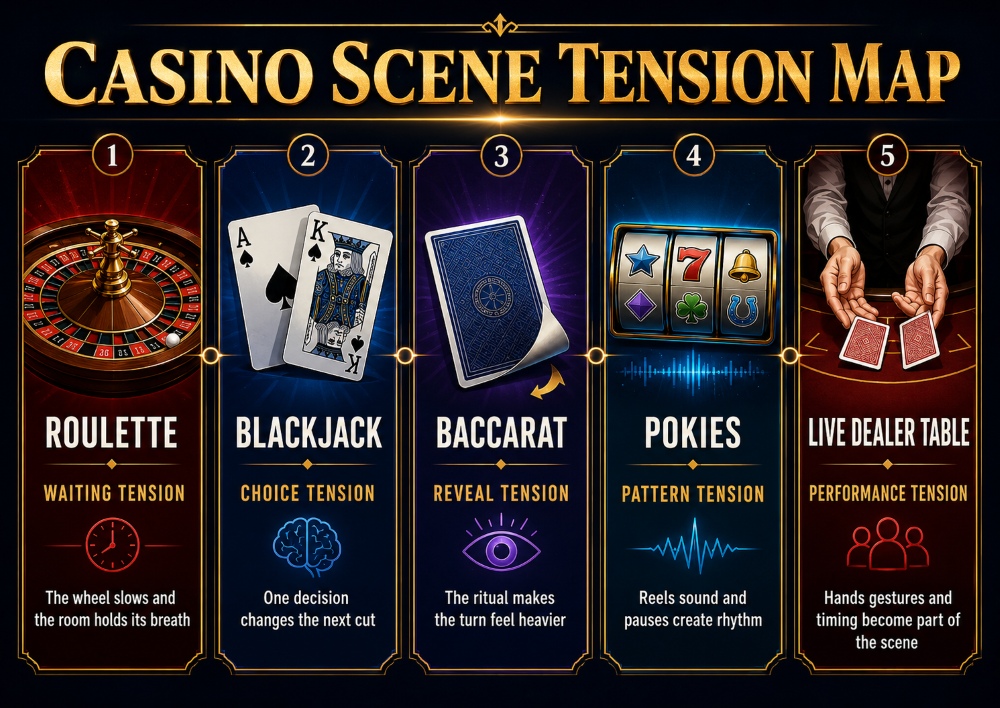
Roulette is built for anticipation. The wheel gives the filmmaker a moving object, a shrinking window of time, and a room waiting for the same stop. The tension is not hidden inside an explanation. It is on the wheel.
Blackjack is built for choice. The scene can pause on a character before a decision, then cut to the card that follows. A cautious character and an impulsive one do not need to announce themselves. Their timing at the table can do some of that work.
Baccarat is built for reveal. The ritual matters because the cards often arrive with controlled pacing. A filmmaker can make the audience watch hands, faces, and reactions before the outcome is fully known.
Pokies are built for pattern. Reels, lights, chimes, and pauses can turn a background setting into a mood. A character seated alone at a machine can feel isolated, even in a noisy room, because the rhythm keeps returning to the same private loop.
The Rules Make Performance Sharper
Actors often get more to play when the game’s structure is simple enough to read. A character who looks calm during a roulette spin is not doing the same thing as a character who looks calm before taking another blackjack card. The first is waiting. The second is choosing. That distinction gives the performance a cleaner spine.
The same applies to editing. Casino games create natural cut points. A dealer moves. A card turns. A wheel slows. A machine pauses. A face reacts. The editor can stretch or compress those beats without losing the viewer, because the audience has been taught where the pressure sits.
This is why casino scenes can fit so many genres. In a crime film, the table can become a place where loyalties are tested without anyone saying too much. In a comedy, misunderstanding the rules becomes embarrassment. In a romance, the shared wait before a reveal can hold flirtation, rivalry, or both. The format gives the scene a frame, while the genre decides the emotional flavour.
Suspense Is a Matter of Attention
The strongest casino scenes rarely stop to teach. They let the viewer learn by watching where everyone else looks. The camera finds the hand, the wheel, the card, the screen, or the dealer. The sound narrows. The room reacts a fraction before the character does, or the character reacts while everyone else stays still.
That kind of tension depends on attention. If the viewer cannot tell what the next beat is, the scene turns cloudy. If the viewer knows enough to follow the moment, even without technical knowledge, the reveal lands harder.
Good casino scenes understand that rules are not just background detail. They are timing devices, performance cues, and editing patterns. A card turning over can carry exposition. A wheel can hold silence. A machine can make repetition feel lonely. The game works on screen when it gives the audience a clean expectation, then lets the character’s face handle the meaning, a pattern that fits broader work on how narrative content, music, and audience response combine in film suspense.
