


By Matthew Pejkovic

IN LIKE FLYNN
What Happened?
Credited with the phrase, “I like my whisky old and my women young”, Errol Flynn’s reputation as a womaniser caught up with him in November, 1942, when he was charged with not one, but two, counts of statutory rape. Peggy Satterlee, who stated that Flynn nicknamed her “J.B” (jail bait), claimed that the swashbuckler had taken advantage of her on board his yacht, The Sirocco, during a trip to Catalina Island. Betty Hansen, who stated that Flynn gave her the moniker “S.Q.Q” (San Quentin quail), accused the cinematic heartthrob of seducing her when she was drunk at a Hollywood party. A sensationalised trial followed, where Flynn’s high-powered Hollywood attorney, the notorious Jerry Geisler (who had also won cases for gangster Bugsy Siegel and theatre mogul Alexander Pantages), dug up all the dirt that he could find on Flynn’s accusers (which included extramarital relations and an abortion), and presented them as women of low morals. Geisler then went on to destroy the testimony of the victims, even going so far as to bring in an astronomer as an expert witness to refute Satterlee’s claim that Flynn took her below deck to look at the moon, stating that the view was impossible through the porthole in Flynn’s cabin. In a final stroke of evil genius, Geisler carefully loaded the jury with nine women, who all swooned at the sight of the debonair Flynn. He was acquitted of all charges.
The Aftermath…
Surprisingly, Flynn benefited both personally and professionally, despite the seriousness of the charges laid against him. His box office appeal remained rock solid despite the court case, and he went on to marry Nora Eddington, an eighteen-year-old who worked in the snack bar where Flynn was being tried. He flirted with her during the court recesses…

JEPPERS CREEPERS, ITS VICTOR SALVA!
What Happened?
Jeepers Creepers filmmaker, Victor Salva, had just premiered his debut picture, the low budget horror flick Clownhouse, when he was hit with sexual molestation charges. The accusations came from twelve-year-old Clownhouse cast member Nathan Forrest Winters, who claimed that Salva had oral sex with him. Salva pled guilty, and also admitted to videotaping the act. He was sentenced to three years in prison, of which he served fifteen months before being released on probation. During Salva’s imprisonment, he was beaten so severely that he had to be transferred to another prison. Prior to his conviction, Salva was earmarked as the next big thing in horror movie circles, thanks to his short film, Something In The Basement, which also starred Winters. Francis Ford Coppola saw potential in Salva, and agreed to bankroll Clownhouse, as well as allow his home in Napa Valley to be the main location shoot. “I didn’t know of anything improper going on, although I witnessed things that caused me to raise an eyebrow,” Coppola said later. “Only in retrospect did things really add up. While this was a tragedy, the difference in age between Victor and the boy was very small; Victor was practically a child himself.” Salva was 29. Winters was twelve.
The Aftermath…
Salva was not given a warm welcome upon his release, save for Coppola, who proved to be both a personal and professional friend to lean on, and went to bat for Salva on numerous occasions, which included him taking a producer credit on Salva’s monster hit, Jeepers Creepers. Salva’s first post-prison feature, the unusual fantasy Powder (viewed by some as a piece of apologist propaganda), was rocked with controversy when Winters picketed an industry screening, handing out leaflets describing Salva’s crime to not-so-impressed Hollywood executives. Salva, however, has continued to work in the industry, directing films like Peaceful Warrior, Rosewood Lane, Haunted and Jeepers Creepers 3.

WHEN WOODY MET SOON-YI
What Happened?
Woody Allen created headlines when it was revealed that he was embroiled in an affair with the adopted daughter of long time girlfriend (and leading lady) Mia Farrow. Allen and Farrow were in a relationship that lasted twelve years, three children (two adopted, one biological), and a succession of classic film collaborations (Hannah And Her Sisters, The Purple Rose Of Cairo). All that came to an end in 1992, when Farrow came across nude pictures of her adopted daughter, Soon-Yi Previn (from her previous marriage to conductor Andre Previn), which were admittedly taken by Allen. Farrow and Allen’s relationship came to an abrupt end, and a long legal battle for custody of their children was played out publicly, with Farrow accusing Allen of sexually molesting another of her adopted daughters, which Allen vehemently denied. Never the less, Allen showed no remorse about the affair –and now marriage – with Soon-Yi. “I didn’t feel that just because she was Mia’s daughter, there was any great moral dilemma,” he told Time Magazine. “The heart wants what it wants. There’s no logic to those things.” The Aftermath… Woody Allen remains a revered filmmaker, but outside of the film community, however, it’s a different matter, with the public and even his own son, Ronan Seamus Farrow, less than impressed with Woody’s actions. “He’s my father married to my sister,” says Ronan. “That makes me his son and his brother-in-law. That is such a moral transgression. I cannot have a relationship with my father and be morally consistent. I lived with all these adopted children, so they are my family. To say that Soon-Yi was not my sister is an insult to all adopted children.”

JONES?…JONES?…JONES?
What Happened?
Unconventional character actor Jeffrey Jones, he of many a Tim Burton film (Beetlejuice, Sleepy Hollow, Ed Wood), and who played hapless high school principal Ed Rooney to Matthew Broderick’s incorrigible titular truant in John Hughes’1986 classic Ferris Bueller’s Day Off, copped five years probation back in 2003 after pleading guilty to inducing a minor to pose for sexually explicit photographs. Jones was charged with employing a fourteen-year-old boy to pose for an X-rated photo shoot in an incident that happened in 2002. A plea bargain saw a further charge of possessing child pornography dropped after the actor pleaded no contest to the damning accusation. His sentence also included the condition that he undergo counselling and register as a sex offender, which he messed up considerably after failing to notify the authorities of a change in address, which had him back in handcuffs in 2004. “This concludes a really painful chapter in my life,” said Jones of the incident. “I’m sorry that this incident was allowed to occur. Such an event has never happened before, and it will never happen again.”
The Aftermath…
Suffice to say, the usually prolific Jones’ workload dried up considerably after his arrest and conviction. It would not be until 2006 that Jones would return to the (albeit small) screen, in his recurring role as newspaper publisher A.W Merrick in the acclaimed HBO western series Deadwood. Before that, Jones’ unnamed victim filed a civil suit against the actor for sexual abuse and sexual exploitation. Jones’ last feature film appearance was in the B-grade disaster flick, 10.0 Earthquake. “Jeffrey Jones is a very decent guy, and his life shouldn’t be ruined,” said the actor’s attorney, Jeff Brodey, whose hopes appear to have been dashed.

MOTHER AND DAUGHTER
What Happened?
The public profile of fifties bombshell Lana Turner hit fever pitch when her mob-connected boyfriend died at the hand of her fourteen-year-old daughter. After eight marriages, Turner appeared to have hit pay dirt when she snagged good looking Johnny Stompanato. Yet it would not take long for their relationship to get rocky, after Stompanato’s ties with notorious underworld figure Mickey Cohen were unearthed. Fearing bad publicity, Turner tried to break it off with Stompanato, only to succumb to his charms in what would be a tumultuous relationship wracked by physical abuse and violent arguments. A jealous Stompanato even threatened Turner’s Another Time, Another Place co-star Sean Connery with a gun; the future Mr. Bond diffused the situation by landing one on Stompanato’s chin. On the evening of April 4, 1958, Stompanato’s constant abuse of Turner proved too much for the actress’ fourteen-year-old daughter, Cheryl Crane, who grabbed a kitchen knife and ran to her mother’s defence, fatally stabbing Stompanato in the stomach. A nationally televised coroner’s inquest saw Crane represented by Jerry Geisler (who got Errol Flynn off the hook), and had Turner deliver an impassioned testimony. “Everything happened so quickly,” she said. “I thought that she had hit him in the stomach with her fist. They came together and then they parted. I never saw the blade.” Stompanato’s murder was ruled justifiable homicide.
The Aftermath…
The scandal rekindled Turner’s flagging career, with 1959’s Imitation Of Life one of the biggest hits of the year. Yet by the end of the sixties, her star dimmed considerably. Crane went on to live with her grandmother, and at the age of 45 would release an autobiography titled Detour: A Hollywood Tragedy – My Life With Lana Turner, My Mother, in which she accused actor Lex Barker (Tarzan actor and Turner’s fourth husband) of sexually molesting her.

MOMMIE DEAREST
What Happened?
1978 saw Christina Crawford, daughter of screen legend Joan Crawford, publish a tell-all autobiography which alleged that her mother inflicted physical and psychological abuse upon her and younger brother, Christopher. Mommie Dearest was written as an act of revenge after the adopted Christina and Christopher were omitted from their mother’s will. “It is my intention to make no provision herein for my son Christopher or my daughter Christina, for reasons which are well known to them,” said the actress in her final testament. In the book, Crawford was painted as an emotionally unstable alcoholic, who was more concerned with her acting career than the well being of her children, all of whom were allegedly adopted for publicity purposes. Crawford’s varied love affairs were also detailed. The most explosive allegations, however, concerned Crawford’s abuse of her children, which included an attempted strangling, and a tirade that involved wire hangers.
The Aftermath…
Many defended Crawford, and her first husband, Douglas Fairbanks Jr., said of the book: “The Joan Crawford that I’ve heard about in Mommie Dearest is not the Joan Crawford that I knew back then.” Other stars, however, such as Helen Hayes, Betty Hutton and Eve Arden, have verified some of Christina’s stories, with Arden stating that while a good person, Crawford’s alcoholism and (alleged) bipolar disorder simply made her an unfit mother. The biggest repercussion from the novel’s release was the 1981 film adaptation. Described by cult filmmaker and trash aficionado John Waters as “the first comedy about child abuse”, Mommie Dearest starred Oscar winning actress Faye Dunaway in a performance that could be politely described as voluble. “Dunaway does not chew scenery,” said Variety. “Dunaway starts neatly at each corner of the set in every scene and swallows it whole, co-stars and all.”

THE DAY FATTY STOPPED LAUGHING
What Happened?
That silent film star Roscoe “Fatty” Arbuckle is rarely mentioned in the same breath as his peers Charlie Chaplin and Buster Keaton is all the more depressing considering the circumstances behind his very public descent. A prolific actor, having appeared in 153 films, Arbuckle reached the peak of his career in 1921, when the baby-faced funny man signed a record-setting $3 million contract with Paramount Pictures. Arbuckle celebrated his new deal by throwing a wild party at the St. Francis Hotel in San Francisco, during which witnesses claimed that he and burgeoning starlet Virginia Rappe disappeared to a private suite. Four days later, Rappe died from a ruptured bladder caused by “an extreme case of external force.” Not long after, Arbuckle was arrested on suspicion of sexual assault, and charged with manslaughter for Rappe’s death. Arbuckle stood trial three times, with the scandal fuelled by malicious gossip courtesy of William Randolph Hearst’s nationwide chain of newspapers. After Arbuckle was acquitted, the jury released a statement which read: “Acquittal is not enough for Roscoe Arbuckle. We feel that a great injustice has been done…there was not the slightest proof adduced to connect him in any way with the commission of a crime.”
The Aftermath…
Arbuckle’s career was destroyed, and he lost his first wife to divorce and most of his possessions in legal fees. With his acting career finished, Arbuckle worked behind the camera under the pseudonym of William Goodrich, with his biggest directorial project being the Marion Davies vehicle The Red Mill. Eventually, Arbuckle appeared in a series of well received short films for Warner Bros, but his comeback was short lived when he died from a heart attack at just 46-years-of-age.

O.J. SIMPSON…NEED WE SAY MORE?!
What Happened?
Former sports great turned actor O.J Simpson found notoriety of a different kind when he was charged with the murder of his ex-wife Nicole Brown and her friend, Ronald Goldman. After making his mark as an American football player, Simpson embarked on a successful film and television career which included prominent roles in The Towering Inferno and the Naked Gun series. Yet nothing could prepare Simpson for the enormous amount of attention that he would receive when hordes of TV viewers pried their eyes away from a David Hasselhoff pay per view special (quite a feat), and were transfixed by the LA police’s low speed pursuit of Simpson on a California freeway. What followed would become the longest criminal trial in California history, and the most publicised in American history. With celebrity lawyer Johnny “If it doesn’t fit, you must acquit” Cochran in tow, Simpson managed to wiggle his way out of a supposedly solid case against him and evade the guilty plea, while placing a light on the racial divide that was still rampant in America after the previous few years’ LA Riots.
The Aftermath…
Although found innocent, Simpson was still seen as guilty in the eyes of the public, after a series of bizarre appearances and continuous run-ins with the law. Simpson has just been released from jail for an incident in Las Vegas involving attempted kidnapping and stealing sports memorabilia at gunpoint. The families of Brown and Goldman successfully sued Simpson for damages in a civil trial, which found that there was enough evidence to find Simpson liable for their murder. With the notoriety of the Simpson trial, lawyer Johnny Cochran would go on to represent the likes of Sean Combs and Snoop Dogg, before passing away in 2005. His theatrical demeanour in the courtroom has been parodied in everything from Seinfeld to That’s So Raven.

DEATH AND THE HOLLYWOOD SIGN
What Happened?
The difficulty of making it in Hollywood was never more keenly encapsulated than in the case of little known Depression era actress Peg Entwistle, who climbed the famed Hollywood sign (which then spelt “Hollywoodland”) and leapt to her death. Born in England in 1908, Millicent Lillian Entwistle (she would take on the stage name “Peg” later in life) moved to America with her family at the age of eight. During the twenties, Entwistle achieved some level of fame on Broadway with her performance as Hedvig in Henrik Ibsen’s The Wild Duck, which inspired a young Bette Davis to pursue acting. “I want to be exactly like Peg Entwistle,” the famed actress told her mother. A move to Hollywood in 1932 brought rave reviews in the play The Mad Hopes, which co-starred Billy Burke and Humphrey Bogart, yet Entwistle’s lone film appearance in the psychological thriller Thirteen Women was all but edited out after the film received negative feedback at test screenings. On September 16, 1932, a depressed and drunk Entwistle clawed her way to the foot of the Hollywoodland sign, made her way up a workman’s ladder to the top of the “H”, and leapt to her death. “I am afraid, I am a coward,” read her suicide note. “I am sorry for everything. If I had done this a long time ago, it would have saved a lot of pain.”
The Aftermath…
Though not a well known actress when she was alive, Entwistle’s suicide secured her infamy for all of the wrong reasons, when she was dubbed “The Hollywood Sign Girl” by The Los Angeles Times. A day after her death, a letter from the Beverly Hills Playhouse arrived at her uncle’s home, offering Entwistle the lead role in a play about a woman driven to suicide.
IN COLD BLOOD?
What Happened?
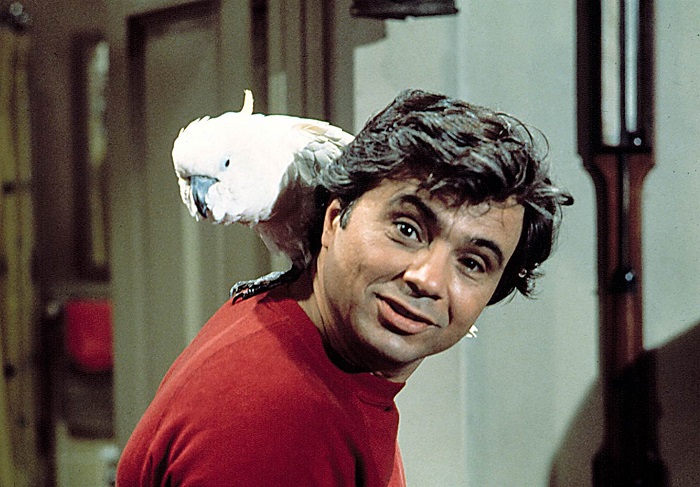
Actor Robert Blake hit the headlines when charged with the murder of his second wife, known hustler Ronnie Lee Bakley. The star of Richard Brooks’ searing 1967 crime classic In Cold Blood and TV’s Baretta first met Bakley in 1999. At the time, the charming lass was involved with the doomed Christian Brando (son of Marlon), and when she became pregnant, she told both Blake and Brando that they were the father. After a paternity test proved that Blake was indeed the father, they got hitched, which marked his second marriage, and her tenth. The union was far from cordial, with Bakley living in a small guest house on Blake’s estate. On May 4, 2001, Blake took Bakley to an Italian restaurant for dinner. Afterwards, Bakley was shot in the head while sitting in their car parked around the corner. Blake told police that he had gone back to the restaurant to fetch his own gun, which he had left on the table (and which tests proved was not the murder weapon). After a year had passed, Blake and his bodyguard were arrested and charged in connection to his wife’s murder, with the LAPD making their move after two retired stunt men agreed to testify that Blake had approached them (separately) with a proposal to kill his wife. Blake was eventually cleared of all charges, prompting the district attorney to state that the actor was “a miserable human being” and that the jurors were “incredibly stupid.”
The Aftermath…
Bakley’s three children successfully sued Blake for the wrongful death of their mother, yet mounting legal costs saw Blake cash strapped, and he filed for bankruptcy. Blake hit all of the talk shows in a bid to keep up his newfound celebrity. He has yet to be cast in a major film for decades, with his last credited on-screen appearance in David Lynch’s 1997 mystery Lost Highway.

BOB CRANE, PORN, AND MURDER
What Happened?
While he was known to viewers as the mischievous Colonel Robert E. Hogan on the WW2 themed sitcom Hogan’s Heroes, actor Bob Crane led a less than conservative life behind the scenes, which can be summed up by his popular quote: “I don’t smoke, I don’t drink. Two out of three ain’t bad.” During Crane’s run on Hogan’s Heroes, he became friends with John Henry Carpenter, a Sony salesman who specialised in video technology. Their love of sex and photography inspired a close friendship, which included picking up women from bars and recording their sexual exploits either on videotape or photographically. When Hogan’s Heroes was abruptly cancelled after a six-season run, Crane found it hard to find steady work, especially since he didn’t hide his addiction to sex, often showing friends and neighbours his collection of amateur porn. On June 28, 1979, Crane was found bludgeoned to death in his room at the Winfield Place Apartments in Arizona. Witnesses stated that he and Carpenter had an intense discussion the night before, yet while Carpenter was viewed as murder suspect number one, no charges were laid.
The Aftermath…
While the district attorney declined to prosecute Carpenter at the time of Crane’s death, Carpenter (who always maintained his innocence) was tried and acquitted when the case was reopened in 1994. The biopic Auto Focus, directed by Paul Schrader, was released in 2002, and starred Greg Kinnear and Willem Dafoe as Crane and Carpenter, respectively. The film was based on Robert Graysmith’s book The Murder Of Bob Crane, which was heavily criticised by Crane’s son, Scott. Interestingly, Scott – in apparent loving memory of his dad – has been hoarding his father’s pornographic material (along with other “memorabilia”) online. Bob Crane’s murder still remains unsolved.

JEAN HARLOW: THE ORIGINAL SCANDAL QUEEN
What Happened?
Few of today’s stars could hold a candle to original blonde bombshell Jean Harlow, whose life was riddled with tragedy and scandal. She dated notable mobsters, appeared in nude photos at the age of seventeen, and was implicated in the suspicious suicide of her husband. Born in Kansas City, Harlow eloped to Los Angeles at the age of sixteen with a considerably older businessman, and became an extra in many silent films before catching her big break in Howard Hughes’ Hell’s Angels. Harlow quickly found success as an actress, which was rivalled by her status as America’s biggest sex symbol, which she shamelessly flaunted in front of the press. “I like to wake up each morning feeling a new man,” she once famously teased. Scandal would almost capsize Harlow’s career, however, when her second husband, MGM producer Paul Bern, was found dead in an apparent suicide. His death was suspicious, to say the least: his suicide note was decidedly odd; police were not called to the crime scene until two hours after Harlow and MGM “fixer” E.J. Mannix first saw the body; and Bern’s mistress was found dead the next day. The whole sordid situation brought with it more questions than answers, with many in Hollywood whispering that the sassy Harlow may have had a hand in her husband’s untimely death.
The Aftermath…
With scandal comes publicity, and with publicity comes more popularity, and Harlow’s profile was higher than ever. It wouldn’t take long, however, for the platinum blonde to cause more controversy when she began an affair with married boxer Max Baer, prompting his wife to threaten divorce proceedings and name Harlow as an adulterer, a situation which MGM promptly diffused by arranging a marriage between Harlow and cinematographer Harold Rosson. The hard living Harlow died in 1937 of uremic poisoning at the age of 26.
