



by Stephen Vagg
 General Curtis LeMay is one of the most notorious figures in American military history – Chief of Staff for the US Air Force from 1961-65, he played key roles in the decision to firebomb Tokyo, the Berlin Airlift, the formation of Strategic Air Command and the Cuban Missile crisis, before running for Vice President in 1968 under segregationist George Wallace.
LeMay is particularly remembered for threatening to bomb North Vietnam into the Stone Age, his enthusiastic proponent of nuclear weapons, and inspiring the characters of both General Ripper and General Buck Turgidson in Dr Strangelove.
If any filmmaker was ideal to bring Curtis LeMay to life, it was writer-director John Milius, whose passion for military history, guns and colourful real-life characters had been displayed numerous times over the years. Milius had a particular knack for dramatising outrageous, flamboyant, self-aware military messiahs: Kurtz and Kilgore in Apocalypse Now, Teddy Roosevelt in The Wind and the Lion and Rough Riders, John Dillinger and Melvin Purvis in Dillinger, Judge Roy Bean in Judge Roy Bean, General MacArthur in Farewell to the King.
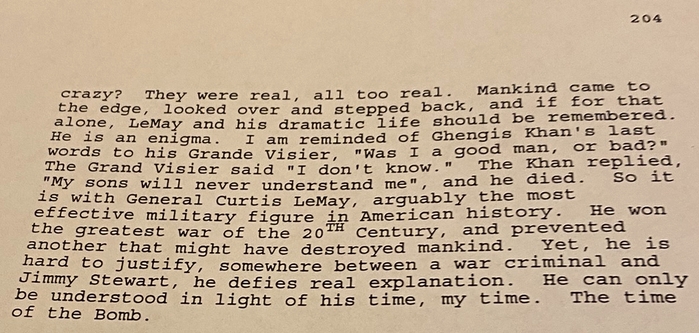
We recently read a copy of Milius’ script M.A.D The Life and Times of Curtis LeMay (draft dated 10 December 1999) at the Writers Guild Foundation Library in Los Angeles. It is broken into three parts. Part 1, ‘The Sheep Dog 1914-1945’, focuses on LeMay’s service in World War Two, particularly the Schweinfurt–Regensburg mission of August 17, 1943 (probably the best sequence in the film, tremendously exciting) and the decision to firebomb Tokyo. Part Two, ‘Aluminium Overcast 1945-55’, covers the Berlin Airlift, the rise of nuclear weapons and SAC, and Korea. Part 3, ‘Russian Roulette 1958-65’, revolves primarily around the Cuban Missile Crisis, although it goes up until LeMay’s retirement in 1965. His political career is not dealt with.
LeMay’s wife and daughter feature but are not very interestingly sketched – Milius was generally a dreadful writer of female characters. Far more interesting is the depiction of real life people – not just LeMay, but cameos from Stalin, Beria, Bomber Harris, Kurchatov, Nimitz, Truman, Oppenheimer, Churchill, Zhukov, Molotov, Sakharov, Edward Teller (model for Strangelove), Khrushchev, Eisenhower, Dulles, Fidel, Che, JFK, RFK, Rusk, and James Stewart, among others. There are some fictitious soldier characters – colleagues of LeMay – who are apparently based on real people.
As written, LeMay himself isn’t as memorable as Kilgore or Judge Roy Bean, and it’s wrong that LeMay’s political career is not dealt with (or foreshadowed more), but it’s still a pretty meaty part. Milius was a great admirer of Francis Ford Coppola’s script for Patton, calling it “a terrific original screenplay. It’s everything. The outrageousness of it, the odyssey of it. There’s a wonderful tastefulness and literacy to the screenplay.” One senses that he was striving for this with M.A.D. He doesn’t quite get there but he might have over a few more drafts, particularly if he was working with a director who pushed him like Coppola did on Apocalypse Now.
Milius wrote the script for Robert Zemeckis, who had been championed by Milius early in Zemeckis’ career – Milius produced 1941 and Used Cars. M.A.D. actually would have been ideal to come out in the noughties, the way that Patton did in 1970, with its gun blazing hero capable of delighting and appalling audiences while American soldiers were fighting an unnecessary war overseas. Alas, it was not to be. We are not sure why – this was the period when Zemeckis became more obsessed with motion-capture animation, maybe that was it. Possibly its flawed hero scared them off. Also, this draft would be expensive, with its large cast and battle sequences (although you could trim it down). It’s a shame because the Curtis LeMay story does have the potential to be a great movie. Maybe it will be one day. It’s never too late.