



by Stephen Vagg
A 1936 vanity project with a cool title.
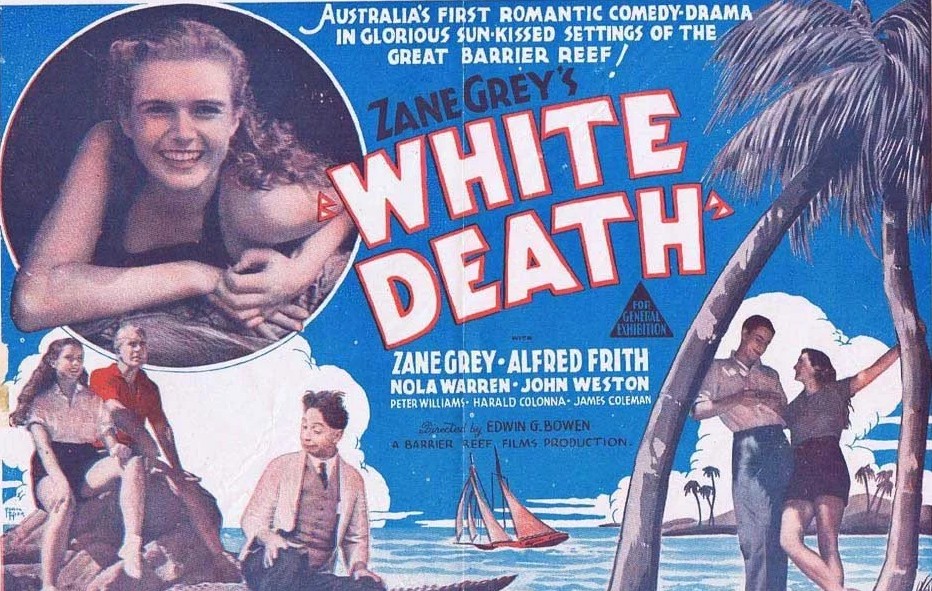
The Australian film industry has turned out some weird star vehicles over the years – we’ve built movies around race horses (Desert Gold), gangsters (Riding to Win with Squizzy Taylor), and sports stars (Snowy Baker’s entire oeuvre). Few, though, are odder than White Death aka American novelist Zane Grey playing himself fishing.
In the 1930s, Grey was a hugely popular author, known not only for his best-selling Western novels, but also his passion for fishing (which Grey advertised loudly, as it dovetailed into his macho image). Grey visited Australia in 1935-36 to try out our fishing hot spots, notably the Great Barrier Reef. (He also had a mistress here called Lola Goodall – read Vicki Hastrich’s new biography, The Last Days of Zane Grey, for the goss.)
Grey’s visit to Australia coincided with New South Wales Premier Bertram Stevens introducing a quota for local filmmakers. As discussed in our piece on Rangle River, this quota would ultimately have minimal impact due to relentless lobbying from distributors, exhibitors, and unsympathetic journalists and politicians who wanted to keep foreign domination of Australian screens at 99% rather than 95%, which apparently was a nightmarish, end of days scenario. However, for a year or so in the mid-‘30s, the prospects for Australian filmmakers looked rosy, prompting a brief boost in production, which included the Zane Grey vehicle White Death. A company was formed for this purpose, Barrier Reef Productions.
It is strange that Grey made a movie in Australia of all places. But it was probably easy to raise money from gullible locals, especially off the back of the quota. Furthermore, Grey was very publicity conscious and had already arranged for cameramen to accompany him on his trip to film him catching fish – so it wouldn’t be that much of a leap to adapt his adventures into dramatic form. Barrier Reef hired Ken G. Hall’s film crew at Cinesound Productions to help make the movie; this included Hall’s regular writer, Frank Harvey, who is given credit for the script. The film was directed (badly) by Grey’s manager, Edwin Bowen.
White Death stars Grey as himself, a famous novelist touring Australia, writing and fishing. The plot revolves around Grey’s attempt to catch a troublesome great white shark off the Queensland coast; in doing so, he is accompanied by a professor (James Coleman) and runs into a comically inept animal rights campaigner (unfunnily played by Alfred Frith), who is protesting against Grey’s fishing expedition (in real life, Grey’s enthusiasm for catching Australian fish had inspired protests from the RSPCA). He also encounters a tribe of Aboriginals, and a white missionary (Harold Colonna), who lost his son and wife to the shark, and whose daughter (Nola Warren) has a romance with the professor’s son (John Weston). None of the cast were really professional actors – it was Grey’s first film as an actor, Frith was a stage comedian, Coleman – who was from a theatrical family and had appeared occasionally in silent films – usually worked in the art department (he did that on this film too), Harold Colonna was a tenor, Warren and Weston were new.
We won’t beat around the bush: White Death is not a very good film. The basic idea is fantastic – Grey rescues a village being terrorised by a shark. But we don’t see any terrorising or even much of the shark, we just get a lot of fishing, and boats, and Alfred Frith. Frank Harvey was the best Australian screenwriter prior to the arrival of David Williamson, but his script for White Death is utterly inept; it is so unlike anything else Harvey wrote that we’ve seen or read (be it stage plays or films) that we guess that Harvey either (a) took dictation from Grey and Bowen, or (b) was rewritten by them. The acting from the middle-aged performers is dreadful (Grey is stiff but Coleman and Colonna aren’t that much better). There’s not even that much shark action in it.
We will admit that White Death has its compensations. The film looks terrific: most of it was shot on location (Hamilton Island, Great Barrier Reef, etc) and those locations are splendid. The young lovers, Nola Warren and John Weston, are charming and attractive. The presence of Aboriginal Australians and Islanders is at least novel (some of the Aboriginals were from Palm Island and had been in Uncivilised, a film on which Coleman had also worked). And there is something endearing about the sheer oddness of the movie – Grey playing himself, Alfred Frith on a camel, a scene where John Weston serenades Nola Warren with his guitar and a dubbed singing voice on the beach, etc. Oh, and the title is very cool.
One just wishes that the filmmakers had put a little more thought into the whole operation. It’s as if they went “Zane Grey shark fishing on location – we can’t miss” and that was it. They really just should’ve done a documentary.
Incidentally, the cast of White Death seems to have been slightly cursed. Both James Coleman and Harold Colonna died in 1937, not long after the film came out; Grey had a stroke in 1937 and died in 1939; Warren became a model and later got knocked up to a married man, prompting a divorce case which diverted readers from war news in 1943; John Weston, her romantic partner in the film, joined the RAAF and died in a plane crash near Wagga Wagga in 1940.
The whole movie is available to view via the National Film and Sound Archive.
The author would like to thank Graham Shirley and the National Film and Sound Archive for its assistance with this article. Unless otherwise specified, all opinions are those of the author.
