



by Stephen Vagg
One of the greatest things you can give a filmmaker is the opportunity to learn and grow. Most Australian directors don’t get this, of course – typically, it’s a case of one or two features and you’re out. Ken G. Hall was lucky, however, in that his first three movies had been big hits – On Our Selection, The Squatter’s Daughter, The Silence of Dean Maitland. Parts of them had been technically primitive, but they benefited from being based on strong pre-existing IP, which acted as a buffer against the movies’ flaws, and created healthy grosses.
Hall wanted to get better, however, particularly after making a few movies that he knew were a little wonky (Cinesound Varieties, Strike Me Lucky, Grandad Rudd). So, he was able to persuade his boss, Stuart F. Doyle, to shut down his studio, Cinesound, for a few months while Hall went to Hollywood to study production techniques, attract talent, and buy equipment. The first feature made on Hall’s return was Thoroughbred, a 1936 horse melodrama.
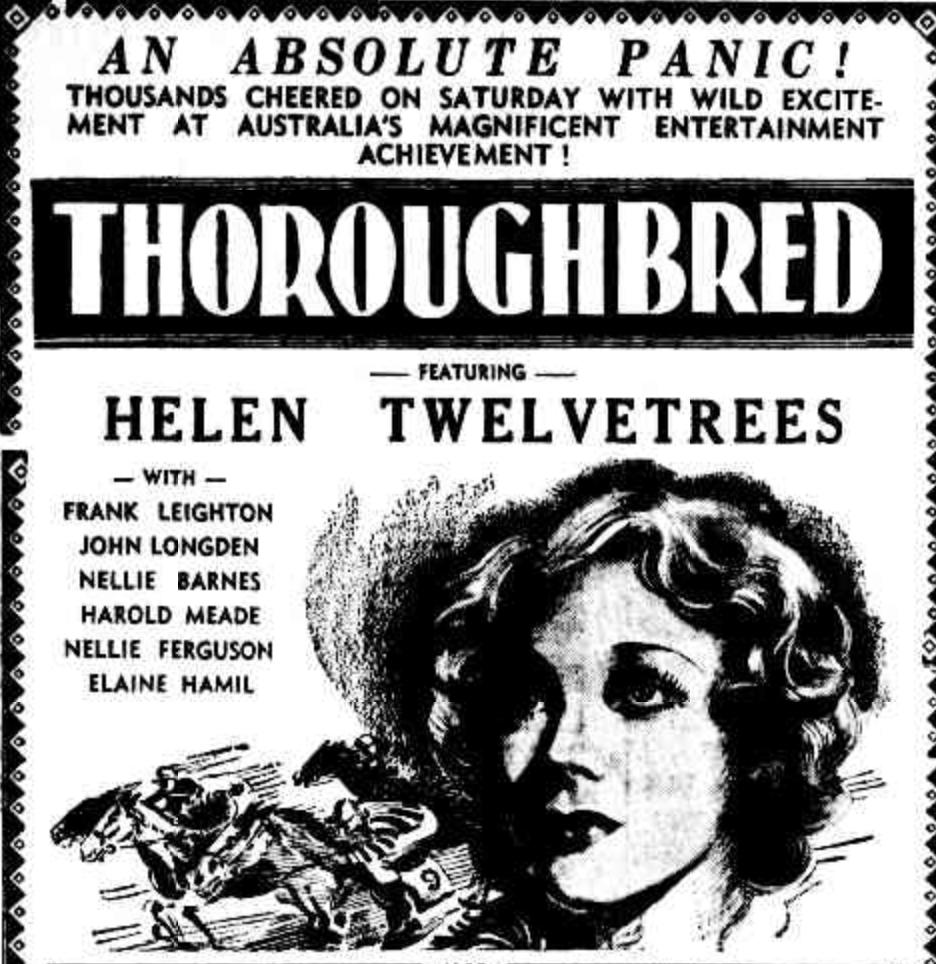
The script for Thoroughbred was credited to Hollywood writer Edmond Seward, who accompanied Hall back to Australia. Hall knew that his movies needed better scripts and, like so many Australian film producers before and since, figured that meant a Hollywood writer. It was a screen original, Cinesound’s first feature to not be based on thoroughly road-tested IP, apart from Strike Me Lucky, which at least had been a vehicle for one of the leading comics in the country (Roy Rene).
Thoroughbred wasn’t totally original – the story bears similarities to the life and times of the famous racehorse Phar Lap, who had died only a few years previously. Indeed, early articles about the film specifically mentioned the Phar Lap connection (the horse at one stage was going to be called “Red Terror” and was going to be played by the racehorse “Peter Pan”).
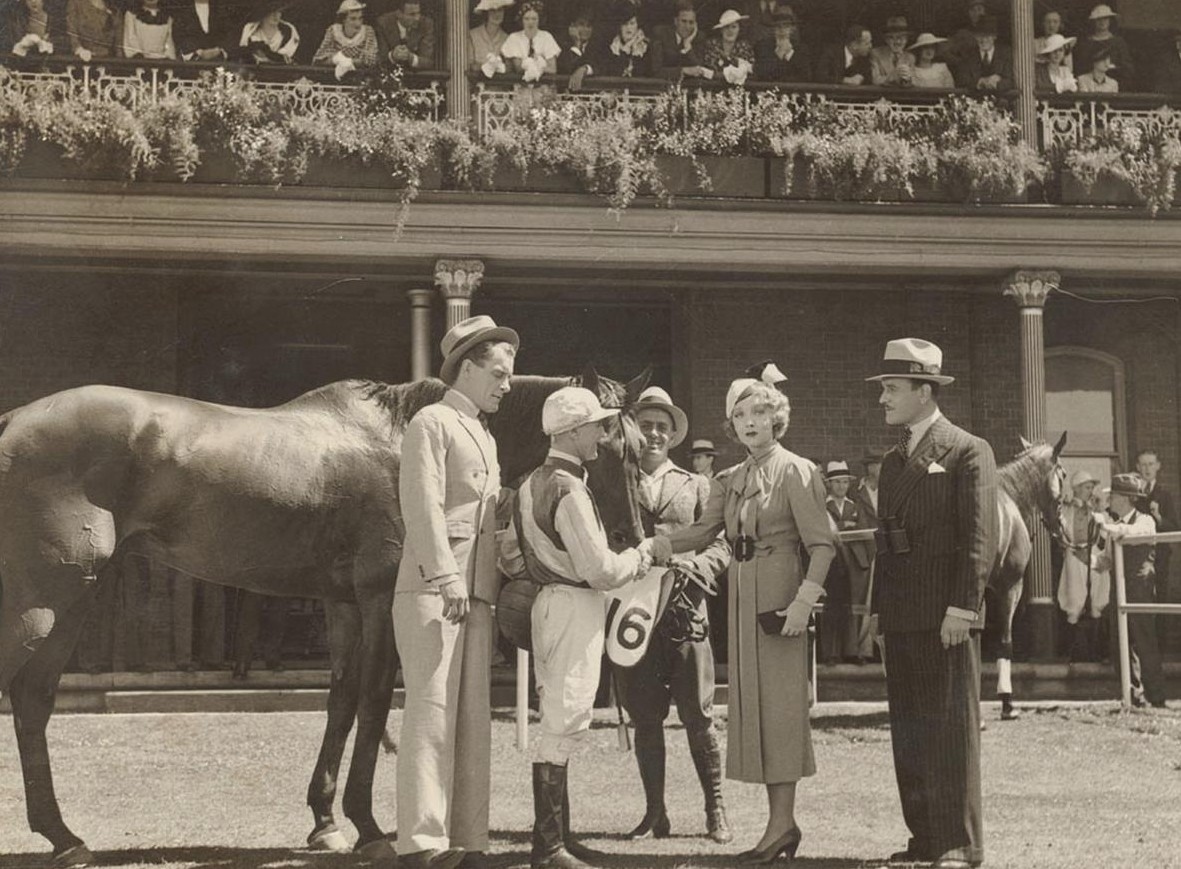
The Phar Lap connection would have given Doyle/Hall/Cinesound some confidence, as would Seward’s Hollywood pedigree, and the fact that Hall had shot some nice horse action in The Squatter’s Daughter. Furthermore, a racehorse movie would give Hall the opportunity to show off the fancy new back projection equipment that he bought in Hollywood.
Thoroughbred starred a Hollywood actor, Helen Twelvetrees, who had enjoyed a brief vogue as a leading lady in the early years of sound, when the studios were grasping around desperately for Broadway trained actors. Twelvetrees found a niche working for Pathe Studios and then RKO in a series of sobby melodramas. She was never in a really big hit and was never that big a star – we’ll be honest and admit that we’ve never seen one of her Hollywood films – though she did co-star with Clark Gable (The Painted Desert) and John Barrymore (State’s Attorney), and definitely played leads in studio pictures for a few years (there are a bunch of them on YouTube). Twelvetrees struggled to cut through in what was a crowded field of female stars – at RKO alone, she had to compete for roles against bigger names like Constance Bennett, Ann Harding, Irene Dunne, Ruth Chatterton and Katherine Hepburn – and her career was very much on the slide when Ken Hall came to town, thus she was open to a trip to Australia to make Thoroughbred. Her presence ensured the making of the film received a lot of free publicity.
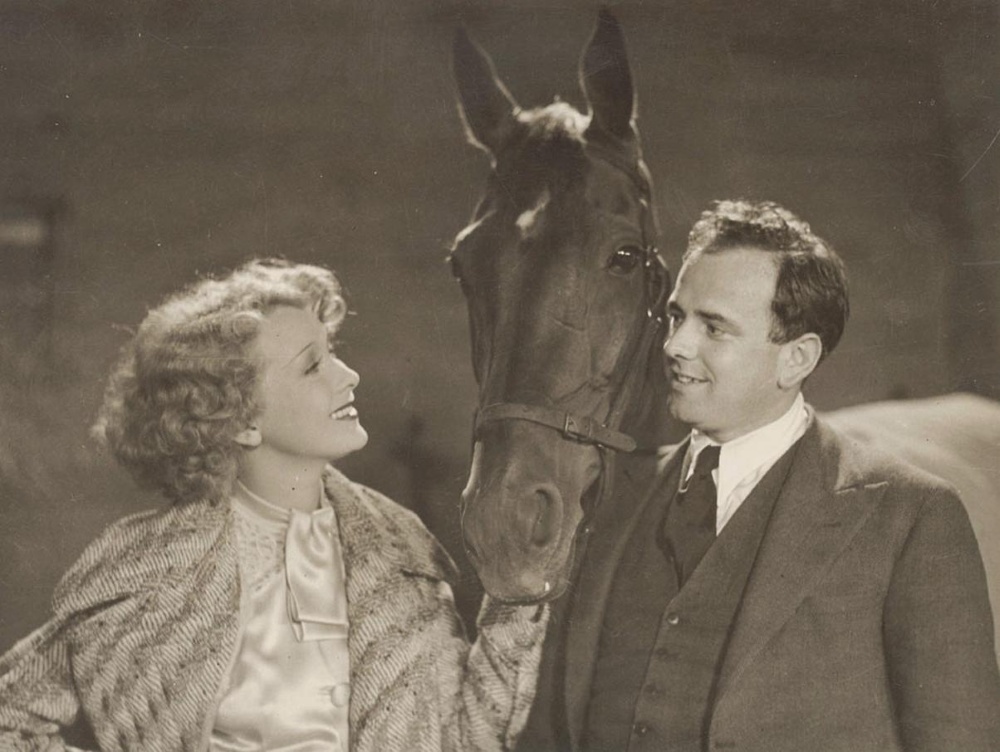
Thoroughbred featured Twelvetrees as a horse trainer/breeder in Australia (her accent is explained by her being Canadian), who works alongside her adoptive mother (Nellie Ferguson) and her mother’s biological son (Frank Leighton) – who Twelvetrees is engaged to… so she’s dating her adoptive brother. Anyway, the trio train a broken-down racehorse called Stormalong and turn it into a champion, Phar Lap-style. And just like Phar Lap, the horse attracts the interests of gangsters. These are led by Ron Whelan, who specialised in playing oily villains – he also worked on Cinesound films as an assistant director. There’s a subplot where posh John Longden (who’d made The Silence of Dean Maitland with Hall) falls for Twelvetrees, making Leighton jealous and act like a goose.
Thoroughbred is an odd film. It’s technically very accomplished, with terrific photography by George Heath (this was his first solo credit as director of photography), impressive production design (from Fred Finlay and J. Alan Kenyon) and a competent cast. Hall’s direction demonstrates his continued improvement and is particularly strong during the action sequences. By this stage, the Cinesound team were really starting to “click”, becoming more professional and better organised, and you can tell that from the movie.
The story is flawed. Thoroughbred should be a girl-and-horse story about Helen Twelvetrees and her horse pluckily battling the odds, fighting off gangsters and wondering which man she should be with, and there is a bit of that, but far too much screen time is instead taken up with Frank Leighton’s character. Which wouldn’t be so bad if Leighton played someone heroic and dashing, or at least entertaining, but his character is mostly an idiot, controlling and unpleasant; he’s kind of redeemed at the end by some heroism, but really, he should be the villain, with Longden as the leading man, and Twelvetrees given more to do. As it is, we don’t meet any villains – Whelan and his gangsters – until 50 minutes in, which is too late.
Even more problematic is that there actually isn’t that much horse stuff in the movie – Stormalong barely registers as a character. At the climax, when (SPOILERS) Stormalong dies after being mortally wounded by a gangster’s bullet, winning the race in the process, there shouldn’t be a dry eye in the house, with Twelvetrees sobbing over the horse and so on. But in the film, she doesn’t even go over to the horse and isn’t there when the horse dies. Instead, she goes to Leighton, who’s been injured. Thoroughbred should have been about a, well, horse.
We wonder what went on behind the scenes during the scripting of this movie – maybe the story started off as one thing and veered into another direction. Or maybe, Seward simply didn’t do much of a job and Hall didn’t have the skills (then) to fix it. Or it might’ve been one of those cases where everyone knew there were problems, but they were locked in to a shoot date because of Twelvetrees’ availability before the problems could be fixed. These things happen, especially when you write an original screenplay – it might explain why Hall’s next “original” movie, Tall Timbers, basically used the structure of another, The Squatter’s Daughter. Sometimes that’s the safest way to go.
You can read a copy of the script here
Sidebar: in the original screenplay, Frank Leighton’s character dies at the end and Twelvetrees winds up with Longden, but in the film Leighton survives to kiss with Twelvetrees at fade out.
In fairness to Edmond Seward, the next movie he wrote for Hall was first rate: Orphan of the Wilderness. That was an animal tale, but it put the animal front and centre; it was also based on a pre-existing story. Newspapers announced Seward would adapt William Hatfield’s Big Timber for Hall, but that was never made (Hall did Tall Timbers instead.) Not long after writing Orphan of the Wilderness, Seward moved back to Hollywood and found a niche scripting Bowery Boys movies before dying in 1954, aged only 47 (both his parents outlived him).
The filming of Thoroughbred gave rise to our favourite anecdote from Hall’s career. During filming, Helen Twelvetrees and Frank Leighton began an affair, which annoyed the man in her life at the time (this may have been her second husband, discussed below). He started threatening violence, so Stuart F. Doyle, Hall’s boss, acted like a true film mogul should and arranged for what Hall later recalled as “two very big men who looked like detectives and probably were” to shuffle the cuckold off to New Zealand for some fishing.
Twelvetrees isn’t that great in the film, by the way – she’s adequate, if a little dull. The same thing could be said for Hall’s next Hollywood import, Lloyd Hughes, who came to Australia soon after to make Lovers and Luggers and The Broken Melody.
Twelvetrees had an interesting if unhappy life – her first husband was a violent alcoholic who would beat her and once tried to commit suicide by jumping out of a hotel window only to survive; he later died in a fight when a bystander tried to stop him beating another woman. Twelvetrees’ second husband was a stuntman – we think he might’ve been the New Zealand fisherman, because they got divorced in 1936, not long after her return from Australia; their romance was dramatised in the 1940 film, I’m Still Alive (Twelvetrees successfully sued over this and got a little money). Her third husband was in the US air force; they were still married when she died of an overdose of barbiturates in 1958. Her life inspired the 2015 stage play I’m Looking for Helen Twelvetrees.
Now, back to Thoroughbred; Frank Leighton and John Longden do everything they’re asked to do by the script. Ron Whelan turns in a competent villainous performance – his entire film and television acting career basically consisted of variations of these roles. We should also mention Nellie Barnes, a young female stage actress who is very lively in a support role. She just doesn’t have enough to do in the movie – like too many of the characters in Thoroughbred.
From all accounts, Thoroughbred did reasonably well at the box office in Australia and was released in Britain, though not the US, despite Twelvetrees’ presence (although the film did pop up on American television). Thoroughbred is an entirely decent, if flawed movie – it shows how Hall had learned from his earlier films, and his subsequent efforts demonstrated how he learned from Thoroughbred.
You can view the film at the National Film and Sound Archive.
The author would like to thank Simon Drake and Jodie Boehme of the NFSA and Graham Shirley for their assistance with this piece. Unless specified, all opinions are those of the author.
