


By Andrew Leavold
“Hello, Imee?”
She motioned me over. She seemed slightly amused to see me. “What on earth are you doing here?”
“Going to your mum’s birthday party,” I smirked. I then filled her in on the next documentary project, “The Most Beautiful Creatures On The Skin Of The Earth”, on erotic cinema under the Marcoses.
“So what is your thesis?” she asked me bluntly. “Why do YOU think cinema flourished under my parents, as it did in Russia under Stalin, and in Italy under Mussolini?”
“Imee, I wouldn’t compare your parents to Stalin or Mussolini!”
“I meant PATRONAGE,” she said with a steely glare. I mentally noted my almost fatal faux-pas, and wondered if firing squads were still operational in Ilocos Norte.
Minutes later we finally got the call – meet Mrs Marcos at the family mansion, a good half-hours’ burn from Laoag past small farming plots and sari-sari stores, and into the unpretentious provincial town of Batac.
Cel drove us past the covered basketball court where her party would be held just hours later, and over a small creek, we arrived at the 19th Century Spanish-styled hacienda poached in our own juices and looking like Hawkwind’s wizened acid suppliers. Aides ushered the five of us through the ornate wooden doorway and into the mansion once home to Ferdinand Marcos’ father Mariano, born in Batac in 1897 and later elected representative of the second district of Ilocos Norte. Mariano subsequently ran for National Assembly but lost to his chief rival and political nemesis Julio Nalundasan; soon afterwards Nalundasan was shot through his bathroom window by a mystery assassin while brushing his teeth, and Mariano, son Ferdinand and his cousin were arrested.
Ferdinand finished his legal studies in prison and famously made an impassioned speech to the judge, who acquitted him of murder. The rest, they say, is history. Mariano would die in the closing phase of World War 2, either at the hands of the Japanese, so the official story goes, or by local partisans executing him as a Japanese collaborator.
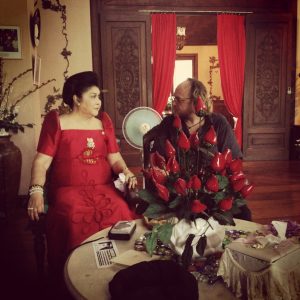
At the top of the beautiful dark wood staircase, we saw Imelda Marcos holding court. Here was the mythic figure made flesh, substantially older and puffier than her official portraits and surrounded by closely attentive nurses but unmistakably the regal figure and former beauty queen once dubbed the Rose of Tacloban and the Iron Butterfly. She was swathed in silks like an Italian countess, the first of four outfits that evening: raised, rounded shoulders like padded saw blades cut her a magnificently regal figure, like a fifteenth century heiress to the House of Medici or Lucrezia Borzia than her idol Evita Peron.
“Mrs. Marcos, it’s an honour to meet you. And this is my crew. This is Daniel from Australia.”
“It’s an old home,” she apologised. “You see? The chandeliers are broken…”
A yelping dog could be heard beyond the walls of the mansion. “Oi! That doggie!”
I half-expected to hear gunshots as the stray pup was summarily executed.
Big Jim set up the camera as Roy swung his iPhone around the room, capturing the tiled portraits, photos of Ferdinand in uniform, statues, paintings, tapestries, the entire gaudy spectacle of the Marcos mansion, one of Imelda’s at least three residences, we’re told, in which she resides the part of the year in Batac performing her duties as Member of the Philippine House of Representatives of Ilocos Norte’s Second District. With son Bong-Bong as Senator and Imee as Governor, the Marcos family’s tentacles could be felt twisting and worming through three tiers of government. I found it remarkable that the family of a disgraced President could make such a phoenix-like return from the ashes; the Marcos’ contribution to Philippine cinema was precisely what I hoped we would talk about on-camera.
“Here I am,” she began, “celebrating my 83rd birthday. What has kept me strong? And still standing up? And at peace? Because I’m at peace with the truth. If you are on the side of the truth and God, nobody can touch you.”
Imelda was an incredible interview subject. She expertly wove around certain questions, disarmed others with a barrage of facts and figures contained behind the steel doors and razor wire of her 83-year-old mind. She was charming, seductive, dangerous, a former dictator who had wined and dined the rulers of the world at Malacanang, and who had experienced the view from the top of the pyramid of power. Her still-considerable power radiated from her and filled the room, something us mortals rarely receive an opportunity to witness, let alone experience ourselves.

Brilliant as ever. Can’t wait to read the full book. The documentary was superb.