


by FilmInk Staff
For decades, there has been a quiet but powerful international tradition of lively, even significant feature films emerging directly from the ‘film school environment’. This is where enterprising students combine meagre resources under the support of innovative professors to complete their studies, not with a short – as is typical – but with a feature.
In the USA, David Lynch’s Eraserhead (1977) began as course work at the American Film Institute. Dan O’Bannon and John Carpenter began Dark Star (1970-974) at LA’s USC. Brian de Palma made Home Movies at Sarah Lawrence in 1980 with undergraduates.
Now, a tight group at Adelaide’s Flinders University have produced an excellent debut feature.
The picture cut of Dry Winter, says producer Michael Harpas, was delivered in November 2018, in time for the team that made it to graduate from Creative Arts Screen (Hons). But he says, it took some time to finesse the final product, which impressed audiences earlier this year at the Visions du Réel in Switzerland.
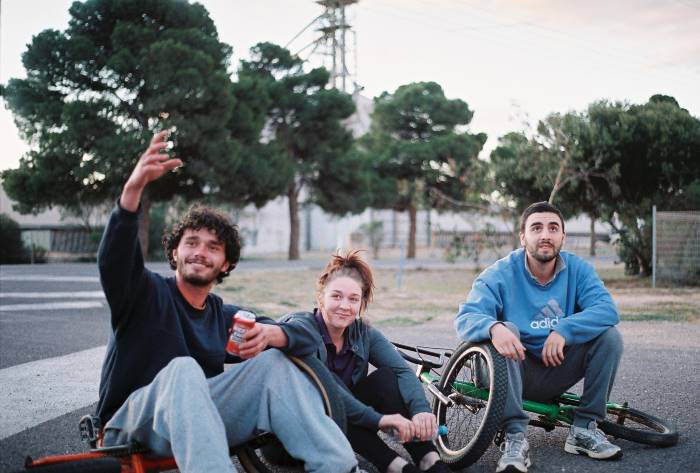
A captivating mood piece set in a remote country town, it features non-professionals Courtney Kelly and Andrew Phillips as a young couple, quietly living out a life of chores, friends, and pets… here, even the comforts of routine seem to swallow time and future.
FilmInk spoke to three of the team behind Dry Winter about the challenges of making a no-budget feature.
We understand that the Honours course at Flinders had been concentrating on making shorts.
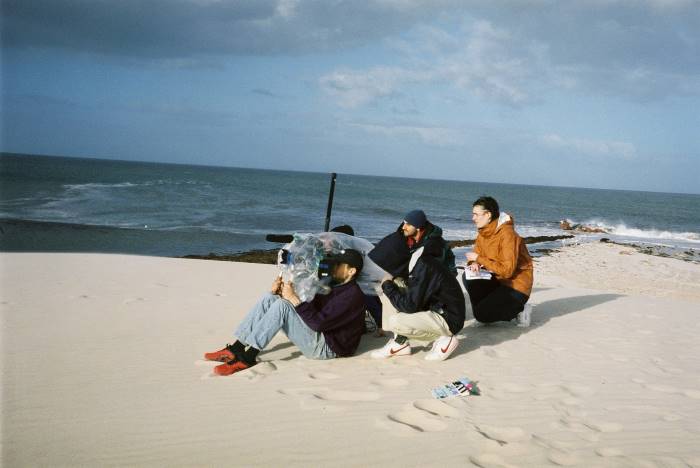
MICHAEL HARPAS, PRODUCER “Right. The core team behind Dry Winter, we’re all friends. We had completed our Bachelors at Flinders in 2017. When we started honours, two of the lecturers – the late Cole Larsen and Tom Young – had just introduced the idea of making a ‘no budget’ feature. We started planning Dry Winter in February 2018. In our group, there were a couple of other teams doing big projects.”
KYLE DAVIS, DIRECTOR “I think we anticipated that [our lecturers] would take us into a direction where we would work with [professional] actors on city [Adelaide] locations. We decided to push it; make a bigger movie on a bigger landscape.”
What did you hope to gain from doing a feature? Getting a micro-budget movie out to the world is never easy, we imagine that making it under the aegis of Uni course work has its own issues…?
MH “It was a great environment. It was quite safe [to do something like this]. Shorts can be monotonous. We thought: ‘when are we going to be able to make a feature in the immediate future? How are we going to do that?’ This would be next level, take us further, help us grow… When we made the film the average age of the crew was twenty-one, twenty-two.”
How was it financed?
MH “In Honours, each student received a grant of $1,000. We combined that.”
Where was it shot?
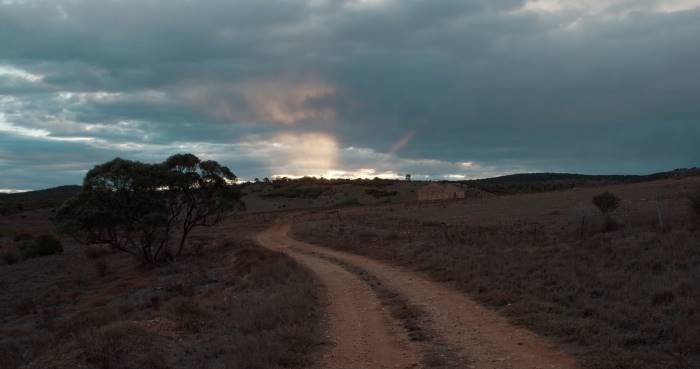
MH “Cowell, South Australia. It has a population of about 1,000. It’s a five, six-hour drive from Adelaide. At the time, there was a severe drought. We were there just under a month from early July, and we shot every day. The locals really got involved.”
What was the concept?
MH “It would be about a couple. We knew it would be a rural story.”
BRIDGET McDONALD, WRITER “After someone saw a cut, they thought it was about the ‘working poor of Australia’.
But the film doesn’t seem to be a ‘statement’ type of film at all?
BM “Yeah. In terms of a theme… we were interested in dealing with life in that kind of place [remote, rural, small] – the routine, the monotony, the alienation. We talked about the story and then I completed the script. We started with a pretty conventional drama screenplay. About seventy pages. At that stage we weren’t actively out to make a less conventional film. But we knew it would change…”
Was it always intended to be a doc/drama hybrid? We understand that Hail, Amiel Courtin-Wilson’s feature from 2011, was an important influence – a merging of documentary and fiction where the cast are ‘acting out’ certain events that have happened to them in real life in a very direct way. But that has a ‘crime-story’ element to it. Dry Winter is low-key, without that plot driver?
BM “Yes Hail was a big movie for us. Not that we wanted to do something like that [Laughs]. It was more the idea of working with non-professional actors. We made a point of not confusing fiction with reality [Laughs]. The actors treated it like a job. They used fictional names. They had lives outside the movie making process.”
KD “I don’t want to make it sound like it was entirely a practical thing. But working within your means, the most interesting thing to do, the most dramatic thing, seems to be to combine landscape and [non-actors], as opposed to working on a set with professionals.”
BM “I was thinking a lot about Italian neo-realism. The Bicycle Thieves. Umberto D. used a lot of non pro actors. Vagabond, too. We like the films of Alena Lodkina (Strange Colours, 2017).
The Dardenne Brothers seem another influence?
KD “Yeah. And the early films of Werner Herzog. Dry Winter initially was more a coming of age story.”
BM “There were a lot of other little storylines and [supporting] characters which were part of the story, but they were cut.”
Kyle, how did you work with the non-actors?
KD “The script gave them a very strong direction. But [the doco feel] comes from the fact that we did not cut after an action was complete, so the takes went on for a long time. We found the drama in the editing.”
The value with professionals is that they have the technique, they have the stamina and the detail to do take after take?
KD “Yeah, but they can make the same mistake take after take! [Laughs]. After a few days, the actors got into the method.”

Some of the style of the film is very adventurous. Like, there is an absence of those kinds of shots that scream ‘Rural Aussie Movie’ – you know, the empty main street, for instance?
KD “Archetypal shots [aren’t there] because they weren’t going to fit the movie. The characters weren’t part of that world.”
What’s the immediate future for Dry Winter?
MH “We’re still out on the festival circuit. We screened at Visions du Réel in Switzerland in April and that created a buzz. Then Melbourne in August. As a team we are planning, developing projects.”
