



by Dov Kornits
“I always thought Skeletor was way cooler than He-Man and as a child, I only ever wanted the villain figurines (with the exception of the Teenage Mutant Ninja Turtles),” answers Dane Hallett when we comment that his style of art is quite dark, and whether this is just an expressionistic style or is he actually like this in real life.
“As far back as I can remember I have adored reptiles, spiders, heavy metal and dark cartoons/movies, though I must admit, that I never considered any of those things evil or ‘dark’. They always represented the most interesting parts of life and have brought me the most happiness. I’m often contacted on social media by admirers of my work only to find that I’m not alone in my passion (which is flattering) but also very affirming that my creativity is not just a reflection of myself but a whole pocket of folk cut from the same (black!) cloth.”
Dane Hallett has worked on the likes of Jupiter Ascending, Mad Max: Fury Road, Hacksaw Ridge, Pacific Rim: Uprising and Alien: Covenant, with the latter resulting in an official book of illustrations.
And now, he is turning to directing, adapting Rancour, his own short film screenplay, with Andrew Mason (Matrix) on board as producer, and Eli Roth/Jason Blum-founded channel Crypt TV offering him a 3-picture deal.
Tell us about David’s Drawings, the book that was recently released?
Fellow artist Matt Hatton and I were fortunate enough to produce all the artwork associated with Michael Fassbender’s ‘David’ on Alien: Covenant. Our mandate was to chronicle the character’s descent into madness with a few hundred ‘fine art style’ charcoal and pen and ink drawings. The book sees all the images finally organised in a sequential format, in the hope that the audience can follow David’s journey in the same detail as we attempted to establish in the film. In both text and illustrative form, the reader can observe him evolve from what we assume is an innocent botanist/entomologist with subtle morbid leanings (as he investigates potentially lethal flora and fauna). Through to the overt, twisted fiend he’s become, playing with the pathogen and its effects on engineer flesh, native insects and unborn children. Depending on how well we carried out our mission, one might see David as hubris incarnate, as the script made him out to be.

Alien: Covenant had a mixed reaction from critics and audiences. What’s your take on the final film? Was it what you always envisioned?
It’s not without its flaws, but I still enjoyed it. As far as what I envisioned there were a few moments in the script that didn’t make the final cut, and I think the end product is all the better for it. Having said that, my thoughts on the project are skewed by the fact that I’m a die-hard Alien fan that got to work with Ridley Scott on an Alien film… It was a genuine dream come true!
You’re now moving into directing yourself. Can you tell us about Rancour, its story, your approach and why it’s something that will connect with audiences?
We’ve all experienced the unresolved complexities of strained relationships. The rot thriving beneath the persiflage of familial exchanges, the secret destruction of shame and self-loathing flourishing in the shadows of unmet expectations. These are themes that are not only personal to me, but it’s an aspect of life I suspect is familiar to everyone.
Rancour is an exploration of self-loathing, the visceral grip it keeps on us and the noxious fallout that results from getting lost in our own personal hell.
The world in which our story takes place is unapologetically disgusting. It’s a slimy, densely textured body horror film – but our story does not revolve around all that. The repulsive underbelly is an illustrative tool, a metaphor for us to inhabit and examine the heavy themes of familial expectations, the impact of addictions and the true face of our shame breeding secrets.
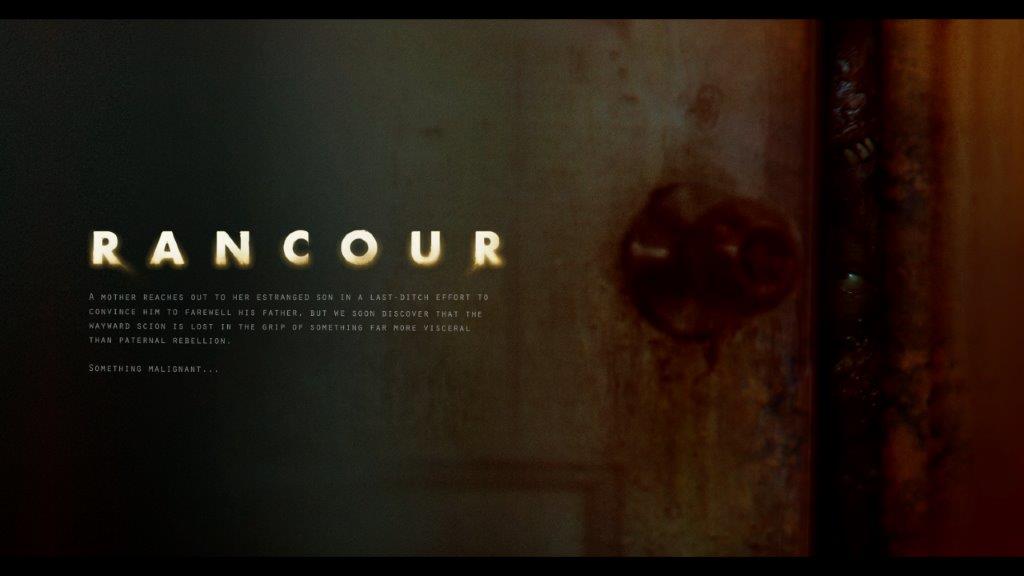
Before I give too much away, I’ll defer to the official synopsis: A mother reaches out to her estranged son in a last-ditch effort to convince him to farewell his father, but we soon discover that the wayward scion is lost in the grip of something far more visceral than paternal rebellion. Something malignant…
You’ve worked with some of the best filmmakers in the world, as you enter your first directing effort, what do you think you can take away from your experiences?
Where to start!? Firstly, I must point out that I count it such an unreal privilege to have been on board some of the most amazing projects with some of the most talented people at the helm. Not just the directors themselves, but the crew surrounding them. It’s been my great fortune to work with known industry titans like Ridley Scott, George Miller, and Mel Gibson, but the first thing I recognise about great filmmakers is their ability to acknowledge, trust and lean on the great unsung talent around them.
On Mad Max: Fury Rad, I was working with the (now) Academy Award winning production designer, Colin Gibson, and that man is profoundly creative and remains something of an inspiration and mentor to me. He believed in me and let me loose just as George did for him and I have every intention of doing the same with our crew.
How did this opportunity to direct something with such a high budget and such experienced collaborators arise?
After I finished up on Aquaman, I really wanted to step away from big films for a while and tell my own twisted story. I actually put up half the budget myself and from there it snowballed into what it is today. My profile in the industry might have helped, as I had already worked with a ton of massively talented people who were keen to back one of their own, from inside the ranks. Once I (kinda) finished writing the script, I passed it onto some trusted colleagues, who instead of giving me the brutal feedback I expected, offered to come aboard. Fellow producers John Marsh, Craig Blair, and James Pratt helped knock it into the shape it had to be in before I showed it to the likes of Andrew Mason (producer of The Matrix trilogy) who took a shine to me and offered invaluable feedback and encouragement.
Tell us about Crypt TV and the nature of the 3-picture deal?
My co-producer John (Marshy) Marsh and I run a production company together called Idea Garage. A few years ago, Marshy directed a short film that played at the Palm Springs International Short Film Festival called Darkness Comes, starring David ‘Wolfman’ Williams. At the festival, our flick caught the eye of Craig Blair, an LA-based producer who turned out to be a great friend and now an IG team member. Once he’d read Rancour and officially came aboard he knew exactly where it would flourish and suggested Crypt TV. Once I investigated the platform I immediately resonated with the studio and recognised its trajectory. Then I saw the heavyweights behind it (Jack Davis, Eli Roth, and Jason Blum) and knew I couldn’t be in better hands. Craig negotiated the deal with them which basically says that if my directorial debut fares as well as we all hope with the audience, the studio will back us for a few more rounds. Fingers crossed!!!
Short films aren’t usually feasible in terms of serious distribution and budget, so can you tell us more about that?
That’s a great point. The mass consumption of media online has absolutely shattered the model of old. The insatiable thirst of the audience has given rise to a host of alternate media platforms that are thriving in every way. As such, if you can prove you are an asset to those groups, there is a good chance you can partner together to make some amazing content. That’s reflected by the big studios investing in this space.
Stay tuned for more news on Rancour as it comes to hand.
For more on Dane Hallett, head over to his Facebook and Instagram pages.
To purchase a copy of Alien Covenant: David’s Drawings, head here
