


by Roger Stone
Bernadette is well-known in LGBT circles in Sydney, Australia, where the film begins. Tick, as Mitzi, and Adam, aka Felicia, are Bernadette’s drag accomplices in a flamboyant drag act. Lip-synching to recordings while executing a haphazardly organised stage show and donning garish gowns, a plethora of feather boas, and a lot of eye shadow are all part of the act. Bernadette, a clearly intelligent individual, is growing tired of it all.
Sydney is also sick of Bernadette, so when an opportunity to perform in the rural town of Alice Springs presents itself, the three pals jump at it. Mitzi’s ex-wife, who now runs a casino, is in desperate need of an act. This sets the stage for the arrival of Priscilla, the refurbished school bus that serves as their dressing room and living accommodations. They set off into the bush; Priscilla painted a vibrant lavender, looking to discover new things.
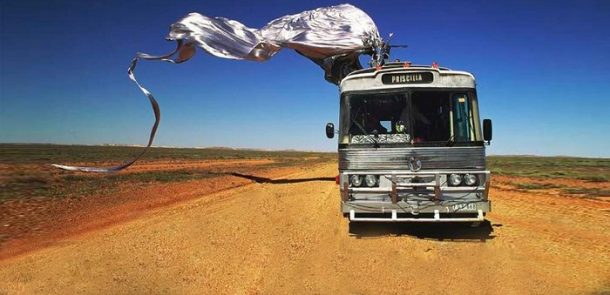
With tonnes of drive-by scenery, soul-searching chats during roadside camp-outs, and risky interactions with the locals, the film fits into the rhythms of many road movies. A drinking contest is held with a lesbian who believes she is more manly than the queens. The anti-gay graffiti on the purple bus is particularly offensive. Bernadette appears to be growing tired of life. Priscilla arrives at Alice Springs just as the prospects of life on the road are running out, and Mitzi’s ex-wife appears to be quite content with the new life her former husband has chosen.
Mitzi’s kid seems unconcerned with the gender-blender scenario. The trio’s nightclub performance is more prevalent in Alice than in New York. Then there’s a subplot about an auto mechanic whose own wife is a stripper who, by comparison, makes Bernadette look decent. I suppose the movie’s scenes of homophobic antagonism are required. Still, the writer-director, Stephan Elliott, doesn’t appear to care about them. I wonder whether he would have been content to have the entire tale as cheerful as his most extraordinary scenes.
The unexpected sight of Terence Stamp in drag at the start of the film cannot be forgotten and distracts us. Still, Stamp is able to give the character a convincing humanity. We eventually realise that the film’s real subject is not homosexuality, drag queens, or showbiz, but rather the life of a middle-aged person trapped in a job that has become tiresome.
Darker notes, on the other hand, are present from the start. The homophobia and transphobia that the three meet along the way are not overlooked. And while the story begins with Bernadette in loss, it concludes with hope and a relationship with Bob, a long-time fan of her performance. When the late Bill Hunter appeared in an Australian film, you knew you were in good hands, and the chemistry between him and Terence Stamp is genuine and heartfelt.
Although it’s difficult to imagine John Cleese as Bernadette, he was considered for the part. They might wish to cast actual trans and homosexual performers in the starring roles nowadays, but the three main characters do a fantastic job. Priscilla has a lot of heart for what could have been a superficial camp/bitchfest. It’s a touch ragged in spots and a little too long, but as far as acceptance songs for mainstream audiences go, it’s excellent. Stephan Elliott has continued to make films, but Priscilla has stood the test of time the best.
The absurd, wicked banter, the extravagant costumes and makeup, and the overall high spirits of the production are more essential than the plot of Priscilla. Stamp provides one of his best performances as the heartbroken woman, whose latent masculinity occasionally peeks through her charmingly elegant demeanour and who enthusiastically participates in the drag numbers. Weaving as the bisexual Tick and Pearce as the strong but fey Adam, whose fixation with Abba presents itself in a rather weird manner, are both fantastic.
Although the film is only a few minutes longer than it perhaps needs to be, it would be an exaggeration to suggest it drags. All of the production credits are outstanding, starting with Brian J. Breheny’s widescreen photography, which transforms the Australian desert into an extraterrestrial planet’s scenery. Lizzy Gardiner and Tim Chappel’s incredibly detailed outfits deserve special recognition. Guy Gross’s score is likewise deserving of praise.
The picture is so ridiculous that it becomes pleasantly disarming, despite the fact that it makes no compromises to a heterosexual audience. It’s difficult not to react to such delightfully crass and in-your-face entertainment. Yet, it’s clearly not for the religious. It should be able to break out of the cult and LGBT sectors and attract a broader audience. Village People, Lena Horne, Patti Page, and, of course, Abba all have great songs on the soundtrack.
