

Worth: $16.00
FilmInk rates movies out of $20 — the score indicates the amount we believe a ticket to the movie to be worth
Cast:
Sarah Snook (voice)
Intro:
a visually striking document of Australia’s biodiversity
Few things are as quintessentially Australian as the kangaroo, its visage is plastered on everything from our coat of arms to airline logos. But how much do you know about the kangaroo itself? If the answer to that is ‘not much’, you can easily, and entertainingly, rectify that gap in your knowledge by watching Kylie Stott’s charming Netflix documentary Kangaroo Valley.
Kangaroo Valley follows Mala, a newborn, eastern grey joey, as she tries to survive her first year on the planet – a feat (we are told) that only one in five joeys achieve. Mala must find her place not only in her mob, but in the valley itself, which is home to a unique assortment of creatures, both friend and foe. One of those creatures is Miro, a newborn dingo pup, who is also Mala’s natural predator. As both learn and grow, they become increasingly close to a confrontation, one which both of them may not survive.
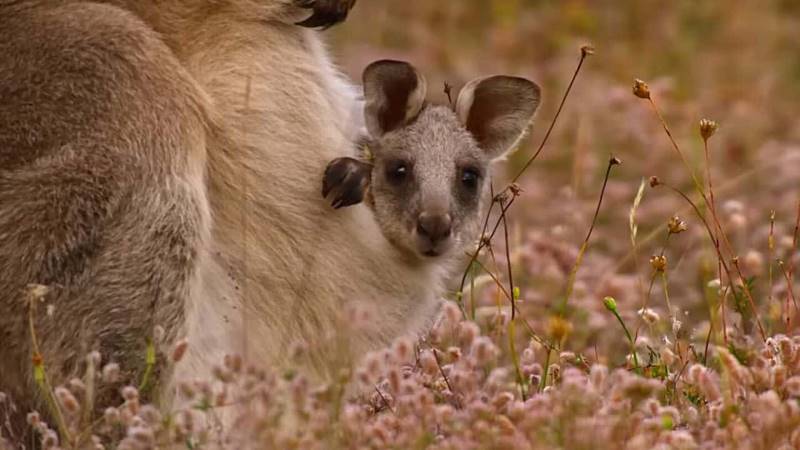
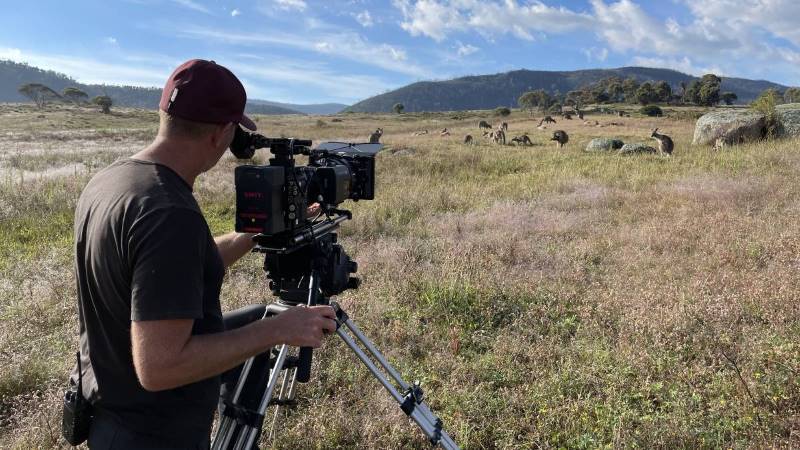
Stott’s film was crafted from over 300 hours of footage shot in the Australian Capital Territory National Park of Namadgi. Unlike many other nature documentaries, this footage is not saturated with dry factoids, but rather story-tale narration (performed charmingly by Sarah Snook), and as a result, an involving coming-of-age narrative emerges.
The wonderful creatures of Namadgi become the characters of Kangaroo Valley, and all are united in one primal goal – survival. With the stakes being literally life or death, Stott’s film becomes effortlessly engaging. Helping with that engagement is Stott’s ability to emulate sequences found in traditional films: Kangaroo Valley contains breakneck chases, bruising fights, and even sequences of physical comedy.
The effectiveness of these sequences is due largely to the dazzling work of a trio of cinematographers – Thomas Crowley, Ben Cunningham, and Richard Kirby – who use an array of techniques and technology to put us right in the action. From suspenseful aerial-shot chases to intimate close-ups of tender affection, the trio captures not only the animals’ ferocious physicality, but also their expressive, even human-like gestures. Through their lens, we get to witness not only the entirety of Namadgi’s beautiful landscape but also the full spectrum of emotions contained within it.
From its misty peaks to its petrified forests – the landscape of Namadgi is deeply cinematic, so much so, that Kangaroo Valley often takes on the aesthetic of an otherworldly fantasy film akin to Peter Jackson’s The Lord of the Rings trilogy. A nighttime sequence showcasing the valley’s bioluminescence is so spectacular and transfixing that it is easy to see why James Cameron draws his main inspiration for his Avatar series from the natural world.
Kangaroo Valley features an emotive score by H. Scott Salinas and Logan Stahley. The fates of the characters can turn on a dime, and that notion is reinforced by music that often oscillates between the rousing suspense of drums and gentle choir singing. The title track ‘We Can Do Anything’ is provided by Sia, and is a fitting send-off for the resilient residents of the valley.
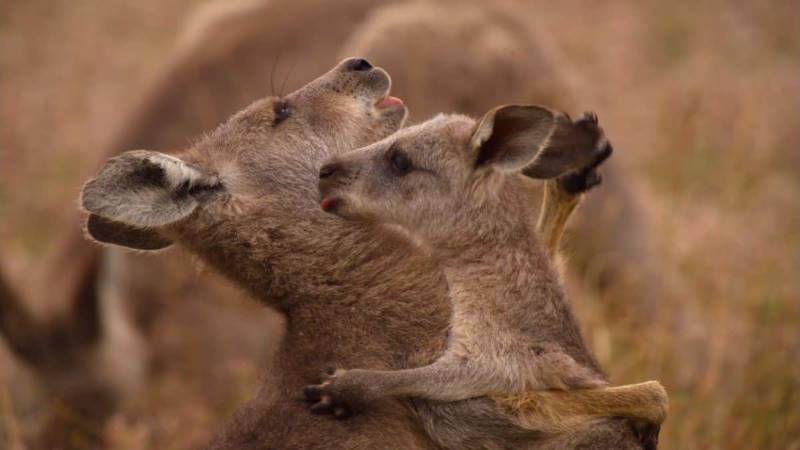
The delivery of the narrative makes it easy to dismiss Kangaroo Valley as simple children’s entertainment, but to do so minimises Stott and her team’s staggering achievement. Instead, the film should be viewed as having something to offer everyone: both a rousing coming-of-age narrative for younger viewers, and a visually striking document of Australia’s biodiversity for adults.
