


by Dov Kornits
Can you describe the difference between the Greek music we might hear at a Greek wedding in Australia and Rembetika?
It’s an interesting question. People might be very familiar with the sound of the bouzouki, but Rembetika music itself has a revolutionary past, and it is the music that comes from the underground, from mass migration, and is often associated with the American ‘blues’. Not so much that it sounds the same as the blues, but more to do with the mode of storytelling. The music captures the heart and soul of people’s struggle and particularly around the time that it emerged which was at the beginning of the 20th century.
There are certainly remnants of more popular cultural elements of Rembetika music that people would recognise such as the soundtrack from the movie Zorba the Greek, but there are many more and that’s something that I hope audiences will discover when they see the film!
How long have you been making My Rembetika Blues?
It took four years to make this film. I made this film from the beginning as an exploration into ideas around music, and community and how people can come together in times of difficulty, trauma and struggle. So the film documents the ways in which forced migration, being expelled from your homeland, being in exile has been part of the history of the 20th century and most certainly now into the 21st.
In this sense, the film required the time and space on the one hand to tell the story about this particular kind of music, but it is also a more personal journey which documents my grandmother’s forced migration from Smyrna and it is a particular historical moment which a lot of people may not know about: the Greco Turkish War in the early 20th century, and the forced migrations of thousands and thousands of people and deaths of thousands of thousands of people.
The music emerged through this confluence of sounds from urban Athens and the Asia Minor migrations. It’s very unique and it is a music of struggle and the streets.
How did you come to the highly personal, diary-style of your films?
One of the important aspects of my filmmaking is the personal essay style that I’ve inherited through the long tradition of wonderful documentarians and filmmakers such as Agnes Varda. She helped to develop the use of the ‘personal’ as a type of character-making and part of the work of cinema. My film is very much using the ‘personal’ as a character to enable audiences to connect to the story. Although it’s a personal journey about the search for my grandmother and this fantastic revolutionary style of music, it is also a universal story about love and loss. I’m hoping that it will connect with different people.
It’s been interesting showing it to different audiences around the world – everyone has connected with it at some level – and I think that’s the power of ‘music’ and community making. Music is so deeply felt that it inspires feeling and emotion, and that’s what helps build the story in my film.

In the film, you speak about how you feel a connection to certain locations that you visit – can you expand on that?
Yes, this is a good question. In my filmmaking – I shoot most of my films as well – so having a really deep connection to a place, to the experience of a place also helps in the visual creation of the images and in the storytelling. I have learnt a lot about this through the work of Wim Wenders, who is a master storyteller of place, and I have had the great privilege to work with him.
And, also, it’s about investigating and going back to places I had never been to, for instance, Egypt where my parents ended up, and being able to experience the place for the first time helped me to put some of their life and history into some perspective. It was deeply moving.
There is something very powerful for anyone who has been displaced from their home – whatever that displacement might be – the experience of going back to country, going back to land, going back to one’s roots, can be healing I think. For me, the film was surprisingly a healing journey, even though I never anticipated that would happen when I started the film!
How much research do you do before you roll the camera/travel to some of these locations?
A lot of research needs to be done in advance, in a particularly getting to know a place, watching films, reading books about it, literature, poetry, other writers eg. there have been some wonderful Greek poets like Constantine Cavafy who lived and worked in Egypt who helped shape some of my thinking around places like Alexandria, Egypt. As well as the Greek Egyptian filmmaker Youssef Chahine (whose catalogue was purchased by Netflix and some of his most wonderful films are available there… He discovered Omar Sharif!). And of course, some of the more well-known English writers like Lawrence Durrell, who wrote The Alexandria Quartet about his Egyptian experience.
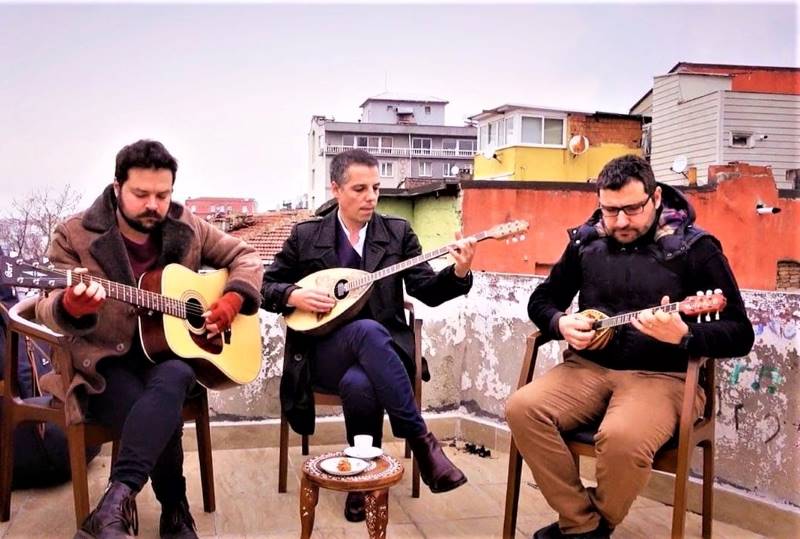
And then of course, there’s the travel itself – which is often a journey of discovery – it can be tiring as well as breathtaking. In this film, I travel to many different parts of the world documenting the music and the experience of the diaspora, not only the Greek diaspora…
Also, I think one of the great joys of making documentary films is that you never quite know where you will end up – so the travel can sometimes be accidental. For example, with one of my main characters, Jim Sclavunos from The Bad Seeds, we first met in Brooklyn, and we ended up in Hydra looking for his grandparents… it’s a parallel story to my own. And I have to say Hydra is a beautiful island too!

What’s the size of your crew?
I made the film with a very small crew. I did the principal filming, writing and directing. There are a couple of occasions where I hired a cinematographer to shoot me in relationship to an environment or with other performers. But mainly my crew is small: it’s usually myself, a film editor and obviously a producer.
I think there are very good benefits to having a small crew because you have a lot of control over the material and content. But into the future when I’m making more hybrid documentary fiction films, I think you need to work with more people – simply in terms of some of the logistics of working with actors etc. Whereas with documentary, you’re always shaping the story as you go, and working with a smaller budget and film can be quite liberating, even though extraordinarily difficult and at times, it can be very hard to do, and you can become despondent.
What role did Tom Zubrycki play in the making of the film, and what sort of budget were you working with?
Tom was a producer on this film and also my first film Dogs of Democracy. He’s been a great source of inspiration and wisdom. He’s one of Australia’s greatest documentary makers, and he has been able to help guide me into this realm of documentary filmmaking.
This film was made with an extremely low budget, we did get assistance in post-production from Screen Australia. I have to say, filmmaking is an expensive art form, at the same time, I’d say to people to just start working on your project and then find ways to make the funding happen. For me, filmmaking is one of the most important mediums for communicating social justice issues, and there needs to more and more independent filmmakers…

Not sure if I missed it, but the obvious person to speak with is a musicologist for the subject of your film – is there much study in the Rembetika space?
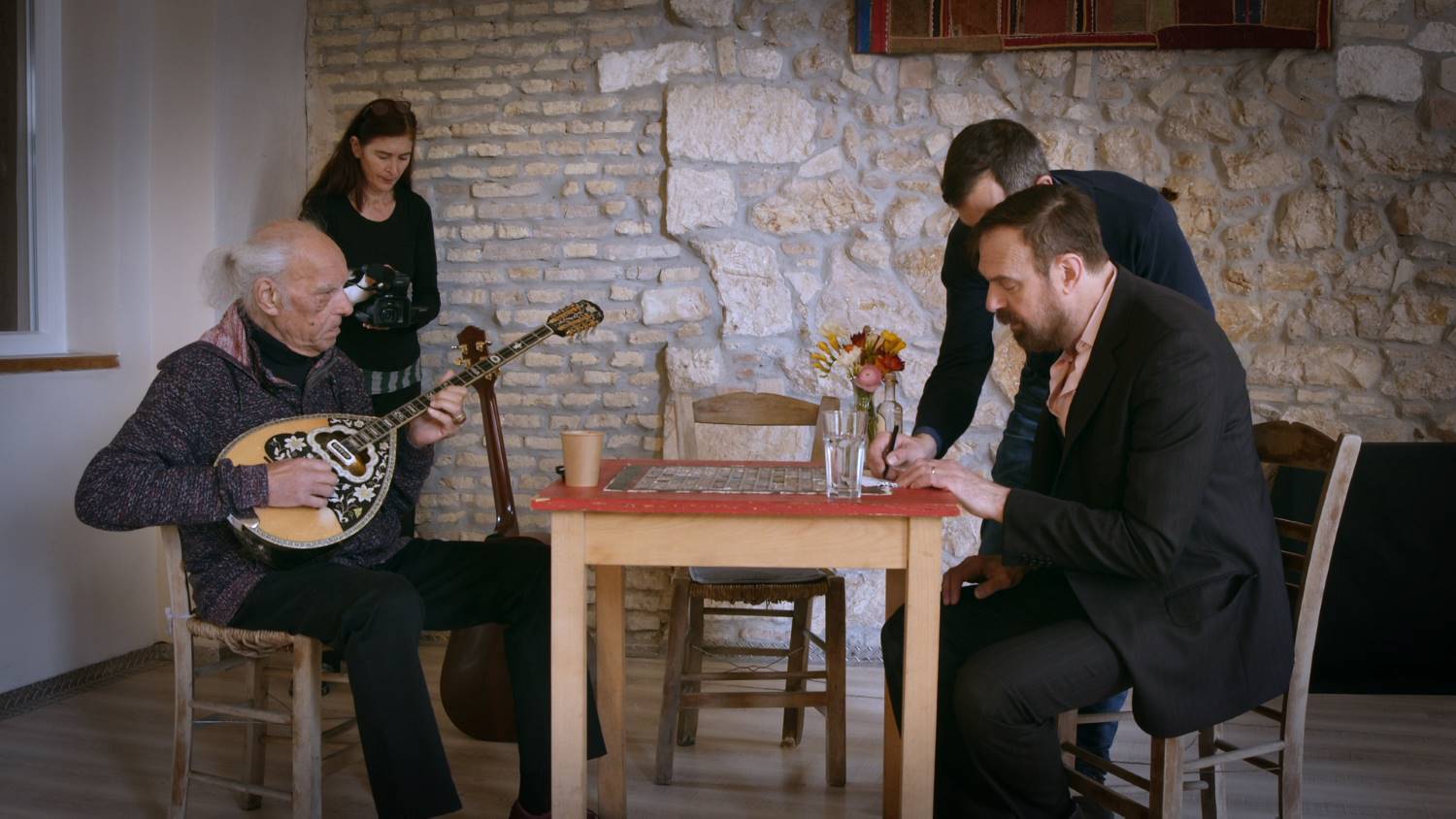
There are definitely musicologists in the Rembetika space. In my film, the author Gail Holst and Fr Romanos are the musicologists, who share their wisdom and experience around the beginnings and history of Rembetika.
However, the film itself is not really about defining the music per se, it’s more about the feel for the sound and the power of music in bringing people together. So, the purpose, although you do learn a lot about the music in the film, is also about the experience and power of music and how it connects you to memory, to place – things that are more intangible…
Do you view these films as extensions of your academic work?
In some ways, yes, it is an extension of my research. But I’d probably put it differently: I’ve come to filmmaking now and I have realised that it brings together all of my research skills, my ability to create arguments, concepts and visual storytelling – in this way, film is research, and so for me, it’s what I’ve doing all my life I think… and I’ve finally found a way to make it work!
What else are you working on right now?
A couple exciting projects – one is a new documentary film about animals. The second film is going to be a hybrid documentary fiction film. I will work with the Australian author Christos Tsiolkas on the screenplay – we are calling it an Australian Road movie…
My Rembetika Blues is screening at Classic Cinema in Melbourne on June 16, followed by a Q&A with Mary. It will also screen on June 23 at The Ritz Cinema in Randwick, July 20 at Marrickville Library, July 27 at The F Project in Warnambool, on October 15 at Odyssey Greek Film Festival in Adelaide and in November at ACMI in Melbourne.
