


by Gill Pringle at the Red Sea International Film Festival in Jeddah, Saudi Arabia
“It was amazing to see women in public working on the passports with passengers. Women weren’t allowed contact with the public before. We had to be shielded and not make eye contact,” says Al-Mansour, who now lives in California, dressed today in blue jeans with gold and white Nikes, a turquoise robe loosely covering her western attire.
Hailed as Saudi Arabia’s first female filmmaker, Al-Mansour made her feature debut, Wadjda, selected for the 2012 Venice Film Festival.
The story of a young girl living in the conservative suburbs of Riyadh, who dreams of owning a green bicycle, Wadjda took five years to make owing to the kingdom’s intrinsic constraints, the segregation of men and women forcing Al-Mansour to direct her film from a van.
Hidden in the van with a monitor and walkie-talkie, the writer-director was forced to yell at people, instructing them what to do.
Making its world premiere at Venice, Wadjda was the first full-length feature to be shot entirely in Saudi Arabia and the international film world immediately embraced this tiny, plucky, woman who broke down so many barriers to achieve her dreams.
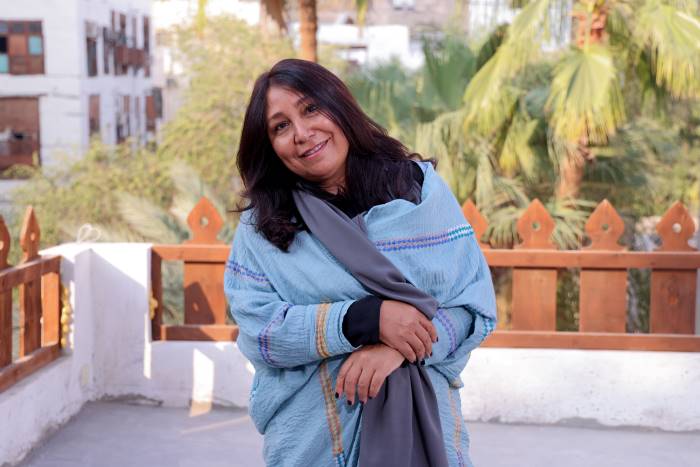
Speaking to FilmInk at the inaugural edition of the Red Sea International Film Festival [RedSeaIFF] following her award, Al-Mansour, 47, says she’s encouraged by what she has seen so far.
“I have a sister who recently got divorced and, whereas before, the father would have taken the kids; she wouldn’t have been able to do any paperwork or go to the court by herself. She would have to have a male guardian and she wouldn’t be allowed to drive. But now she’s driving and taking care of her kids and did all her paperwork on her own. She’s so empowered as a human being, also running her own business.
“So, this is huge for her,” says Al-Mansour, recalling how when she herself married, she wasn’t allowed to do a doctor’s exam without her American husband’s signed permission.
“It was very weird for him. I remember he wrote a long letter saying he didn’t object,” says the filmmaker who met her future husband, US diplomat Bradley Niemann, while he was working in Saudi Arabia. When he was posted to the US embassy in Australia, Al-Mansour completed her Master’s degree in Sydney, before moving to Bahrain.
“I created my own luck. I grew up in a small town in Saudi Arabia, not speaking any English at all. I went to local public schools and was lucky that my parents were liberals and didn’t force me to wear the veil,” she says.
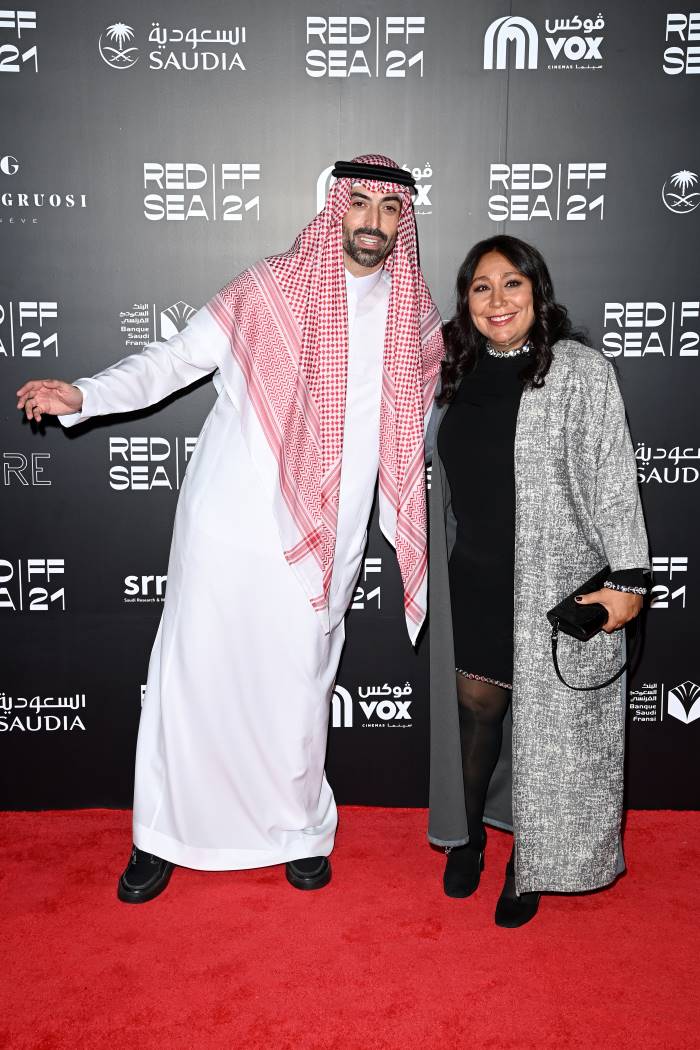
With the creation of RedSeaIFF, she believes this is an important first step to the continuing empowerment of women in this region. “I feel now that if a woman has a passion to tell a story, there is a place for her to come and perhaps find funding. If a young female filmmaker like me, from a small town, can do it, then there’s definitely a place for other female filmmakers to begin,” she says.
“I’m excited to see more female filmmakers from Saudi. I think Saudi cinema is very intimate because it is still at its beginning and there’s huge room for a woman to tell stories because you don’t want to immediately become very commercial and have a producer.
“We need to see more voices, and more liberal voices, from this world. It’s a process. We need to open up and we are opening up but to have more fundamental change, things need to acclimate, so we need more local stories that can create a cultural shift,” she says.
And while Al-Mansour and her family live in California today – where she has developed a thriving TV career, directing episodes of popular series, The L Word and The Sinner, currently directing Abbey Lee and Anthony LaPaglia in upcoming TV crime series, Florida Man – Saudi Arabia will always be home.
“I love making films here. It’s coming back home. You understand the language, you understand the food. Working in the west is like being on the wheel. It doesn’t stop. You get to work with major actors and learn the process and the trends and become very skilled in your craft. So, I enjoy coming back and trying to apply all that I’ve learned and work with new actors and take them to the next level, it’s amazing and exciting,” says Al-Mansour who also directed Elle Fanning and Bel Powley in 2017’s Mary Shelley. She also returned to Saudi Arabia to make the feature The Perfect Candidate in 2019.
“Women are having a moment right now. I don’t think there is even a glass ceiling anymore because women can do anything if they believe in themselves.”
She remains cautiously optimistic about a real change for a Saudi Arabian film industry. “It’s still a conservative society and there will be a lot of struggle. It’s not like a dream or a rosy picture but it is a picture that is worth telling and a journey that is worth taking and it will pay off.
“People will not immediately accept it because it’s been conservative for so long, but the reward is high when people will listen. Women need to capitalise on this moment and never take no for an answer and not be intimidated by the challenges,” says the filmmaker who says there is even a discussion about launching a film school in Saudi Arabia.
Women shouldn’t underestimate the hurdles ahead, she says: “It’s been a lot for me to be away from my family and missing my kids, and missing their birthdays. It’s not easy to be in this business and you have to really have the passion and really want this to be your life. It’s tough for all female directors, no matter which country you’re from. Every time, the team around you will always try and test you to make sure you know your shit. You have to continuously assert yourself in a way that a male director doesn’t.”
She’s inspired to see Chloe Zhao take home the Oscar earlier this year, a feat she hopes might be repeated by Jane Campion with The Power of the Dog next year. “I’m really rooting for her. It would be amazing for a woman to win the Oscars twice in a row and that will make a splash and pave the way for people to understand that we are just part of the mainstream. It’s not like ‘women’. No. We are filmmakers and that’s how you must assess us.”
She’s proud of her first woman status in Saudi Arabia, if only to inspire other girls to create their own stories.
Like Zhao, she’d like to direct a Marvel movie. “I want that paycheck!” she laughs. “I like Scarlett Johansson and I like that she stood up for herself. If I were to direct a Marvel movie, I would want it to be a dark female character like Black Widow.”
