


Worth: $13.00
FilmInk rates movies out of $20 — the score indicates the amount we believe a ticket to the movie to be worth
Cast:
Jimmy Carter, Ted Koppel, Walter Mondale
Intro:
…extraordinarily detailed…
It is a testament to her status as an acclaimed and respected documentarian that Barbara Kopple is able to include political luminaries such as US President Jimmy Carter, VP Walter Mondale, and broadcast journalist Ted Koppel (of Nightline fame) in her latest film.
While Kopple has directed episodes of television dramas, the American film director is perhaps best known for her two Academy award-winning documentaries: the first in 1976 for Harlan County, USA, about a Kentucky miners’ strike, and the second in 1991 for American Dream, the story of the 1985–86 Hormel strike in Austin, Minnesota.
Now, she’s set her sights on documenting the Iran Hostage Crisis that chaotically unfolded during the early eighties. Produced and directed by Barbara Kopple, Desert One painstakingly – at times, tediously – charts every stage of the real-life drama as it unfolded and developed over several months.
Using new archival sources and unprecedented access to various high-profile subjects who were involved in the operation forty years ago, Kopple meticulously illustrates the full story behind one of the most daring rescue plans in modern US history: a secret mission to free hostages captured during the 1979 Iranian revolution.
The Iran hostage crisis was a diplomatic standoff between the United States and Iran. Fifty-two American diplomats and citizens were held hostage after a group of militarised Iranian college students took over the U.S. Embassy in Tehran amidst the Iranian Revolution. The hostages were held for 444 days from November 4, 1979, to January 20, 1981.
Despite his efforts, President Jimmy Carter was unable to diplomatically resolve the crisis. Four months into the captivity, on April 24, 1980, Carter ordered a disastrous rescue mission in which eight U.S. military personnel were killed and no hostages recovered. In November 1980, Carter lost the presidential election to Republican Ronald Reagan. Minutes after Reagan’s inauguration as the 40th president of the United States in January 1981, the 52 captives held at the U.S. embassy in Teheran were released, ending the Iran Hostage Crisis after fourteen grueling months.
Using archival news footage of the revolution in Iran, lots of ‘talking heads’ interviews from both sides of the operation, and gloomy watercolor-style animation filling in for absent images, Kopple takes us through every stage of the drawn-out saga and ill-fated rescue mission. Although a bit of a slog, her doc does an excellent job of illustrating the context, backstory and political events leading up to the Hostage crisis.
We learn that the USA had engineered a coup in 1957 to install the Shah as a puppet dictator. It’s explained that Iran was “very important to the Americans.” Oil is conspicuously not mentioned, rather it’s explained that a US presence in Iran was important for the monitoring of nuclear and missile tests being carried out by the USSR.
Resentment against the Shah and his relationship with the American President grows. The Ayatollah Khomeni – an exiled clerical leader – returns to Iran to massive and enthusiastic crowds, and proceeds to incite anti-American sentiments. The American Consulate in Tehran is invaded by thousands of angry protestors who occupy the premises and take the inhabitants hostage. The Ayatollah gives his approval, stating that “the hostages will remain in captivity until the Shah is returned,” for trial by the Iranian people. Two weeks after the storming of the embassy, the Ayatollah released all non-U.S. captives, and all female and minority Americans, citing these groups as among the people oppressed by the government of the United States. The remaining 52 captives remained at the mercy of the Ayatollah, and their captors, for the next 14 months.
We hear from several of the hostage-takers, one of whom explains that, as a group, they felt that they had “no alternative but to continue the battle until we were certain that American interference in Iran was stopped.” The takeover of the US Embassy was deemed necessary to “guarantee our political independence.”
When interviewed by Kopple, President Carter recalls warning the Ayatollah that if any of the American hostages are harmed, the US will impose a complete trade and commercial blockade on Iran, adding that if he killed a hostage, “we would attack Iran militarily.”
In interviews, the surviving hostages relate horrifying episodes of psychological intimidation as well as decent treatment. There is a sense of growing despair as the weeks turned into months.
Carter remains committed to finding a diplomatic solution, but retains the rescue as an alternative in case negotiations fail. Yet all attempts of diplomacy keep getting rebuffed by the Ayatollah. Eventually, Carter agrees to military action, having been convinced by his advisors that it would be successful.
Four months after the Embassy takeover, President Carter is briefed on the rescue plan. In interview, VP Walter Mondale also recalls discussions of the rescue mission, called Operation Eagle Claw.
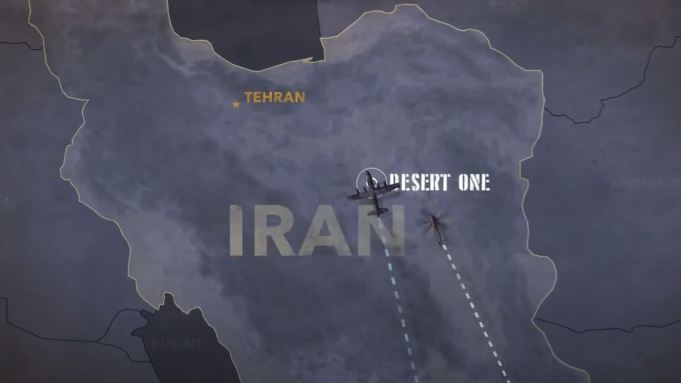
Delta Force, a crack team of highly-trained military special operatives that was considered “the best of the best” is assembled and prepped. Major William G. Boykin, a Delta Force operative, recalls, “Our mission was plain and simple — bring home 52 American hostages.” An animated map charts each stage of the entire high-risk, classified operation plan.
Colonel Charles Beckwith, the Delta Force Commander, recalls, “It was a very difficult plan, but it was not an impossible plan. I was responsible for a lot of lives and I didn’t want to butcher it all up. I wanted our unit to do well.” We even learn that the Delta Force team pored over any investigative footage aired on news programs such as Nightline for clues and useful data.
Broadcast journalist Ted Koppel (no relation to the filmmaker) covered the State Department and their grueling daily noon briefings for the Nightline TV current affairs show.
Kopple balances her sources, giving equal time to the politicians and military personnel as well as the hostage takers themselves and their captives. At times, it’s quite intense to hear the harrowing, first-hand recollections of the drama.
Delta One is an extraordinarily detailed examination of the mission itself, its planning, the men involved and what exactly went wrong. While the sure hand of filmmaker Barbara Kopple presents each stage of the complex story clearly and coherently, keeping the timeline intact, the resulting documentary makes for labored viewing.
