


By Erin Free
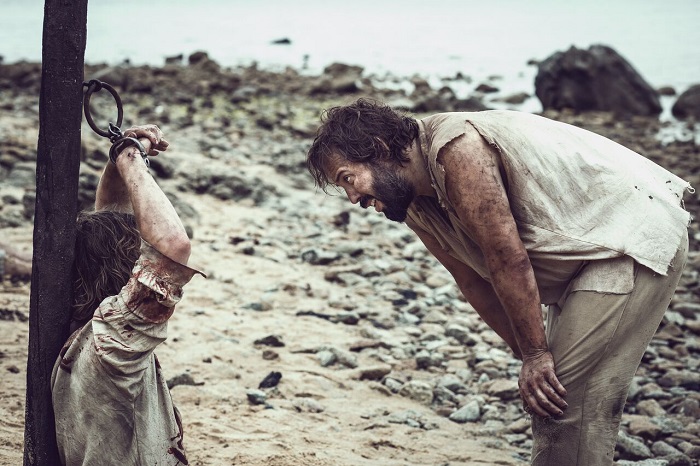
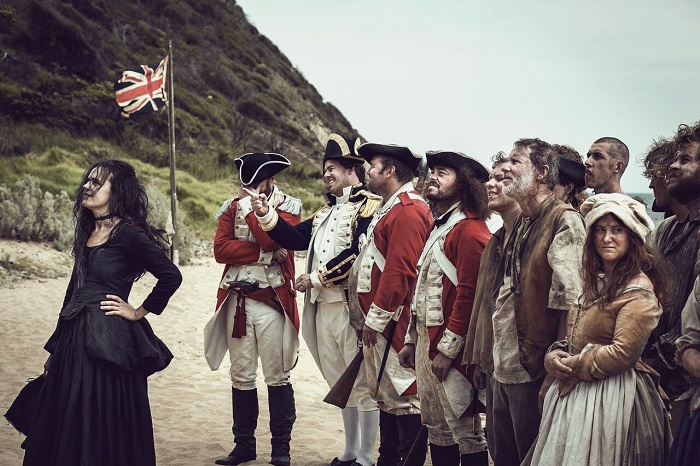
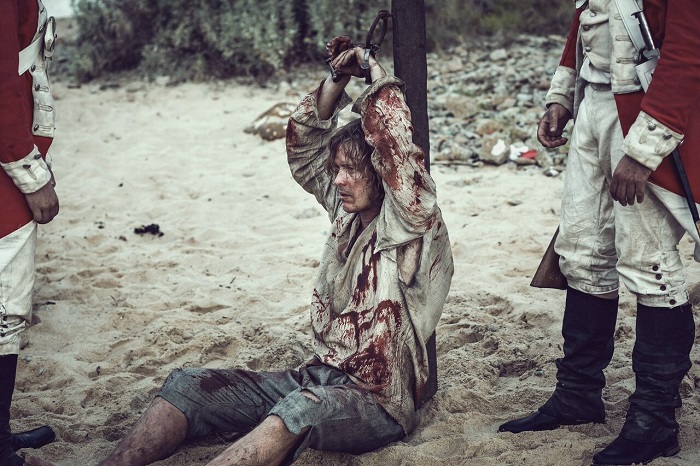
An hilariously squalid comedy from the team behind How To Talk To Australians, Bruce tells the story of Bruce Williamson (Offspring’s Richard Davies), a modern-thinking man horribly out of time in the early 1800s, whose simple plan of following his soulmate, Daisy (Veronica Thomas), to the new land of Australia by getting arrested backfires severely, trapping him in a violent prison camp in the middle of nowhere surrounded by lunatics. Bruce’s new prison tent “roommates” are the irritating Garry (Dave Lawson) and the poetic, philosophising, apparently sensitive Mick (Angus Sampson), who also might just be a marauding serial killer with a long list of colonials on his hit list. Applying a distinctly modern mind-set to a far different time (think Seth Macfarlane’s A Million Ways To Die In The West with a very broad Aussie accent), Bruce excavates laughs where you could never imagine them existing, and provides a fine showcase for the talents of both its hilarious cast, and its ingenious creators: writers, Mat Blackwell (Good News Week, The Glass House) and Warwick Holt (The Project, Good News Week), director, Tony Rogers (Wilfred, How To Talk To Australians), and producer, Jason Byrne (Sucker, How To Talk To Australians), who chatted to FilmInk about this inventive new web series.
Jason…convicts and comedy! It’s not the usual jump-off for a project – how did the idea materialise? “The very fact that it hadn’t been done before drew us to the idea. And even on the surface, it appealed. The whole colonisation experiment seemed inherently ridiculous: take a bunch of criminals, ship them to the other side of the world, and expect them to start a brave new world. It’s absolutely incredible that modern Australia even exists. At the same time, it is a very grim place for the convicts themselves, particularly looked at through modern eyes. In the main, the story that we’re told from history is that of the officers who returned to England to publish their memoirs; we know little of what the convicts themselves were thinking. We took that as license to think of them as the modern Australians who are their descendants. While the Governor busies himself with how he’ll be remembered in history’s page, the convicts are concerned with the more primal concerns of life, death, and who’s got the biggest bit of the tent.”
Did you have any major influences, in terms of other films or TV series? “Influences came from all over the place. Aesthetically, we did talk about Deadwood quite a bit. And also the grim humour of a series like M*A*S*H (not to mention the canvas). Series like Shameless had a big influence on Tony, and ultimately a primal love of Monty Python films does seem to have seeped through the writing.”
Offspring’s Richard Davies is such an essential piece of this comedic puzzle. Can you talk about your casting of him in the title role? And also your other impressive players, Dave Lawson and Angus Sampson? “We did a series of readings back in 2010 with four different casts of what was then a half-hour pilot, and Richard, Dave and Angus were in three of those reads, and stood out for the parts. Fortunately, they were also all great mates, and they had a natural chemistry that really helped the energy of their key comic scenes together.”
What’s the style of shooting and creation on Bruce? Does Tony allow for a lot of improvisation on set and in rehearsal? “Improvisation is definitely allowed on Tony’s set, though he also insists on getting the scene as written, so he always has a fallback when cutting. But a little bit of that improvisation has made it through to the final cut.”
What was the biggest high point of the whole experience? And the lowest, or most difficult/challenging point? “The biggest high point is probably right now, seeing this nine-year development process finally result in a series that we’re proud of that can be seen around the world. It’s a good feeling! And the lowest points were probably those times when we felt like we were about to be greenlit by a network, only to have our hopes dashed by a corporate restructure or changing of the guard. Somehow through it all, the core creative team kept the faith, knowing that this was a series whose time had come.”
Does the online format dictate or influence the content in any way? Does it allow you more freedom? “Originally, this was intended to be a half-hour series for TV, but perhaps it was just too different, and too black, for Australian TV networks to take on. The big advantage of going online was that the team was able to put out our vision unadulterated, not to mention reaching a global audience all at once. That said, there is still plenty of material in our convict world that didn’t make it to the online version of Bruce…what we’re saying is that we will take networks’ calls.”
Do you see this as the future of television-style content? What do you see as the biggest challenge in the creation of specifically online content, and getting the word out there? “The main challenge remains a financial one. Whether commercial or public broadcasters, a model exists there that allows everyone to make a living out of a programme. Here – particularly as we made the decision to make Bruce free from advertising to maximise our audience – our budget, even with production funding from Screen Australia, was very limited. But it’s amazing what you can do with a little money and a lot of creative excitement!”
Check out all seven episodes of Bruce at the official website, or on YouTube.
