


By Matthew Pejkovic & Erin Free
The late Curtis Hanson’s L.A. Confidential is considered one of the great films of the nineties, a modern noir masterpiece deftly acted, written and directed. Yet it was also considered too risky by the power players of the Hollywood studio system, who didn’t find any qualities in the project worthy of financial backing. “This movie got willed to be made, against incredible odds, and against a business environment that said, ‘This is the kind of movie that should not be made,’” said the film’s producer, Michael Nathanson.
L.A. Confidential was a passion project for director/co-writer, Curtis Hanson, whose dream to make a period piece in Los Angeles gained traction when he secured the film rights to James Ellroy’s sprawling crime novel about corruption, Hollywood and the LAPD in fifties Los Angeles. “On L.A. Confidential, Curtis Hanson and I – both LA natives – discussed the points of LA arcana, before and during the L.A. Confidential shoot,” James Ellroy told FilmInk. “I worked quite closely with Mr. Hanson.” The filmmaker then bunkered down with his co-writer, Brian Helgeland. “We wrote the screenplay, and finally had the script close enough to show Warner Bros. Their reaction was not enthusiastic, to say the least,” said Hanson.
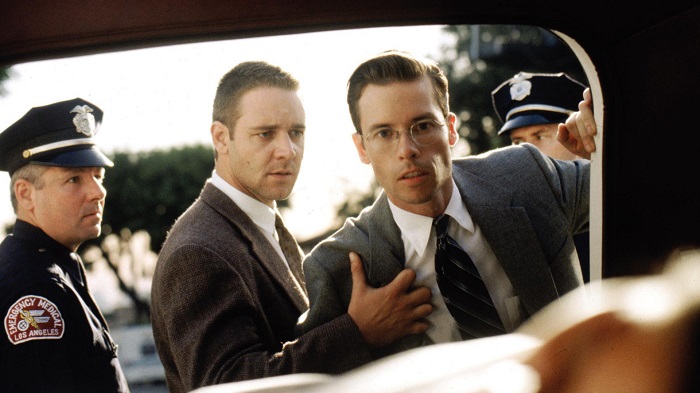
It quickly became apparent that there were elements in L.A. Confidential which turned off studios wherever they went. Period films were a nightmare for movie studios; the multi-character story had many requesting that major characters be dumped for the sake of brevity and clarity; and the fact that it was a film noir made L.A. Confidential untouchable, since noir movies equalled commercial death. The icing on the cake was Hanson’s insistence that two unknowns play the lead roles of L.A. cops, Bud White and Ed Exley, with little known Australian actors, Russell Crowe and Guy Pearce, cast in the plum roles. “We were facing a good deal of cynicism,” Russell Crowe has said of the film, which also featured bigger names like Kevin Spacey, Kim Basinger, Danny De Vito, and James Cromwell in supporting roles. “This period, noir-cop thingy based in the fifties…who cares?” In the end, Hanson secured a budget of $15 million and went on to make a critical and financial darling which scored two Oscars (Best Supporting Actress for Kim Basinger, and the screenwriting gong for Hanson and Helgeland), and no doubt a legion of apologies from studio heads who should have known better.
As with all things, the famously pithy James Ellroy is fairly blunt about the movie adaptations of his work. “They sell shit loads of fucking books. That’s what they do,” he told FilmInk. “They enhance the perception of my books and enhance the readership. They grow the readership in ways I will never be able to access.” But much more than just a license to print money, the stylish, gripping, and beautifully constructed L.A. Confidential still stands as the best screen representation of the author’s highly complex work (“L.A. Confidential was the protestant version of my work and The Black Dahlia is the Catholic,” the author has said), and as a testament to Curtis Hanson’s skill and tenacity as a filmmaker in getting it there.
