


by Flynn Shan Benson
Worth: $15.00
FilmInk rates movies out of $20 — the score indicates the amount we believe a ticket to the movie to be worth
Cast:
Leslie Cheung, Maggie Cheung, Andy Lau, Carina Lau, Jacky Cheung, Tony Leung, Rebecca Pan
Intro:
Despite the fact that it was made almost four decades ago, Days remains fresh and exciting: Wong’s camera is so graceful, his edits so enlivening, that most contemporary arthouse films seem half-asleep by comparison.
A story is told multiple times in Wong Kar-wai’s sophomore feature Days of Being Wild: a bird is born without legs, meaning that it must fly its entire life, only descending to earth to die. It’s a fitting image for the Hong Kong auteur’s film, which remains resolutely at the level of the poetic — complete with voice-overs and lingering close-ups — even as its characters’ lives remain banal and sordid.
The scenario, such as it is vaguely sketched, is of a Hong Kong man, Yuddy (Leslie Cheung) entangled with different women: first he seduces Li-Zhen (Maggie Cheung), a box office attendant, before discarding her for the cabaret dancer Mimi (Carina Lau). Hovering over him is his adoptive mother (Rebecca Pan), a former prostitute who won’t tell him his real mother’s identity. Yuddy, blank-faced and world-weary, follows these plots for trysts, murder, and an extended sequence of debauchery in the Philippines.
It would do an injustice to Days to dwell too much on plot: this is a film, like the rest of Wong’s oeuvre, that is less interested in a chain of events than in moods and moments. When Yuddy shows Li-Zhen his watch, he tells her that he’ll remember this moment, at this time, on this date, for the rest of his life; in the next shot, they are in each other’s arms. It could be the sleazy line of a pick-up artist, but under Wong’s direction, you not only think he could mean it, but you even believe that this moment tells you everything about the love and lust that draw these two together.
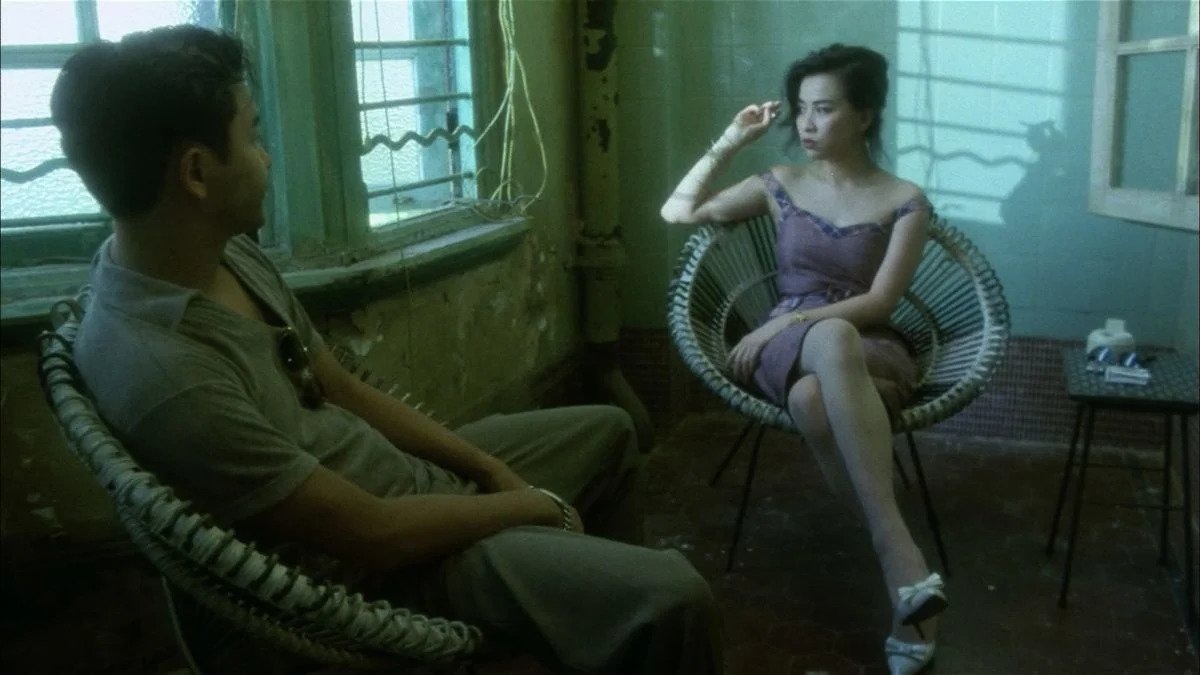
Days also marks Wong’s first collaboration with the Australian cinematographer Christopher Doyle, who renders the cramped interiors and rain-drenched streets of Hong Kong with a green palette that easily achieves beauty, without losing sight of this incongruous colonial outpost, with British telephone booths and tropical storms.
But even if Wong’s artistic sensibility is clearly established in this film, he is still yet to achieve the emotional and aesthetic brilliance of later works like In the Mood for Love. The film drifts into indulgence at times, Wong’s idiosyncratic humour can jar, while there are moments of violence that are as incongruous as those in David Lynch’s Mulholland Drive.
Despite the fact that it was made almost four decades ago, Days remains fresh and exciting: Wong’s camera is so graceful, his edits so enlivening, that most contemporary arthouse films seem half-asleep by comparison. Even if Wong has inspired generations of acolytes — including Barry Jenkins and Bi Gan — his films remain recognisably sui generis.
