



by Nataliia Serebriakova
Worth: $13.00
FilmInk rates movies out of $20 — the score indicates the amount we believe a ticket to the movie to be worth
Venice Film Festival
Cast:
Javier Bardem, Penélope Cruz, Stephen Graham, Patrick Schwarzenegger, Paul Dano, Mark Gatiss
Intro:
… an entertaining and occasionally sharp social satire …
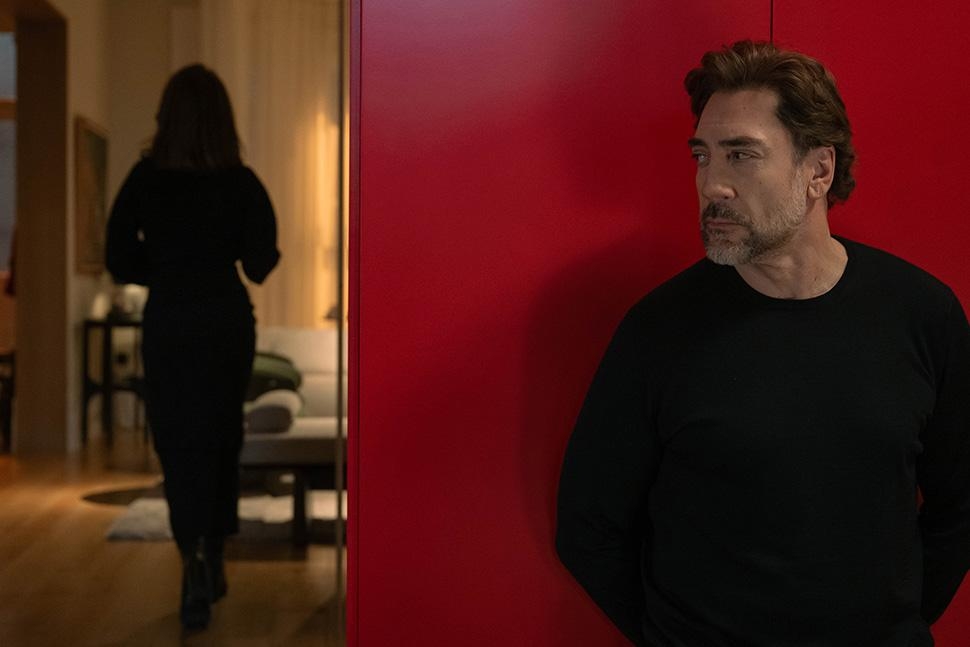
Florian Zeller, who turned dementia into an unnervingly intimate experience in The Father and struggled to reproduce that sophistication in The Son, now shifts his attention from mental illness to a different kind of social pathology: the growing conviction that the world is becoming too dangerous to share with other people. Bunker places this idea inside the luxurious London home of a wealthy Spanish creative couple, played by Javier Bardem and Penélope Cruz, and then proceeds to build a class conflict around their garden wall.
Miguel Moreno, a successful architect whose career is doing well enough to attract a bizarrely lucrative commission from a Silicon Valley millionaire: designing a private survival bunker for the apocalypse. His wife Sofía is a successful book editor who is considerably less enthusiastic about the project. Her concerns lie elsewhere, particularly in the widening gap between those who can afford to protect themselves from catastrophe and those who will simply have to live through it. The Morenos have two daughters and a cat, to which Miguel happens to be allergic — an apparently minor domestic detail that becomes part of Zeller’s portrait of a man increasingly irritated by the life he has built for himself.
The couple’s comfortable existence is further disrupted by their working-class neighbour, played by Stephen Graham. He wants to turn his garage into a studio and cuts a window into the wall separating the properties, allowing him to work in natural light. For Miguel, this is an unacceptable invasion of privacy; for the neighbour, it is simply a practical attempt to make a living. The dispute escalates into a miniature war over property, entitlement and the right to exist in someone else’s field of vision. It is an obvious but effective parallel to Miguel’s professional project: while he is designing a bunker that will allow the rich to seal themselves off from a collapsing world, his own home is becoming a smaller version of the same fortress.
Zeller’s cleverest move is casting Bardem and Cruz as a married couple whose intimacy has begun to acquire cracks. Their familiarity with one another gives the domestic scenes an effortless quality, while also making the tension between them more convincing. Sofía appears increasingly bored with a husband who has become somewhat intoxicated by his own success, while Miguel grows visibly jealous of her relationship with an American writer and colleague, played by Patrick Schwarzenegger.
Their political differences are never entirely abstract. Sofía’s concern for people outside their privileged circle exposes the moral complacency of her own household, while Miguel’s bunker project becomes a test of how far his professional ambitions have separated him from the world beyond the walls of his home.
Unfortunately, Bunker is much more interested in explaining these contradictions than in allowing them to emerge organically. Its metaphors are rarely difficult to decode. An exhibition of contemporary art, where the characters stare at a series of black squares and debate the originality of the artist’s concept, immediately recalls the satirical art-world absurdity of Ruben Östlund’s The Square while inevitably invoking Malevich. The scene is amusing, but its point arrives before the joke has even finished landing. Elsewhere, Miguel’s increasingly elaborate security measures — including a system that releases fog to blind potential intruders — push his paranoia towards farce. The film understands the absurdity of wealthy people preparing for social collapse while simultaneously contributing to the inequalities that make such fears possible, but it rarely trusts the audience enough to leave the idea alone.
At Venice, Bunker arrives in interesting company, alongside films such as Lee Chang-dong’s Possible Love that also examine relationships through the pressures of contemporary society and class. But where Lee Chang-dong finds ambiguity, emotional complexity and formal invention, Zeller tends to underline his conclusions. Bunker is an entertaining and occasionally sharp social satire, and Bardem and Cruz make its marital dynamics worth watching. But for a film about walls, borders and the fear of what exists outside them, it is surprisingly unwilling to leave much space for the audience to think beyond its own carefully constructed boundaries.
