



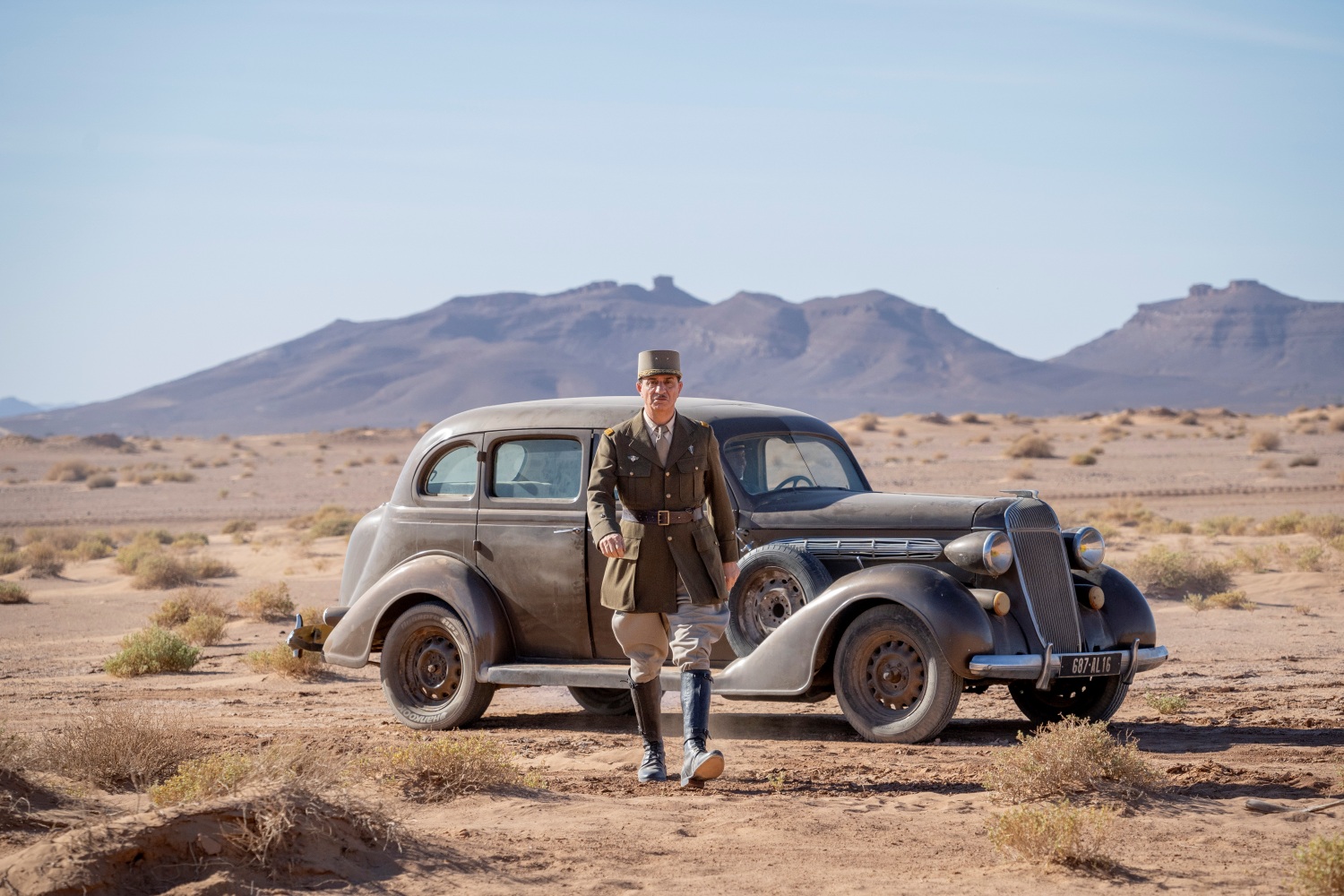
by James Mottram
Writer-director Antonin Baudry is unapologetic about his gargantuan new two-movie project about French wartime hero Charles de Gaulle. With a combined running time of nearly five-and-a-half-hours, that’s a lot of history to absorb. “You cannot tell the story of ‘Free France’ between 1940 and 1944 in one film,” argues Baudry, when FilmInk meets him in Cannes. “You would be very disloyal. Disloyal to their story. There are so many ups and downs, so many turning points, so many obstacles, so many characters, so many battles. I’m not only talking of physical battles, [but also] moral battles … it cannot be said in one film.”
De Gaulle: Résistance is the first part, covering the rise of former army officer De Gaulle during World War II, when he led the French Resistance against the Nazi occupation. Together with the sequel, De Gaulle: Liberté, it makes it the most expensive movie project in France this year, with a combined budget of nearly 80 million euros for the two films. That may be peanuts in Hollywood terms but following films like The Count of Monte Cristo and the two-part take on The Three Musketeers, it shows the French are capable of matching American studio spectacle.
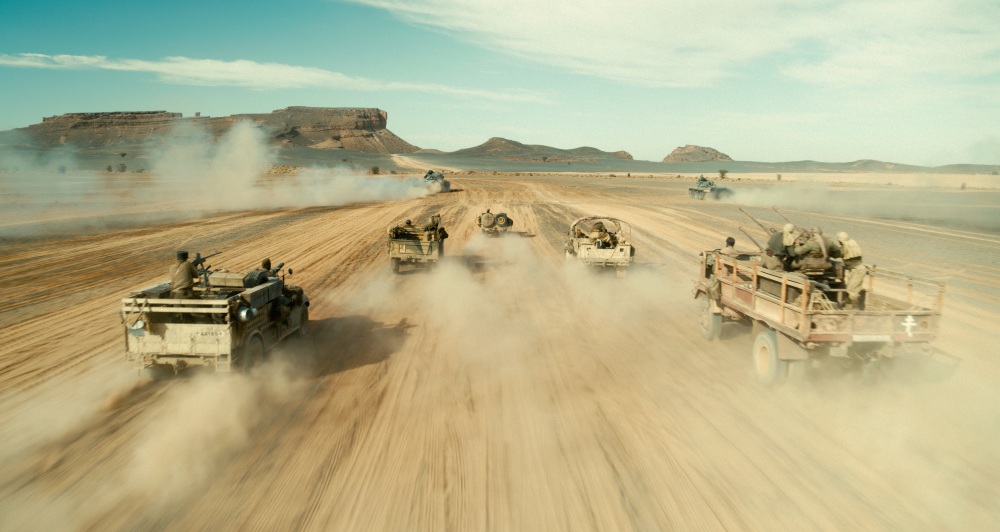
Playing De Gaulle is the French-Armenian actor Simon Abkarian, who admits that he was taken aback by the project. “I was surprised that one guy [Baudry] decided to make a film about a crazy guy. But when I realised he was as crazy as the guy he was talking about, I said, ‘Okay, I’m okay with it.’ No, because you have to be. I mean, it’s a joke, but you have to be a little bit crazy … and I was not afraid because I couldn’t afford being afraid. If I have to represent this kind of hero, it would be insulting to the guy I’m trying to embody to have a coward actor [play him]. I mean, you have to go for it.”
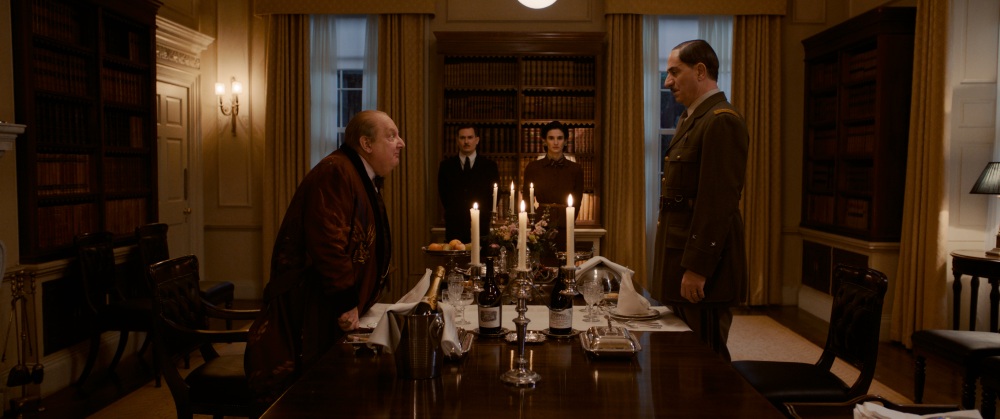
Joining Abkarian is British actor Simon Russell Beale as Winston Churchill and American star Campbell Scott as Franklin D. Roosevelt, lending the film a real international flavour. De Gaulle: Résistance also includes some of France’s brightest, including Matthieu Kassovitz as Admiral Francois Darlan, an instrumental part of the collaborationist Vichy government in France, and Benoît Magimel, who features as Marie Joseph Pierre François Kœnig, the French general who famously commanded a resilient Free France brigade during the Battle of Bir Hakeim in North Africa in 1942.
The result is a visceral war movie, one that truly places you at the heart of some of the biggest decisions made in the 20th Century. “I’m not especially interested in history or historic films,” claims Baudry, who wrote the scripts for Résistance and Liberté with Bérénice Vila. “That’s why in this film I really tried to tell the story from the present time of the characters, not knowing what came after, not knowing about the iconic figure of De Gaulle. What they had in front of them was the void – taking risks for their families, being condemned to death for a cause that was very likely to fail, and yet they did it. That’s what interests me.”

Baudry [above, on set], who previously directed 2019 submarine thriller The Wolf’s Call, estimates that he read about 150 books before combining with Vila to write a screenplay that sees De Gaulle travel to London and establish Free France, the government-in-exile. “In France, people don’t know about all of this. They don’t know how many obstacles De Gaulle had to fight. They don’t know that De Gaulle was totally alone at the beginning. You might think that the French people know that, but they don’t. So, yes, my point of view changed radically, reading after reading and book after book.”
Curiously, he admits that he also found “an inspirational parallel” in Cervantes’ epic Don Quixote, the classic 17th Century Spanish novel about a chivalry-obsessed would-be knight-errant and his squire, which also was told in two parts. “I mean, if you look at the second book, so many people heard about Don Quixote that some people want to be him and pretend they’re him. So, he has to fight against fake Don Quixote, which is exactly what happens to De Gaulle. What was driving me was to be loyal to the story of the Free France, which is a chivalry in its own way, a modern chivalry.”
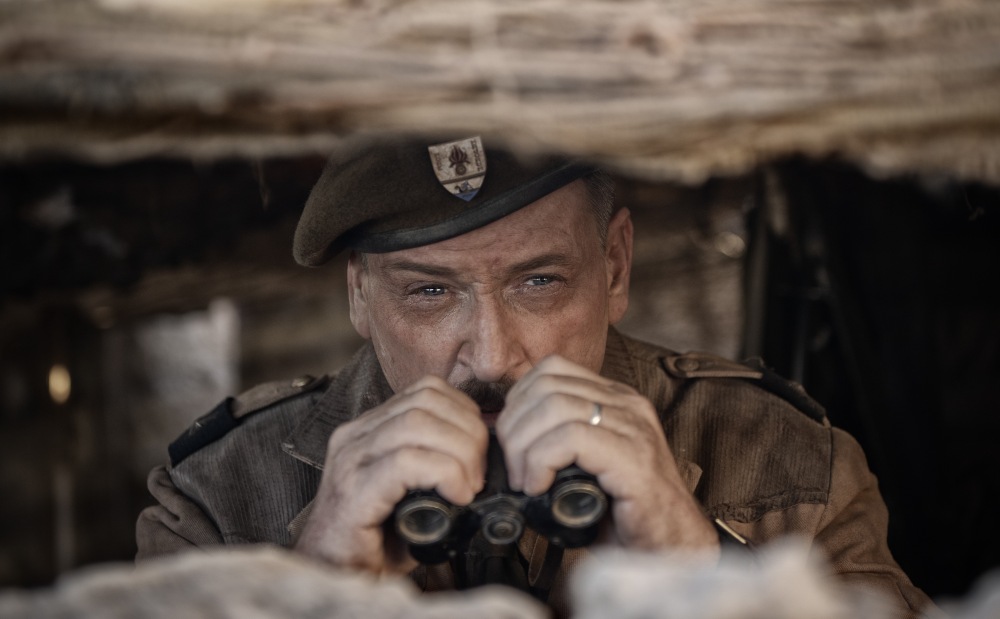
The director wasn’t the only one buried in research. Abkarian, who first came to widespread public attention as the lead in Sally Potter’s 2004 film Yes, also did a deep dive. “When I worked this part, De Gaulle, I not only watched him in the archives. I watched also Mussolini and Hitler. I watched them with different eyes. I saw them, but when you see them talk and move in the speeches, the world is floating, because these guys, these two guys, are speaking to the fear of their people, their own people. De Gaulle talks to their conscience, to their nobility.”
More than anything, Abkarian studied the way De Gaulle held himself. “The body language for me is very, very important – for every film I do. In this case, for me, it was important to be always straight on my horse … no matter how poor you are, how poor you look, your armour is broken, your sword is rotten, your helmet is cut in two, but still, you don’t lose your majesty, because if he does lose his majesty, he dies. He dies, and he’s the one who gave back the majesty of France.”
Abkarian feels that the importance of De Gaulle: Résistance lies in what it shows us not of the past but the present. “The language has shifted that way, and the technological processes have shifted,” he says, “but the period is the same because fascism is still here. This ideology is still here. So, the period is still the same. Fascism and Nazism is the modern invention. It’s not an old invention.”
Intriguingly, De Gaulle: Résistance isn’t the only film tackling the topic right now. Also in Cannes this year was Moulin, which focuses on Resistance hero Jean Moulin (who also features, briefly, in Baudry’s movie). Is France now ready to face this chapter of its history? “There had been films on the Resistance before,” answers Baudry. “If you think of L’Armée des ombres by [Jean-Pierre] Melville, it was a great film about resistance. So, I think this story was not absent before. I don’t know if it’s a significant fact that there are two films that have Moulin. Maybe it’s a sign of the times.”
De Gaulle: Résistance opens on 3 September 2026
