

by FIlmInk Staff
SBIFF jury award winner finished from first cut to DCP delivery in a single platform.
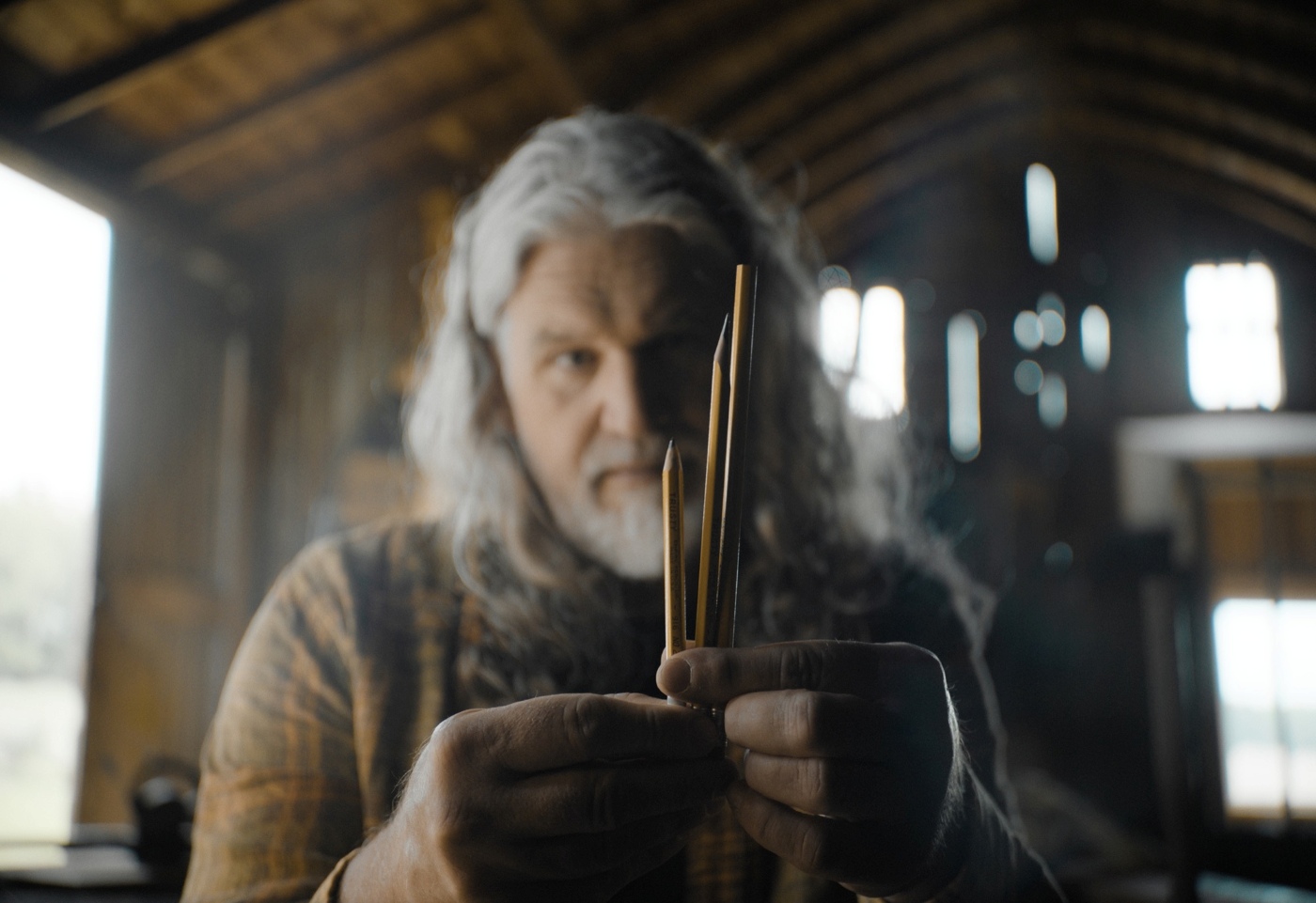
Blackmagic Design have announced that the documentary short A Short Documentary About a Giant Pencil was edited and finished by Director and Colorist Daniel Straub and Cinematographer and Editor Austin Straub using DaVinci Resolve Studio editing, color grading, visual effects (VFX) and audio post production software.
The film follows a Lake of the Isles homeowner and a Minnesota chainsaw sculptor as they shape meaning, and a 20 ft. tall pencil, from the twisted trunk of a fallen oak tree. The pencil is not meant to last. Every year, thousands gather for a sharpening ceremony, sacrificing a piece of the pencil and renewing a collective promise to “do something.” The film premiered at the Santa Barbara International Film Festival (SBIFF), where it won the Best Documentary Short Film Award.
The idea began with a video Daniel spotted online. “I had seen a post on social media of the sharpening ceremony, and it just became an obsession. I wrote down ‘Giant Pencil’ in my notes app under a film ideas folder and kept coming back to it,” said Daniel. “I didn’t fully understand the significance of the story yet, but the art and community response felt so unique and special. A few cold calls and emails later, Austin and I were headed to Minneapolis with a minivan full of equipment.”
That instinct shaped the edit as well. “We knew the shots we wanted to open and close the film with, and we knew the climax would be the sharpening itself,” Daniel said. “The rest of the film was a pretty big question mark before shooting, which is how I like to work in documentary. Part of the joy is walking in with a plan but still letting the story reveal itself.”
With a surplus of interview moments and verité footage from the ceremony, the structure took shape quickly once cutting began. Staying in DaVinci Resolve Studio from start to finish also let the pair begin shaping the look and sound early. “Knowing that we were going to stay in Resolve end to end allowed us to start working on our colour as well as the sound design and mix really early in the process, which made the entire process a lot more enjoyable,” said Daniel.
Colour management was central to that workflow. Daniel has graded every project Austin has shot, and over the past five years, the two have continually refined a PowerGrade node tree for Austin’s look.
“One of the banes of my existence as a DP is when footage gets ingested into an NLE with poor colour management, especially on a long form project, where the error won’t be apparent to me for months,” said Austin. “By then, everyone is used to the incorrect look, and restoring original intent in the grade can be an uphill battle. What I loved about editing this film in Resolve is that it was correctly colour managed from end to end, and we were able to edit in real time with my PowerGrade applied to the entire timeline. The look of the film changed very little from beginning to end because we were setting looks for scenes as we went. Unconventional, but in our workflow, it was a walk in the park.”
In the grade, DaVinci Resolve Studio’s HDR wheels helped the pair handle footage that carried more range than most displays can show. “They really came in handy for defining exposure zones and creating crisp contrast in the clouds while maintaining a gentler curve on people and faces in the midtones,” said Austin.
The production also ran into an unexpected foe: smoke drifting into Minneapolis from the Canadian wildfires. “The entire shoot had pretty terrible spectral pollution from the scattering of light through the haze, but we were able to use the Color Warper to gently squish it out and get everything and everyone looking much more natural,” noted Austin.
Playing with scale is a running theme of the film, so the pair used a small drone for select shots of the sharpening ceremony and applied a tilt shift effect to the footage in DaVinci Resolve Studio’s Fusion page. “Colour matching the drone to the main camera was super easy with the colour space transforms in Resolve to get everything into the same family,” Austin added.
The two normally edit and grade side by side, but midway through post Daniel got sick with a festival submission deadline looming. “So we booted up DaVinci Resolve Studio’ Remote Monitor feature and were able to make quick progress with Daniel still in quarantine,” said Austin. “As independent filmmakers, the ability to create DCPs right inside of Resolve, correctly and accurately translated into XYZ colour space from our Rec. 709 grading environment, gives me huge peace of mind when delivering files for exhibition,” continued Austin. “I know that all the hard work we put into the look will not be in vain in the final and crucial step of exporting for a theater.”
A Short Documentary About a Giant Pencil is currently screening on the festival circuit, including a recent appearance at the Berkshire International Film Festival.
About Blackmagic Design
Blackmagic Design creates the world’s highest quality video editing products, digital film cameras, colour correctors, video converters, video monitoring, routers, live production switchers, disk recorders, waveform monitors and real time film scanners for the feature film, post production and television broadcast industries. Blackmagic Design’s DeckLink capture cards launched a revolution in quality and affordability in post production, while the company’s Emmy™ award winning DaVinci colour correction products have dominated the television and film industry since 1984. Blackmagic Design continues ground breaking innovations including 6G-SDI and 12G-SDI products and stereoscopic 3D and Ultra HD workflows. Founded by world leading post production editors and engineers, Blackmagic Design has offices in the USA, UK, Japan, Singapore and Australia. For more information, please go to www.blackmagicdesign.com/au.
