



by Nataliia Serebriakova
Worth: $16.40
FilmInk rates movies out of $20 — the score indicates the amount we believe a ticket to the movie to be worth
Cast:
Gintarė Parulytė, Žygimantė Elena Jakštaitė, Marius Repšys, Indrė Patkauskaitė, Amelija Adomaitytė
Intro:
… a sharply observed satire about proximity and privilege.
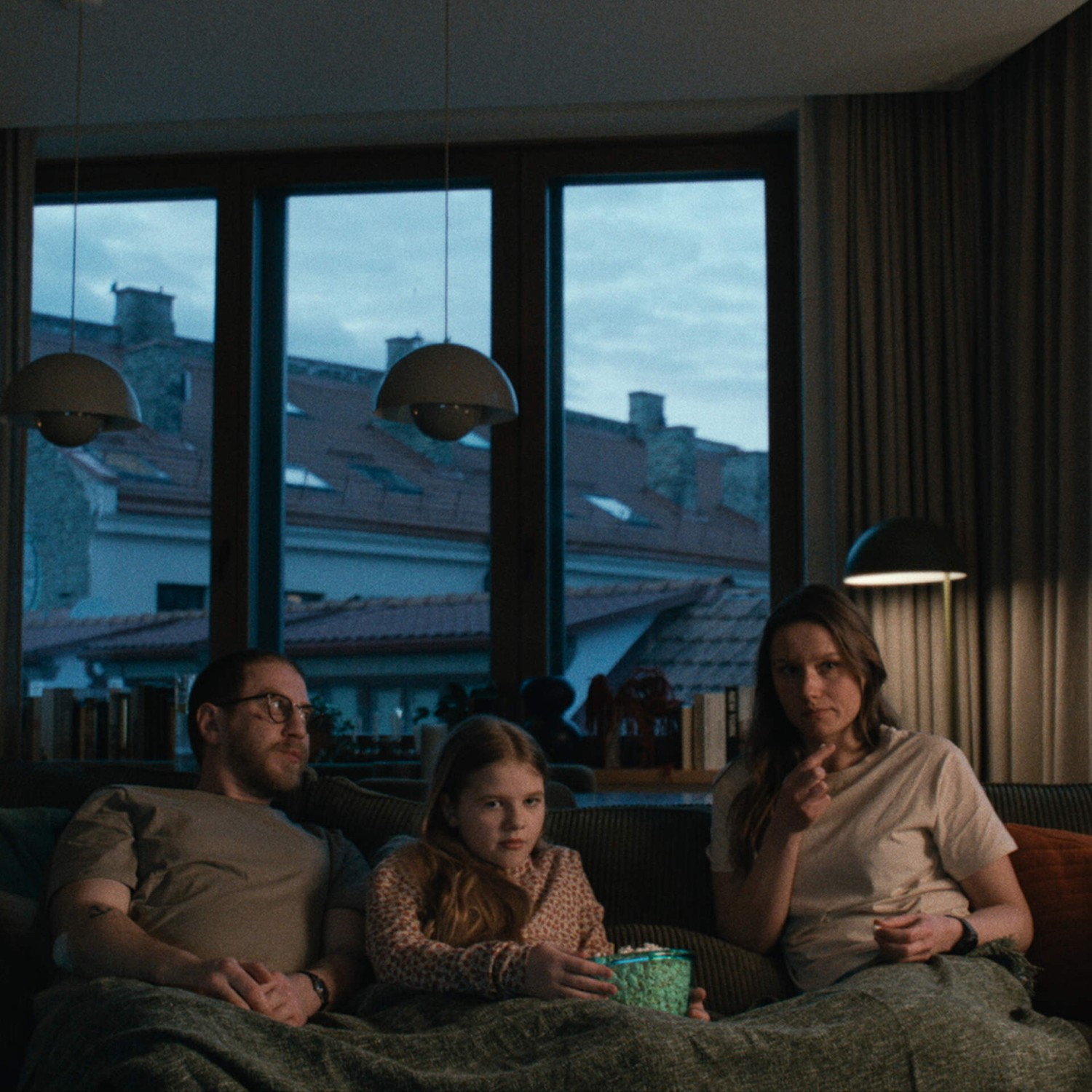
Vilnius, February 2022. Maria (Žygimantė Elena Jakštaitė), a successful top manager at an entertainment content company, decides to tell her husband Vitas (Marius Repšys) that she wants a divorce right there in the car in a parking lot, while their daughter Dovile (Amelija Adomaityte) is at music school. Vitas, an unemployed director, has in recent years turned into a househusband who cooks, cleans, and takes care of their daughter. Maria blames Vitas, saying that life with him has become boring and that he is no longer as cool and fun as he used to be, without mentioning the main thing — that she is having an affair at work with a friend and colleague.
The next morning, Russia’s invasion of Ukraine begins. Everyone in Vilnius is saying that the Baltic states are next. However, Vitas pulls himself together and moves out to live with his pro-Russian parents in the suburbs. Maria, inspired, begins helping Ukrainians and takes in a woman from Kharkiv with her two sons. It then turns out that her company is financed by Russian money. Upon learning this, she boldly quits her high-paying job.
Vitas, meanwhile, cannot stand listening to the constant Russian propaganda that his parents play on television. At times, he volunteers in support of Ukraine, at others, he takes part in anti-war performances, and at other times, he even smashes the window of a car with Russian license plates. Their daughter, in the meantime, struggles deeply with her parents’ divorce and says that she wants all Russians to leave Vilnius.
This film by Lithuanian director Andrius Blaževičius, which won the Directing Award at Sundance, may mislead you with its deliberately television-like visuals, primitive dialogue, and rather serial-like plot development — if you fail to realise in time that it is satire. Once it becomes clear where the filmmaker is heading (roughly halfway through), you begin to take real pleasure in its caricatured situations and in the realisation that a divorce during wartime in a relatively prosperous Baltic country is, in fact, a classic storm in a teacup.
From that point on, the film reveals its true strategy: exaggeration as a means of calibration. The characters’ emotional responses begin to feel intentionally disproportionate, exposing not their insincerity but their disorientation. Blaževičius is not mocking the fact that they suffer; rather, he interrogates the scale of that suffering in relation to a geopolitical catastrophe unfolding just across the border. The result is an uneasy duality: the viewer is invited both to empathise and to maintain critical distance.
Maria’s arc, in particular, gains an additional layer once her moral awakening is placed alongside her personal motivations. Her decision to help refugees and to resign from a compromised workplace appears ethically sound, yet the film subtly questions whether these actions also function as a form of self-reinvention. In this reading, solidarity becomes intertwined with identity construction, and political clarity risks turning into another mode of personal narrative.
Vitas, by contrast, embodies a fragmented, reactive masculinity. His oscillation between passivity and impulsive action reflects not ideological conviction but a lack of stable grounding. His gestures — whether altruistic or destructive — carry the same undertone of improvisation, as though he is trying on different roles in search of coherence. This instability becomes one of the film’s central observations: in moments of historical rupture, identity itself becomes provisional.
The daughter’s perspective cuts through these layers with unsettling directness. Her desire for a simplified moral order — where enemies are clearly defined and removed — reveals both the psychological toll of the situation and the human impulse toward reduction in times of stress. In her case, the war is not an abstract political reality but an emotional environment that reshapes her sense of safety and belonging.
Ultimately, the film positions the Baltic setting as a liminal space — geographically close to war, yet not fully consumed by it. This in-between condition generates a specific kind of anxiety, one that manifests not through immediate danger but through anticipation, projection, and the constant negotiation of one’s stance. The divorce at the center of the narrative thus becomes more than a personal rupture; it mirrors a broader instability, where established structures — family, work, identity — begin to fracture under external pressure.
By the end, what initially appeared as a modest, even simplistic story transforms into a sharply observed satire about proximity and privilege. Blazevicius suggests that when history accelerates, private life does not pause — it continues, often awkwardly, sometimes absurdly, revealing the limits of individual perspective. The “storm in a teacup” is not dismissed; rather, it is reframed as an inevitable, if insufficient, way of processing a reality too large to fully comprehend.
