



by Mark Lipkin
I must have walked that unsealed dirt track a dozen times before the day itself, its only landmark being the carpark opposite Bruny Island Honey. The night before the shoot, the reality landed: we weren’t getting the key to the gate. That left two options, find a new location at midnight, or walk the damn thing, hauling camera gear, sound gear, unit supplies and everything else across kilometres of sand and dirt through dense Tasmanian bush.
After dinner in the shearers’ quarters at Murrayfield station, I gathered the team. “The whole reason we’re on Bruny Island is to shoot at Arch Beach,” I told them, “and for that to happen, we walk.” My first assistant director’s face dropped. She knew what a rebellion looked like. She also knew her first responsibility was keeping the crew safe.
At roughly 6am the next morning, we loaded up and went anyway. My fifth production, and still the same feeling, barely slept, running on something that isn’t quite adrenaline but sits right next to it. The camera cart snagged repeatedly on the terrain. Everyone pitched in. We were three days from wrap after a gruelling schedule in the wilderness that doesn’t much care about shooting schedules.
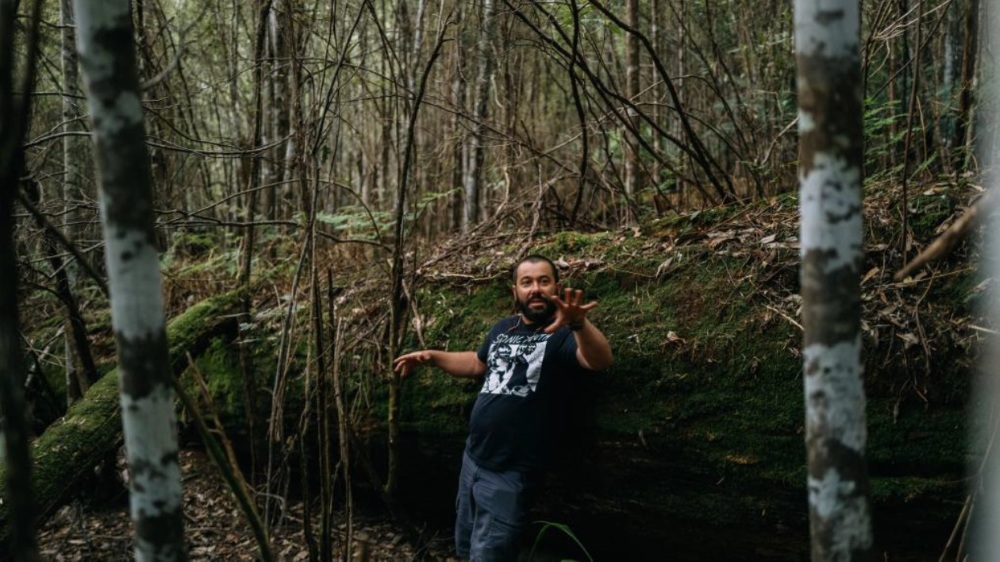
We reached the shoreline and got to work. But something was off, unspoken, felt by everyone. The tide was coming in far faster than we’d calculated. The highest tide of the month, on the one day that we needed the rocks exposed. We directed the two cast members against the incoming water, crew timing their positions around the surge, and it became clear that we weren’t going to get the shots we needed, the final sequence, the most important in the film. Exhausted, the call was made. We hauled everything back.
With the team safe and moving, I stood alone on the shoreline. And something happened, one in a series of things that happened across the whole shoot, to crew and cast alike, that none of us could quite account for. A large flock of seagulls came in tight formation along the waterline, approaching me, and then, uncharacteristically, turned inland, just before the track. From the outside, unremarkable. From the inside, something else entirely. I stood there for a while before following the others back.
The following morning, we picked up shots at the Aboriginal-owned Murrayfield station where we were staying. But the essential sequence was still unshot, and we had one day left. That evening I called our cultural advisor, who had been with us throughout the process in ways that mattered. I told him about the shoreline. He suggested that we shoot at the Big Lagoon, not far from where we were. We did. More gear on that dirt track, but closer. And we got it.
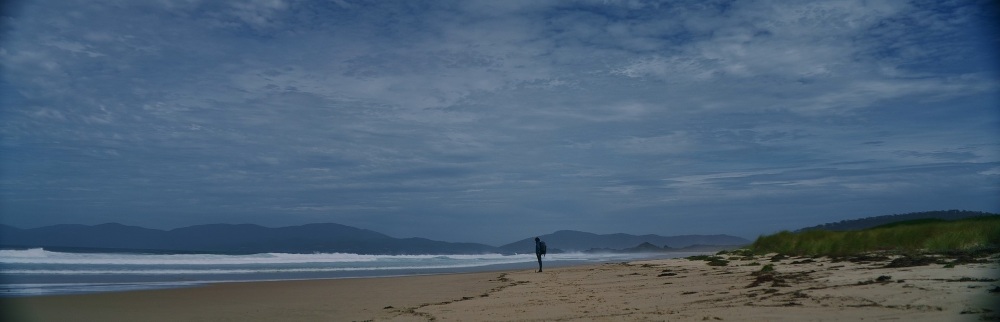
So, what were we doing on Bruny Island at all? That story starts earlier.
After finishing My False Vacuum in 2023, a family road drama, I wanted back into genre filmmaking. An idea I’d been circling for years finally arrived with the kind of clarity that defies explanation. It didn’t come through logic or development. It just came. The core of it was simple: past events, real traumatic events, imprint on landscape. The land holds what happened to it. From that abstraction came context, and from context came a story.
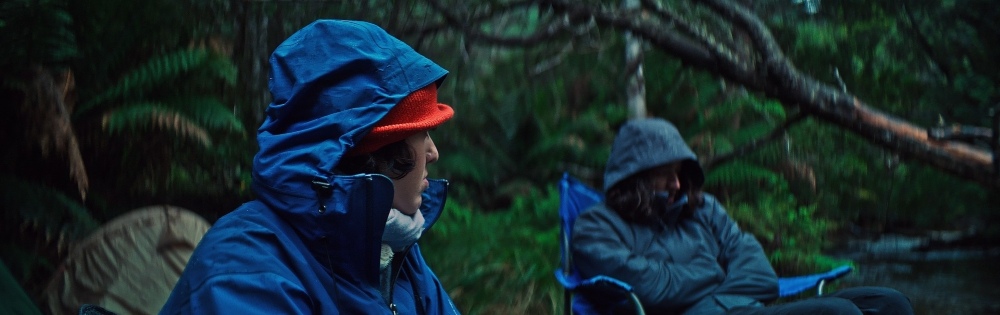
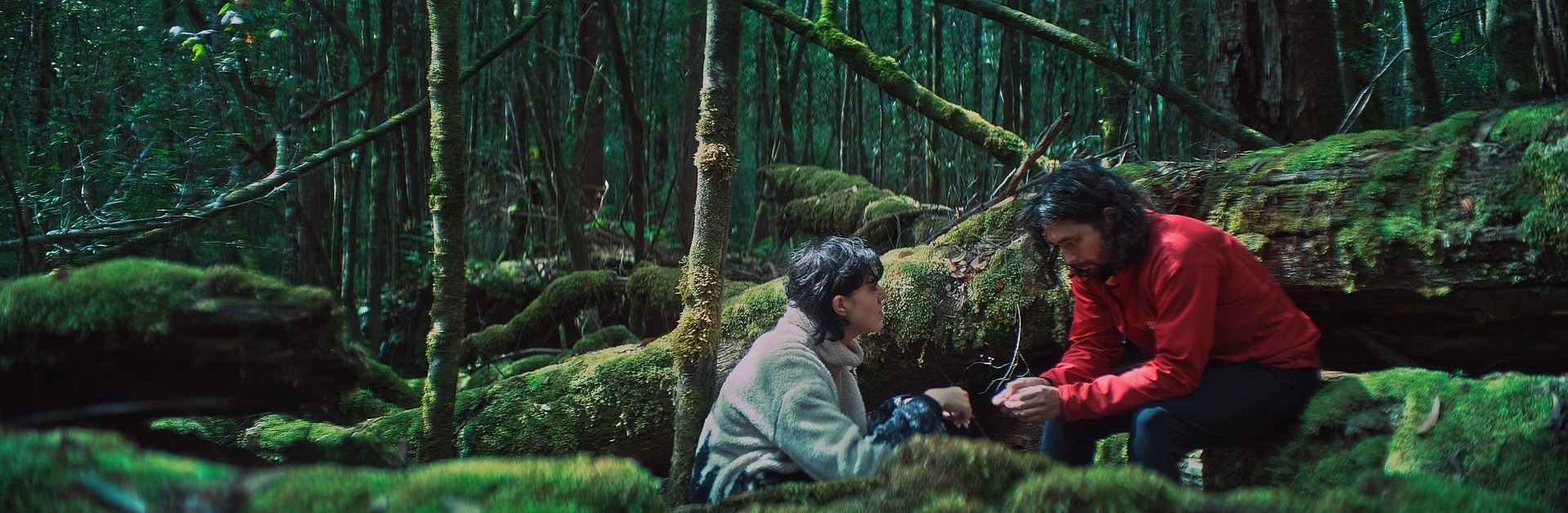
The film was originally called ‘Mistah-Goosnitzah’, a placeholder really, before being renamed after a real place called Pelverata, and incidentally one of the places where we shot. I wrote it the way I write all my screenplays: no outline, no beat sheet, just the story finding itself on the page. What I didn’t fully understand, until much later, was what it had actually touched and why.
In Adam Scovell’s 2017 book Folk Horror: Hours Dreadful and Things Strange, he develops what he calls the folk horror chain; four interlocking links: landscape, isolation, skewed belief system, and summoning or happening. The whole genre, he argues, hangs on these connections. The skewed belief system link is where it gets interesting. Scovell builds it entirely from European paganism and occultism, belief systems that exist outside the mainstream, reconstructed and romanticised, invented at a safe distance from modernity. Something old and strange that the land still carries, or so the story goes.
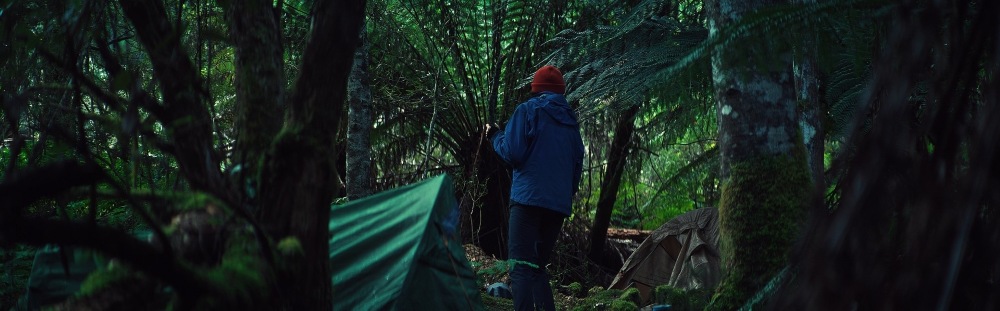
But here’s what troubled me while writing Pelverata: in Tasmania, the skewed belief system isn’t the strange folk religion of isolated rural people. It’s the colonisers’ own creed, the absolute conviction that unceded land can be surveyed, owned, and extracted. The palawa [the Aboriginal people of Tasmania] carried a belief system predating British arrival by 40,000 years. The land still carries it. It was never myth. It was never reconstructed. It simply persisted, under everything.
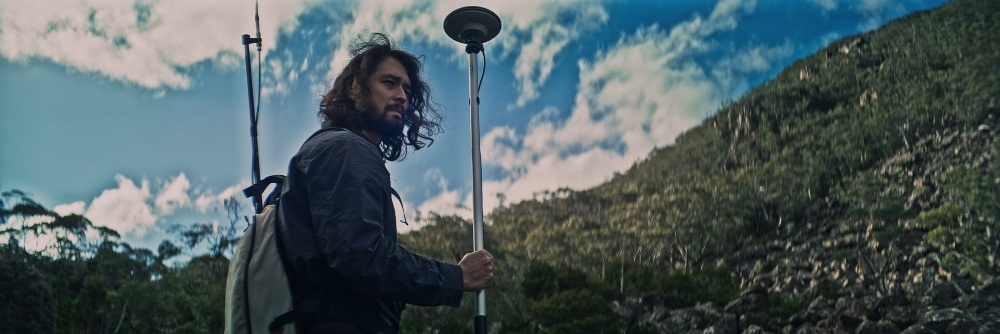
When you shift that one link, the chain doesn’t just weaken. It runs in reverse. The horror isn’t the protagonists stumbling into something strange. They are the strange thing, arriving with clipboards and survey equipment into country that was never emptied of meaning, only of people.
Mark Fisher, in The Weird and the Eerie (2017), holds up Peter Weir’s Picnic at Hanging Rock as the defining example of the eerie Australian landscape, a place where there is nothing when there should be something, a “failure of presence” that the rational mind cannot resolve. The girls vanish. The rock keeps its silence. Fisher distinguishes the eerie from the weird carefully: the weird is the intrusion of something that shouldn’t be there; the eerie is the disturbing vacancy where something ought to remain.
The deeper reading of Picnic at Hanging Rock isn’t about European schoolgirls absorbed by an alien wilderness. It’s about a landscape that became eerie precisely because of what was done to it. The palawa were systematically made not to exist in their own country. What makes the land eerie is its capacity to hold that memory, not as supernatural residue, but as historical fact. The failure of presence is archival, not spectral. The wound doesn’t close because it was never acknowledged.
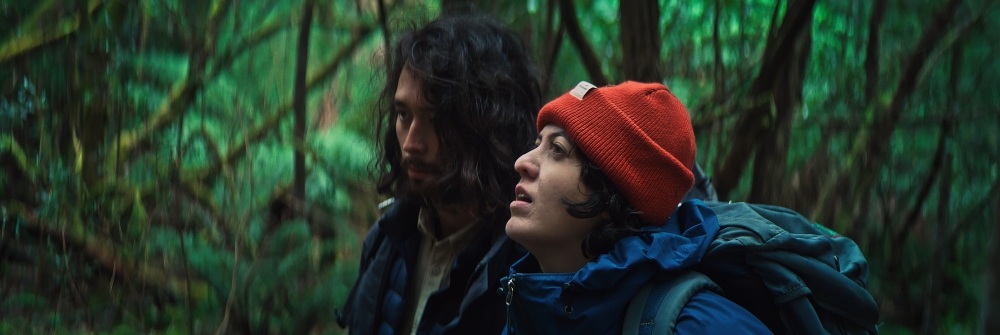
Picnic at Hanging Rock didn’t know it was colonial horror. It arrived at those ideas through instinct, via the landscape asserting itself against a narrative that tried to ignore it. Pelverata knew. That consciousness, writing toward the history rather than away from it, changed what the film demanded, and what I owed it.
The palawa people lived on lutruwita [what is now Tasmania] for over 40,000 years, one of the oldest continuous cultures on earth, isolated from the mainland by rising seas around 6,000 BCE, developing a distinct language, culture, and relationship to country shaped across unimaginable time. Within 32 years of British colonisation, around 100 remained. The Black War, the Black Line, forced exile to Flinders Island, the mechanisms were both military and cultural: the deliberate destruction of language, ceremony, and connection to country. Colonial authorities used words like “extirpation” in official correspondence without apparent discomfort.
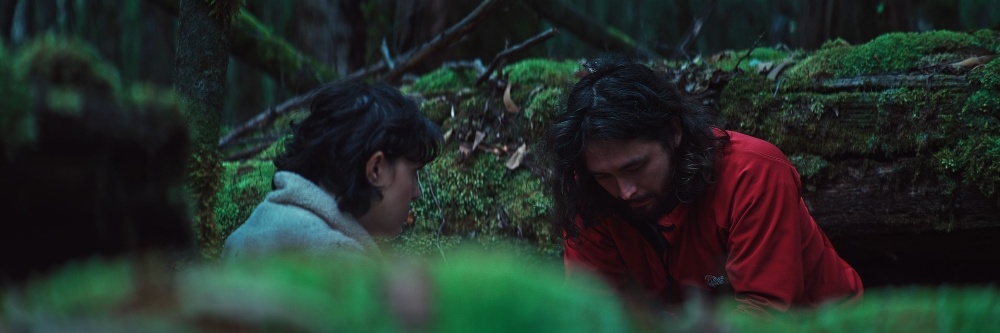
Raphael Lemkin, who coined the word genocide, cited Tasmania specifically when formulating the concept. That is the ground the film is set on. The Aboriginal Land Council of Tasmania is clear: no land was ever ceded. Every title on the island sits on country that was never given up.
Among the palawa, the understanding is that the land owns us. To believe the inverse, that we can own land, survey it, partition it, extract from it, is the skewed belief. Pelverata is not a film about supernatural forces punishing trespassers. It’s a film about what it means to arrive somewhere with that inversion already installed in your thinking, and what happens when the ground beneath you refuses it.
Val Plumwood’s 2005 essay Shadow Places and the Politics of Dwelling gave me the clearest language for what the film’s two engineers actually represent. Plumwood argued that modernity depends on shadow places, sites of extraction and damage kept deliberately invisible so that centres of consumption can appear clean and sustainable. The ecological costs are real; they are simply relocated, out of sight, into the periphery. Out of mind.
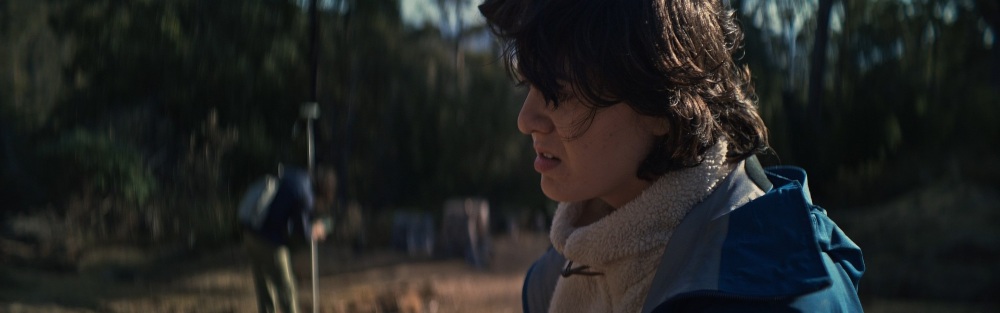
Surveyors are the professional mechanism of shadow place creation. They transform country into property, they are the first act of the colonial process, the imposition of the grid, the conversion of a living relational entity into a commodity with coordinates. Misha and Myaree don’t arrive in lutruwita as villains. They arrive as professionals, doing what professionals do. That’s the point. The horror isn’t exceptional. It’s structural, and it’s inherited.
Plumwood’s call for a “politics of dwelling”, an attentive, relational inhabitation that acknowledges what a place holds, is what the film asks of its characters and ultimately cannot deliver to them. They don’t have the framework for it. Neither, for most of our history, have we.
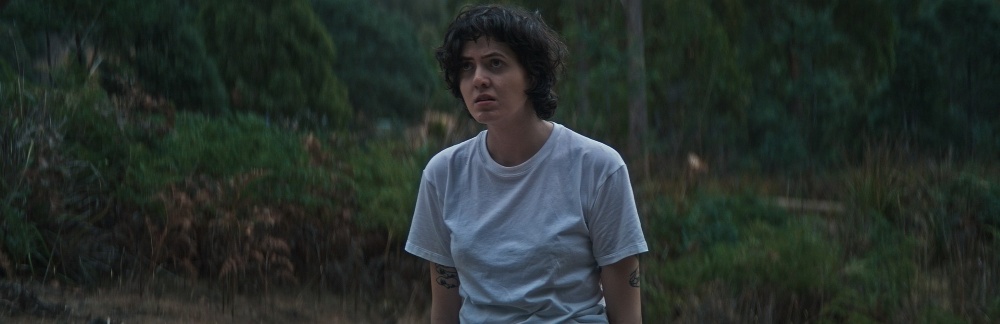
Folk horror was built to describe the horror of landscapes that hold old beliefs. The British version mythologises, reconstructs, imagines, it reaches back to something it can only approximate, the pagan and the archaic rendered strange through the distance of centuries. In Tasmania, the beliefs are real, documented, and living. The land is not haunted by the supernatural. It is haunted by the historical. And the historical, in this case, is recent enough that its consequences are still legally, culturally, and personally unresolved.
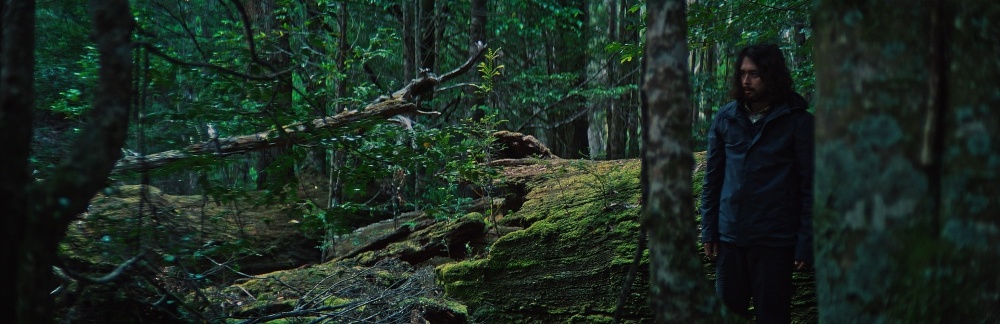
As the inheritors, we need to see this from the inside. Landscape cannot be emptied of its history and meaning, only of its people. People come and go with their notions of ownership, but the ground keeps its own account.
It was standing at Murrayfield station on the final wrap day, looking out across the water, that I understood the chasm between the film I’d set out to make and the one I’d actually made. I came to Pelverata wanting to make an atmospheric genre film, something that might finally give me traction in an industry that had, across four films, remained politely closed.
Everything was staked on it. I finished the edit having sold the family home, relocated to far north Queensland, and sat with a film that had become something I hadn’t planned and couldn’t quite explain.
The wider film community has largely passed on it. No festival entries landed. It’s not a film that “sells”, and the architecture of the industry has little room for things that don’t. It’s finding its own course, the way the ideas it carries have always had to.
I don’t think it’s a film for right now, necessarily. But the experience of making it, specifically what happened on that shoreline, that was something else. Something that resists the language I’d normally reach for.
Perhaps that’s the point. Perhaps, like the surveyors I put on screen, my own attempt to make a film from this history, to frame it, capture it, contain it in 101 minutes, was its own version of the skewed belief. Presuming to enclose what, by its nature, cannot be enclosed.
Landscape cannot be emptied of its history and meaning, only of its people. I made a film trying to hold that truth still long enough to show it. The land, I suspect , was quietly amused.
