



by Stephen Vagg
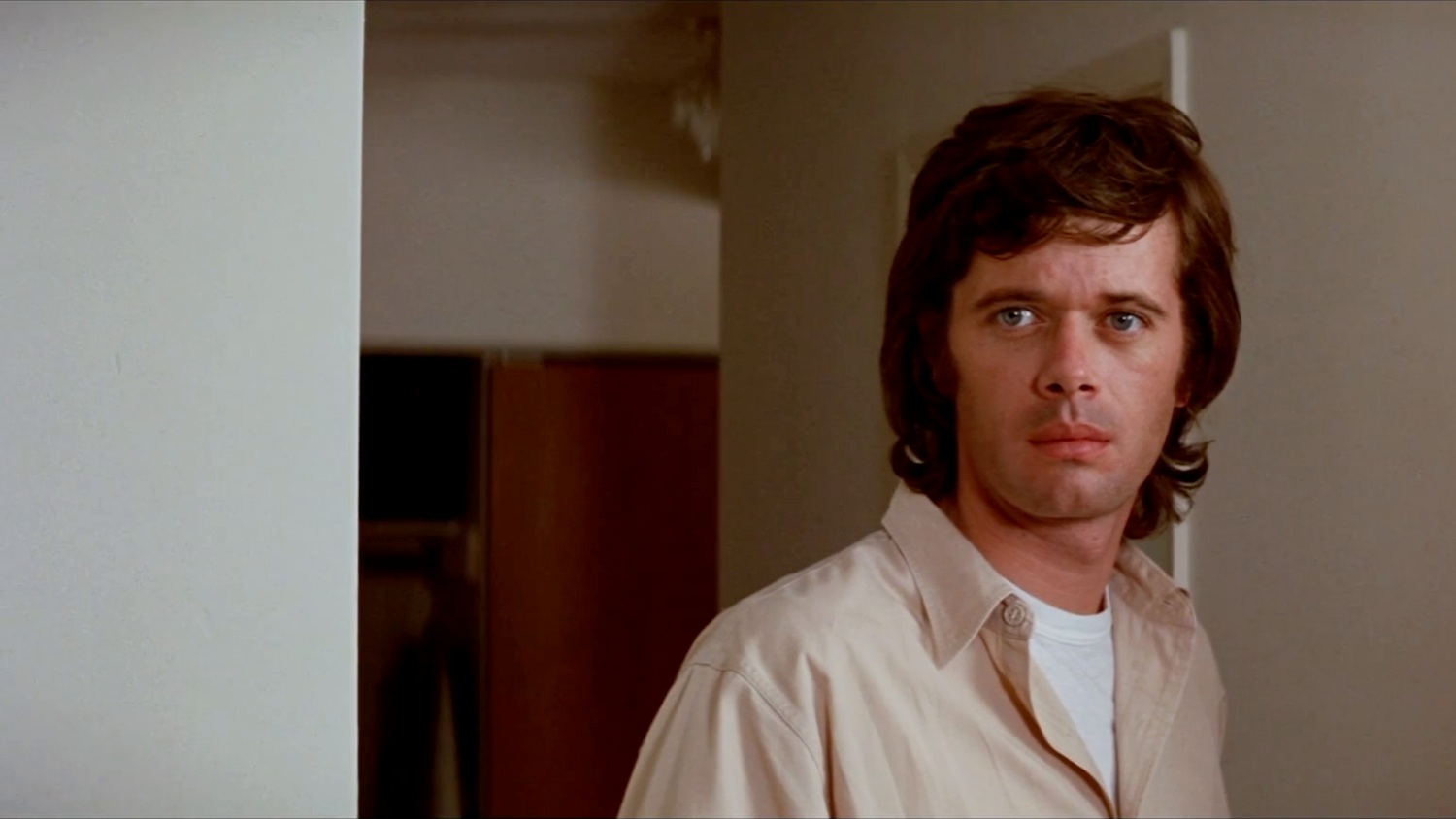
The late 1960s saw the rise in Hollywood of the skinny, androgynous leading man – lean, shaggy haired, angsty, non-macho, beautiful, heavily inspired by the sensitivity of James Dean. Christopher Jones was one such example of this species, as was Kristoffer Tabori, Jan-Michael Vincent and, for some reason, a large number of nepo babies (Michael Douglas, Peter Fonda, Beau Bridges, Arlo Guthrie). The king – for a long time, at least – was Michael Sarrazin, who got several chances at being a star; more opportunities, in fact, than anyone else we’ve done an article on in this series. He never got there, despite Hollywood trying for over a decade, but it did result in some classy credits.
Sarrazin was Canadian, born in Quebec City in 1940. He started acting professionally while a teenager and soon began appearing regularly on Canadian television, including a play called Romeo and Jeannette, opposite Genevieve Bujold directed by Paul Almond (a big name in the cinema of the Great White North), and A Spring Song, an adaptation of an Australian play by Ray Mathew (Canadian television adapted several Australian stage plays eg Summer of the Seventeenth Doll, The One Day of the Year).
Sarrazin had a soulful, sad-eyed look, which made him ideal to play sensitive/doomed young men – within a year, he was one of the busiest actors in his home country, and in 1965 he was signed to a seven-year contract by Universal in Hollywood. Universal were the last of the Hollywood studios to have scores of young actors on permanent contract, in part because they made so much stuff. Sarrazin found himself doing guest shots on Universal shows like The Virginian, TV movies such as The Doomsday Flight (1967) and features like Gunfight in Abilene (1967).
20th Century Fox borrowed Sarrazin to support George C. Scott in The Flim Flam Man (1967), which flopped but at least tried to be a good movie and drew plenty of attention to the Canadian. Universal, duly impressed, promoted Sarrazin to leading man status in its feature films; the problem is, the films generally weren’t that good, mostly medium budgeted programmers made with one eye on television: A Man Called Gannon (1968), Journey to Shiloh (1968) (with Harrison Ford and Jan-Michael Vincent, who were also under contract), and Eye of the Cat (1969). Fox asked him back for another feature, the young person melodrama The Sweet Ride (1968), which also flopped, though that at least had Jacqueline Bisset in it; she and Sarrazin got along so well during the shoot that they wound up living together for several years.
Sarrazin’s looks and potential saw John Schlesigner cast the actor as Joe Buck in Midnight Cowboy (1969); this could have taken him right to the top of the pile, but Universal got cocky, asked for too much money for Sarrazin’s services, the producers backed off, and Jon Voight took the role instead. There was some compensation for Sarrazin in that his Midnight Cowboy screen test was seen by producer Joseph Janni (an old mate of Schlesinger’s) who cast him in the lead of In Search of Gregory (1969) alongside megastar Julie Christie – but that turned out to be Christie’s least memorable movie from this period in her career, while Midnight Cowboy became a sensation. What sort of Joe Buck would Sarrazin have made? He probably would have been fine – not as good as Voight but he wouldn’t have wrecked the movie.
Fortune smiled on Sarrazin again when he was cast in They Shoot Horses Don’t They? (1969) by director James Poe alongside Jane Fonda. Poe was fired during pre-production, replaced by Sydney Pollack, who in turn constantly tried to replace Sarrazin before and during the shoot with Robert Redford and Warren Beatty, neither of whom were interested/available (Bruce Dern, who was in the support cast, offered himself up as a replacement only for Pollack to snap at Dern, “You are not a leading man”). Sarrazin is fine in the (excellent) movie – but watch him alongside Jane Fonda, Gig Young, Susannah York… he’s simply not in their league. And that’s the thing with Sarrazin – he was absolutely fine as an actor, handsome and affable… but he wasn’t a heavy hitter.
Still, Horses was a big hit and critical sensation, and Sarrazin was in much demand. A Los Angeles Time profile in 1969 compared the actor with Van Johnson in the 1940s and Tony Perkins in the 1950s, i.e. sensitive, all-American boy-next-door types. According to Robert Evans, Sarrazin even turned down the male lead in Love Story (1970); while, everything Evans says needs to be taken with a grain of salt, it’s interesting to imagine how Sarrazin’s casting would have affected that movie as well – it likely still would’ve been a hit just not as good as it was with Ryan O’Neal.
Sarrazin played leading roles throughout the 1970s, but (with one exception) none of the movies became a personal triumph, despite having quality names attached. His credits included: The Pursuit of Happiness (1971), a sensitive man drama directed by Robert Mulligan with Barbara Hershey; Believe in Me (1971), story about junkies, with Bisset; Sometimes a Great Notion (1971), supporting Paul Newman and Henry Fonda, under Newman’s direction; The Life and Times of Judge Roy Bean (1972), playing a cameo as Bisset’s husband; The Groundstar Conspiracy (1972), a thriller with George Peppard; Harry in Your Pocket (1973), a pickpocket tale with James Coburn; Frankenstein the True Story (1973), playing the monster in a TV version of the classic novel (the British one, with James Mason – there was also an American version that came out the same year); For Pete’s Sake (1974), as the husband of Barbra Streisand; The Reincarnation of Peter Proud (1975), a psychological thriller from director J. Lee Thompson; the European swashbuckler The Loves and Times of Scaramouche (1976) with Ursula Andress; The Gumball Rally (1976), a cross country race drama; Caravans (1978), an adaptation of James Michener’s novel financed by the Shah of Iran; Double Negative (1980), a Canadian thriller.
What to make of this run of films? One or two cut through – For Pete’s Sake was a hit off the back of Streisand’s huge popularity, The Reincarnation of Peter Proud became a cult classic, and Judge Roy Bean did well (though Sarrazin’s role is tiny). Many of the movies played endlessly on television. But on the whole, the response to these films was underwhelming. Yes, we know all of them have fans, especially among people who saw them as a child, but we are talking on the whole. The one exception is the 1973 Frankenstein, widely acknowledged as a classic of television.
Some of this was Sarrazin’s fault. He had a great look but was simply not a compelling presence on screen – he tended to blend in; teaming him with a more charismatic co star (Paul Newman, Anthony Quinn, George Peppard, Barbra Stresand, Bisset) didn’t seem to work. But mostly, his luck was bad. For Pete’s Sake is commonly regarded as one of Streisand’s worst movies; even today, no one seems to like Sometimes a Great Nation, despite Paul Newman; Robert Mulligan had an off day on Pursuit of Happiness; The Gumball Rally seems like it was one of the few cross-country-race-movies from this period not to make money; far too many of the “coldly commercial” films were simply inept executed (Caravans, Harry in Your Pocket).
And thus, Michael Sarrazin never became a star. He remained in demand as an actor through the 1980s until the 2000s, notable roles including supporting Morgan Fairchild in The Seduction (1982) and appearing in the Canadian TV mini-series Joshua Then and Now (1985). He kept a low profile, rarely did interviews, and died in Montreal in 2011, aged 70.
Sarrazin was a handsome, competent actor. But the fact is unavoidable: Hollywood cast him in leading roles for almost fifteen years, and he never really made it as a star despite a famous girlfriend, A-list directors and legendary co-stars.
We should also point out that Sarrazin’s career continues to have cultural impact. The rise of actors such as him in the late 1960s inspired Quentin Tarantino’s Once Upon a Time in Hollywood (with Ric Dalton losing roles to Sarrazin types). He was a character in original drafts of Shane Black’s The Nice Guys.
He made some good movies, had a family, earned a bit of coin and dated Jacqueline Bisset. We should all be so lucky.
