


by Nataliia Serebriakova
Worth: $17.00
FilmInk rates movies out of $20 — the score indicates the amount we believe a ticket to the movie to be worth
Cast:
Sandra Hüller, Caro Braun, Godehard Giese, Marisa Growaldt (narrator)
Intro:
The film’s greatest revelation is Sandra Hüller’s performance
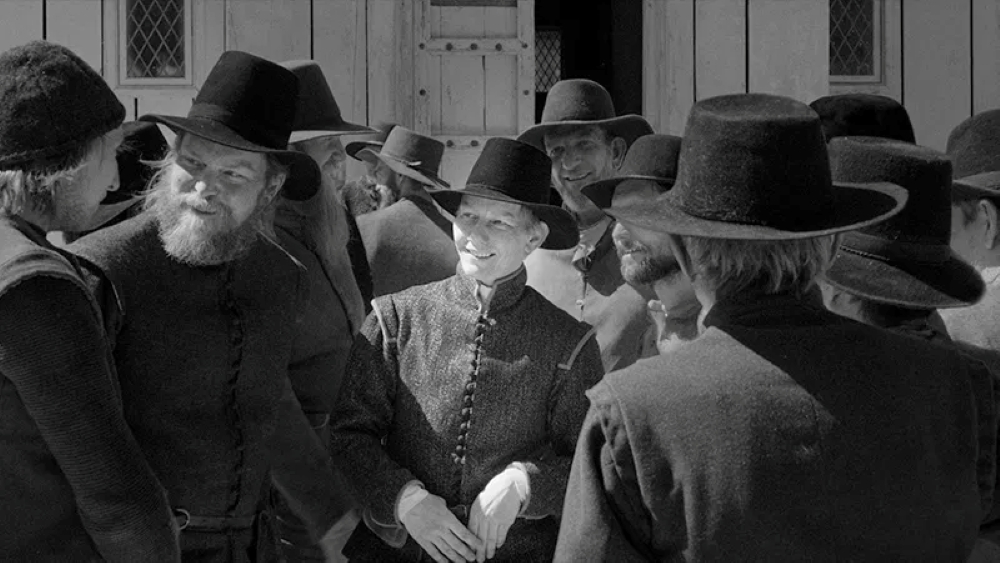
The opening of Marcus Schleinzer’s film is preceded by a title card stating that this is the story of a woman named Rose who pretended to be a man and served as a soldier. The action unfolds in the early 17th century, in an Austrian village where Rose settles, dressed in men’s clothing and a wide-brimmed hat. Having gained experience in military service, Rose knows not only how to trap a bear but can also read and write — skills that earn her the respect of the village’s male inhabitants.
One of the settlers strikes an unexpected bargain with her: he offers his daughter Susanna in marriage, along with a dowry (a cow and a chicken) and a piece of land. After a brief wedding ceremony, a cart pulled by the cow arrives at Rose’s house, and she must find a way out of the delicate predicament of fulfilling marital duties on the wedding night. Susanna appears to be an inexperienced country girl; in truth, she has secrets of her own.
Rose is only the third feature film by the experienced casting director (The White Ribbon, Lourd) and actor Marcus Schleinzer, a student of Michael Haneke who gained notoriety in 2011 with his scandalous debut Michael, about a paedophile and his ten-year-old victim.
Rose, presented in the main competition of the Berlinale, is an almost brilliant film, faintly echoing The Devil’s Bath by Veronika Franz (wife of Ulrich Seidl), which premiered there two years ago. Schleinzer’s black-and-white film is less exploitative and, in a sense, more humane. One could say that contemporary Austrian cinema rests on two pillars: Michael Haneke, who mentors new directors, and Ulrich Seidl, who often produces them.
From his teacher, Schleinzer inherited a severe purity of framing and a narrative that gradually transforms from drama into tragedy. But Rose is imbued with a gentle irony absent from Haneke’s austere cinema. The film’s greatest revelation is Sandra Hüller’s performance — perhaps the second truly monumental role of her career after Toni Erdmann. With cropped hair and a scar on her face (from an enemy bullet), Hüller plays Rose with a restrained physical femininity yet conveys a distinctly masculine charm. Through a particular squint and a crooked smile, she seems to achieve the impossible in this role. She unquestionably deserves a gender-neutral award for Best Performance (as the Berlinale has, in recent years, stopped dividing acting prizes into “male” and “female” categories).
For the first forty minutes, the director does not explain the heroine’s decision to wear men’s clothing; he simply presents it as a given, and at first this narrative gap feels unsettling. Yet this is a film that refuses to rush. A female voice-over, deliberate and contemplative, guides the viewer through the philosophy of medieval life, asking above all whether a woman can claim even a fragment of freedom within a suffocating patriarchal order.
And by the end, Rose feels less like a historical drama than a quiet meditation on identity itself — on the fragile space between survival and selfhood. In the stark light of its monochrome landscapes, Schleinzer finds a strange tenderness: as if beneath the coarse wool of men’s coats and the rigid codes of the century, a heartbeat persists, stubborn and unmistakably human. And even the final catastrophe does not alter this feeling: at least Rose tried to be free.
