



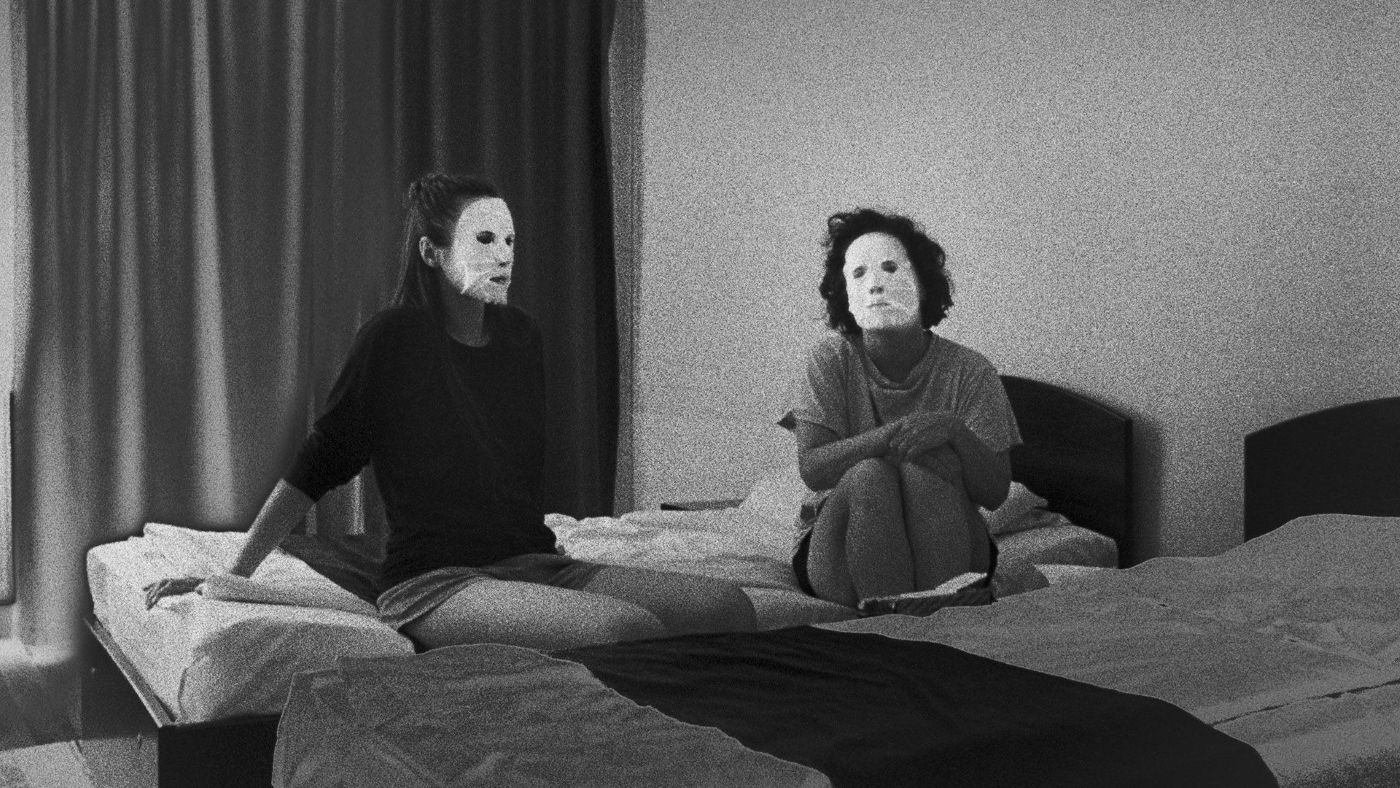
by Nataliia Serebriakova
Worth: $17.00
FilmInk rates movies out of $20 — the score indicates the amount we believe a ticket to the movie to be worth
PÖFF
Cast:
Olga Kviatkovska, Margaux Dauby
Intro:
… unhurried road movie invites viewers to reflect on the price that Ukrainians pay to defend their homeland — and on the longing that Ukrainian refugees feel for the country they had to leave behind.
After the full-scale war in Ukraine began, Sasha left the country and moved to France. There, she continued working as a sculptor. When she received the news of her grandmother’s death, she decided to travel by car across almost all of Europe to Ukraine together with her Belgian friend Margaux. Margaux brought along a Bolex camera to film their journey.
This is how the experimental narrative of Canadian-French filmmaker Harald Hutter begins — a film shot entirely on 16mm, which premiered at Tallinn Black Nights Film Festival.
However, even before the opening credits, we hear verses by Ukrainian poet Lesya Ukrainka about the bloodshed in her homeland. These lines set the tone for the entire film. Hutter and his team drove in two cars from France to the Ukrainian border, crossing multiple countries and capturing moments of Sasha and Margaux talking on the road.
Sasha, played by Ukrainian actress Olga Kviatkovska, tells stories from her childhood — about her grandmother, who in the difficult 1990s had to travel to Poland to sell food in order to earn money; she also teaches Margaux how to play durak, a popular Ukrainian card game.
Despite the light-hearted nature of their conversations, the film is imbued with a melancholic and anxious atmosphere. At times, Sasha dreams of destroyed Ukrainian cities and villages. The final destination of her journey is Okhtyrka, a town in the Sumy region, where her grandmother is from, according to the story.
The film is shot from two perspectives—black-and-white for Sasha and colour for Margaux — emphasising that Sasha’s European friend sees the world in familiar tones, while Sasha herself is burdened with concern for her country’s fate. Hutter wrote the script together with Olga Kviatkovska, whom he met in Paris. Just like her character Sasha, Olga had to leave Kyiv when the war began. The actress spent a great deal of time with other Ukrainian refugees, recording their experiences to help shape the film.
Alex Nevill’s camera captures poetic yet unsettling landscapes reminiscent of Abbas Kiarostami, as well as industrial vistas in the spirit of Peter Hutton. The narrative also evokes the cinema of Chantal Akerman, especially her film From the East. And the fact that the camera centres on two women adds an even stronger connection to the Belgian auteur’s work.
This unhurried road movie invites viewers to reflect on the price that Ukrainians pay to defend their homeland — and on the longing that Ukrainian refugees feel for the country they had to leave behind.
In the end, this quiet film — woven from dust, long roads, and borrowed horizons — leaves the feeling that Sasha and Margaux’s journey is not just a trip to the place where a family line meets its earthly end, but a slow touch to a wound that pulses in every Ukrainian far from home. Their road becomes a metaphor for returning to oneself, to the voices and shadows we carry within us, even when we have crossed thousands of kilometres. And when the colour film of European familiarity gives way to the black-and-white anxiety of displacement, the viewer realises: distance doesn’t heal — it only makes longing more visible, like light that becomes sharper through the grain of 16mm film.
