

By Julian Wood
Filmmaker, Ivan Sen, and leading actor, Aaron Pedersen, are a bit of a double act. Following their collaboration on Mystery Road in 2013, their follow-up, Goldstone (which again features Pedersen’s Indigenous Detective Jay Swan) was again the opening night choice for The Sydney Film Festival, and it was a warm and emotional moment when all the cast and crew received a standing ovation.
Now, with the new desert-set actioner/western/drama, Goldstone, about to hit screens across Australia, they are out in full force on the promotional trail. Pedersen – who seems to be magnetically attractive to viewers – is quite relaxed and knockabout. He is also honest and direct and generous with his views. It is also obvious that he loves collaborating with his multi-talented mate, Ivan Sen. Sen is more initially circumspect. Minus his trademark Spielberg-style baseball cap, he is dressed in all black and still looks the part of the film director. He looks younger than he is, but given that he began making his run of ten films over fifteen years ago, you recall that he is no longer an early career director.
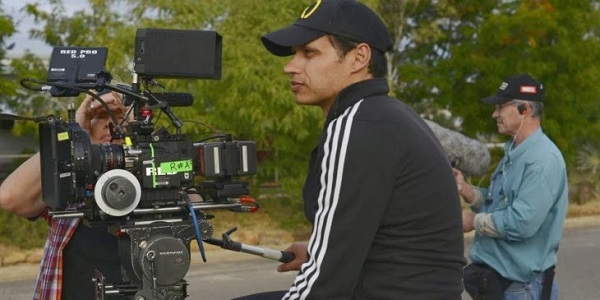
Sen is not in the mood for a misty-eyed retrospective. In fact, he seems as driven as ever. He has just been discussing how to make his next feature with a funding body, but he has other projects on the go at the same time. He cannot talk directly about them now, but they sound like exercises in guerrilla filmmaking that will bypass the usual funding blockages. “That’s why I want to put the foot down now,” he says. “I realised that we’re not getting any younger. Over the last five years. I’ve worked my way into a position where I can do stuff, so I’ve decided that is what I should do: I should just produce stuff. I should not let the constraints constrain me. There are topics that I want to tackle. The motivation to do it is the reality that is out there.”
Goldstone, which is not-exactly-a-sequel to Sen and Pedersen’s Mystery Road, can be read as partly a political film. After all, the plundering of traditional lands to make huge mining profits for a very small number of white people is not just the filmmaker’s imaginary backstory. In the film, all the white mine managers etc (and the local Mayor, played with a slimy false civility by Jacki Weaver) are spectacularly corrupt. Again, Sen does not need to sugar coat this aspect of the film. “That was part of the point; to show that this stuff [the mining, and the short term pillaging of the land’s resources] doesn’t really belong there,” the filmmaker says. “Not in the way that the other culture [Indigenous] does. The whole mining town is just a temporary set up for individual gain through positional advantage. And it is now affecting Indigenous people and the people in the land councils.” Sen tells a story that he heard from other local connections. “That amount of money can be corrupting for the land councils. Like when they’ve approved a Uranium mine [as happened recently in Western Australia] which the local community didn’t really sign off on.”
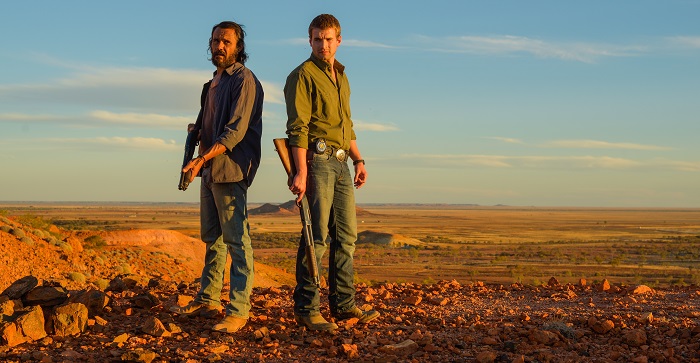
Sen is keen to establish that, just as the film has mixed genre elements, his view of the situation is that there are mixed motives and cover ups in the relationships that we see in the film. “People say that there are layers in my work, but the layers are there because the layers are there in reality. I am just putting them together so you can say, ‘Oh, that joins to that.’ We are so busy living our lives that we don’t see the connections. Everything is connected.”
The other thing that Sen does in the film is to take in the landscape both as a natural or even sacred force, and the weird devastation-production site that mining has made of it. There is a sense of the vast open cut mine in the film scarring the land like an inverted pyramid. Sen’s trademark use of aerial shots underscores this gigantic despoilment. “There is a strange aspect to it,” he says. “It is almost beautiful. It is like something that could be on Mars.” But of course, it won’t last as long as the culture that it is over-writing.
Sen is obviously good with actors. Pedersen – who may yet return as Jay Swan in a further development of the story (a TV version is also being discussed) – is keen to point out that his sets have a collaborative and family feel. “It’s like we’re all on the same journey,” says Pedersen. “His sets are more fun. We’re all involved in the story that way.”
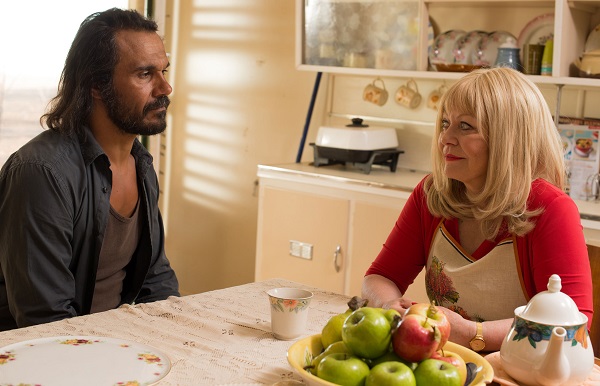
The conversation loops back to Jacki Weaver’s role as the Mayor. Sen gets animated when he recalls her contribution. In particular, he loves her big eyes. “Her eyes are incredible. It’s as if she can control the dilation of her pupils! She seems to have control over them, and they move at key times. That role was written for her, and I don’t think that I could have made the film without her, because she brings such a weight to the role.”
Both Sen and Pedersen also liked working with Alex Russell, who plays the local cop who teams up with Jay Swan. Pedersen offers: “He’s my brother boy!” Sen agrees that he is right for the role partly because of his [Russell’s] country roots. “He’s a country boy. He’s from Rockhampton – not one of these types from Surry Hills who think they can get country ways! He understands the culture. I am from the country myself, and I know what is authentic in that direction.”
The term “outback noir” emerged from the critical response to Mystery Road. Sen gives the sense that labelling a style is more a concern for people who write about films rather than those who make them. Still, he is happy to banter about it. “I’m not sure about it really,” he smiles. “A lot of that comes from the lighting as much as anything. Noir always had very high key lighting, and for me, that light is the sun, and I use the shadows to add mystery. I chase shapes within the shadows. And there was a bit of an Art Deco feel [to some of the set design] almost too, which added to it perhaps. But this one is considered neo-noir,” Sen laughs, “as much as ‘neo western.’ But hopefully the film is so rich that there are lots of elements within.”
Goldstone plays at The CinefestOZ Film Festival, which runs from August 24-28. To buy tickets to Goldstone, head to the official site.
