



by Julian Wood
What does it mean to be a famous artist? Well, it is an existential question that won’t trouble most creative people. However, if you stick at it long enough, and have enough talent, then it may come to feel like it is your destiny. Fame and the accompanying lavish critical acclaim have certainly come to Sir Isaac Julien. He is in Australia for the launch of his multimedia installation Once Again…Statues Never Die, which can be seen at the Museum of Contemporary Art [MCA] on Circular Quay. Given the almost over-the-top reverence that he now attracts and having been knighted (he got it for services to the Arts (how British)), he could be a daunting prospect to interview. So, it is somewhat of a relief to find he is unaffected, warm and engaging. And he is happy to chat. Julien takes his art – but not himself – seriously.
Julien’s works are complex in structure and in terms of the research and detail that they embody. However, not everyone will have the knowledge of his subject matter and of art technique, so one wonders what he thinks about its impact on ‘ordinary’ audiences. He acknowledges that there are going to be a range of audiences, but his main concern is more with his process and in doing the best job that he can.
“If I am making an artwork, an installation work in a museum context, I guess I am thinking about the aesthetic encounter that the audience might have. But if I am honest, and this goes back to my early work too, I am thinking about how I can perfect a quest to understand. I mean, ‘visual investigation’ might be a bit too ‘social sciencey’ but I am making a work to the best of my endeavour and if I achieve it, that is what matters. The rest – beyond the work itself – is reception and I am not really a master of that. I am concentrating upon how I can get to the highest level of attainment that I am capable of.”

Once Again takes place in a large room. It is a carefully curated space through which the audience can wonder while floor-to-ceiling screens project various images. These include a recreated conversation between historical figures, based on the correspondence in the early 20th Century between the (white) philanthropist and art collector Albert Barnes (played here by Danny Huston) and (black) philosopher and leader Alain Locke (played by Andre Holland, Moonlight). This filmic element somewhat dominates the installation, but it is not the only element. There are also various stills on display as well as African sculptures in glass cases around the edge of the room. So, one wonders whether the installation can be consumed in a sense as a ‘film’.
Julien has made films over his lengthy career [Looking for Langston (1989), Young Soul Rebels (1991)], so he is aware of film processes. However, he has moved into installation in a way that both goes beyond, and incorporates, the power of narrative film and documentary. He likes film, but he reminds us that he is no longer defined by that art form.
“There is my mediation on the work through various forms; ‘picturing’, performance and the way in which film and curation encapsulates all of the art. I like to pay attention to all the forms, to the detail. I am quite obsessive in the way that I make works. Of course, what installation work does share with film is the inherently collaborative nature of the project. I work with lots of other people, with cinematographers, with sound designers and there are all these levels that they add.”
As you walk through the exhibition, there are striking images including one sequence where the Locke character dressed (perhaps symbolically) in black tie stands meditatively while snow gently drifts down on him. It is a haunting image of great visual pleasure and it contains a kind of beauty that embodies an artistic truth. One is interested in what Julien feels about this ‘pure beauty’ element.

“It is an interesting category that. Some people have slightly obsessed about it in my work. I admit that I am interested in achieving a certain aesthetic. Actually, that sequence is also juxtaposed with a text from [African intellectual] Bell Hooks, which is a kind of manifesto that she wrote called Winter (2010). In it, she talks about autonomy. In that snow sequence, it’s an important moment in the work as a whole, where I want to see if we can move into another realm. It revolves around the idea of the prison house of identity. I wanted that to be a kind of high point, something that transcends the way we view. I am really interested in what craft can do here. I am hoping that through my craft, I can move them [the audience] to another position.”

We discuss various ways in which art has been taught in art colleges and this brings up the question of how much art can have an essence that speaks from and for itself beyond, or beneath, interpretation. Julien went through many such debates in the nineties and noughties and is happy with the fact that we cannot settle such things once and for all. There will always be a tension, in a sense, between art and art theory. He is happy too to articulate some positions that might seem ‘old fashioned’ on this point.
“I am not against theory, but I don’t think work should be merely an illustration of theory. It [the work] has to be for something else.”
He recalls hearing reactions from his collaborators about featuring the ideas of Albert Barnes, who was arrogant and even a bit patronising and racist despite encouraging black artists. Interestingly, Barnes and Locke fell out after a long friendship. Julien addresses the idea that Barnes is a complex character, but he is okay with that too. He feels that there has to be some nuance about judging people and their utterances. People might say some things one does not agree with when you pay close attention, but that does not mean that you simply ignore them in their entirety.
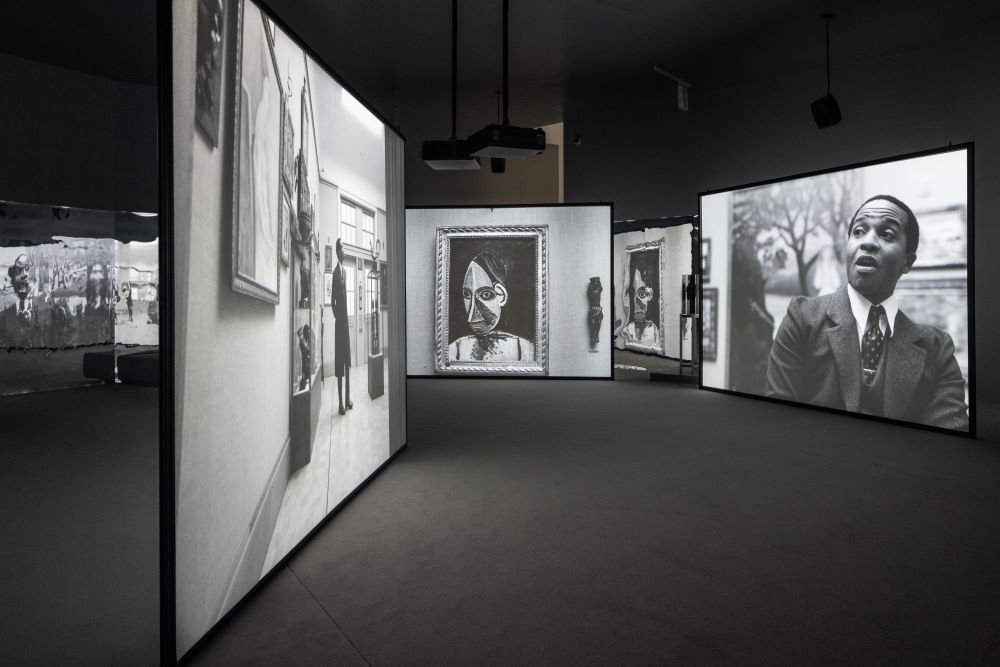
Sir Isaac Julien is both Black-British and gay and perhaps these elements are bound to feature in his art. However, one wonders if he is still even interested in these combined-elements identities that sociologists would describe as ‘intersectionality’.
“Well, the thing I think about intersectionality is that it has a sense of déjà vu for me because it is something that we produced work around when I first started in the early Eighties. So, yes, to talk about it in 2024 seems ‘belated’. But that belatedness in those debates is not as exciting as it used to be. Of course, sometimes these old-fashioned ideas do haunt the present in a different kind of way. Another example might be ‘decolonial’. I am not sure I understand what that really means. I understand post-coloniality, but when people say ‘decolonial’, is that just going to be a buzz word? I think, in a way, we are all neocolonial maybe.”
Once Again… (Statues Never Die), 2022 is on at the MCA in Sydney until 16 February 2025, click here for more information.
